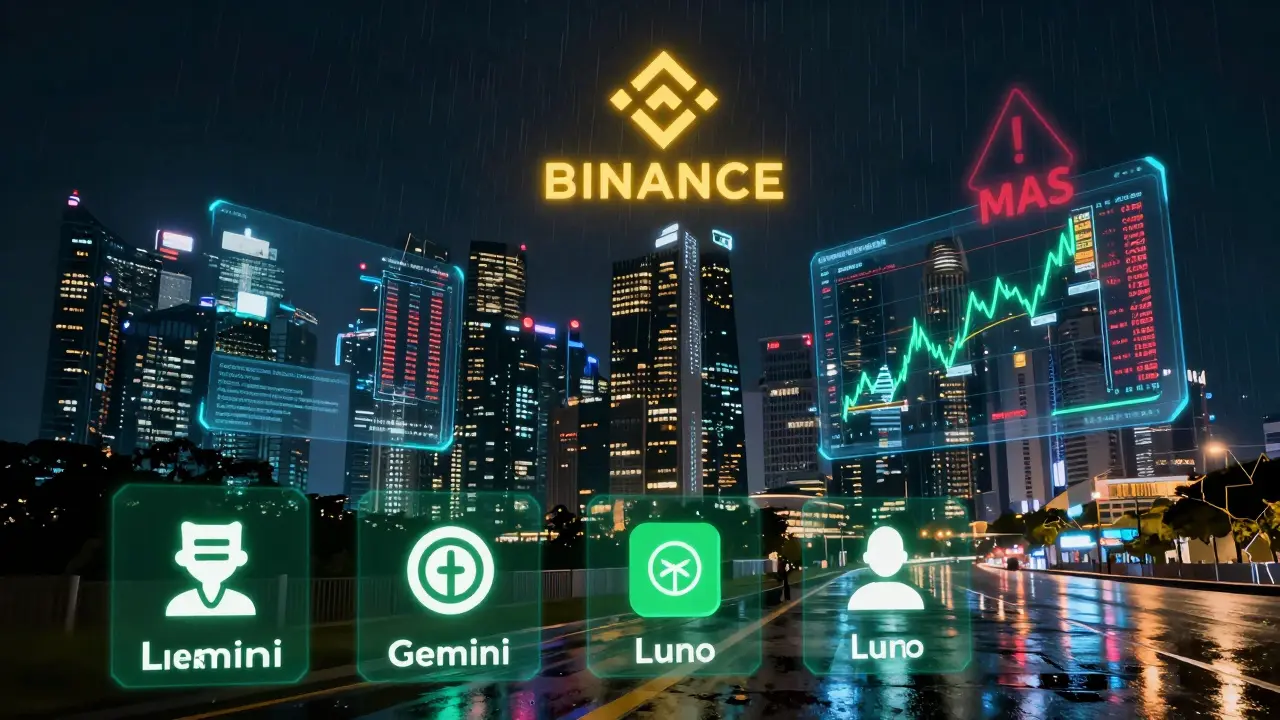
When you're looking to trade crypto in Singapore, Binance is hard to ignore. It's the biggest exchange in the world, handling over $76 billion in daily trades and serving more than 255 million users. But size doesn't always mean safety - especially in Singapore, where the Monetary Authority of Singapore (MAS) doesn't just let any exchange operate. The question isn't just whether Binance works here - it's whether it's legal and safe for you to use.
Is Binance Licensed by MAS?
This is the biggest issue. Unlike Gemini, Luno, or Coinhako - all of which have clear MAS licenses - Binance doesn't have a Singapore-specific license. It operates under its global entity, with offices in Malta and the Cayman Islands. MAS requires every crypto exchange serving Singaporeans to get a Digital Payment Token (DPT) license. Without it, you're using a platform that's not officially approved to operate in Singapore. That doesn't mean it's blocked - you can still sign up, deposit, and trade. But if something goes wrong - a hack, a freeze, a dispute - you have no legal protection from Singapore’s financial regulators.
Compare that to Gemini. It’s licensed by MAS. If you lose funds due to a system failure, you have a clear path to complain and potentially get compensation. With Binance, you’re relying on their internal support - and global user reports show customer service delays are common. In Singapore, where trust in financial institutions is high, this gap matters.
What You Can Trade on Binance in Singapore
Here’s where Binance shines. You get access to over 500 cryptocurrencies and more than 1,300 trading pairs. That’s way more than Gemini’s 70 or Luno’s 20. Want to trade Solana, Shiba Inu, or a new memecoin that just dropped? Binance has it. Most local exchanges don’t even list them.
Trading fees start at 0.1% for spot trades - far lower than Gemini’s 1.49% for SGD transactions. If you trade often, that adds up. Binance also offers:
- Binance P2P: Buy crypto directly from other users using SGD, PayNow, or bank transfer. It’s peer-to-peer, so you avoid card fees.
- Binance Earn: Stake your crypto and earn interest - up to 10% APY on some coins.
- Launchpool and Megadrops: Get early access to new token sales without needing to buy on the open market.
- NFT Marketplace: Buy, sell, and trade digital art and collectibles.
And yes - you can use Apple Pay, Google Pay, and credit cards to deposit. But here’s the catch: Binance doesn’t clearly state if these methods support SGD deposits directly. Some users report successful SGD top-ups. Others say they had to convert USD first. That lack of transparency is frustrating.
Levage and Derivatives - For Experienced Traders Only
If you’re not just holding crypto but actively trading, Binance offers up to 150x leverage on futures contracts. That’s insane. Most local platforms cap it at 10x. But high leverage isn’t a feature - it’s a risk. One wrong move, and you lose your entire margin. MAS warns against leveraged trading for retail users. Binance doesn’t block Singaporeans from using it - but it doesn’t warn them either. That’s a red flag.
Compare that to Coinhako, which doesn’t even offer derivatives. It’s designed for beginners. Binance? It’s built for people who know what they’re doing. If you’re new, you’ll feel overwhelmed.
Interface and User Experience
Binance’s app and website are packed with features - too packed, for some. The UI isn’t intuitive. Buttons are buried. Charts have 20 different indicators. New users often get lost. Decentralised News calls it “complex for beginners.” That’s accurate. Luno and Coinhako have cleaner, simpler interfaces. They show you your balance, let you buy Bitcoin in one tap, and explain things in plain English.
Binance assumes you already know what a limit order is. If you don’t, you’ll spend hours watching YouTube tutorials. For Singaporeans who want quick, simple crypto access - especially older users or part-time investors - that’s a barrier.
Security and Past Issues
Binance has had security problems. In 2019, hackers stole 7,000 BTC. In 2022, it froze withdrawals during a market crash. Since then, they’ve built a $1 billion Secure Asset Fund for Users (SAFU). That’s good - but it’s not insurance. It’s a safety net, not a guarantee.
Compare that to Gemini. It uses cold storage, institutional-grade security, and is insured. If your funds are stolen, you get paid back. Binance’s SAFU fund isn’t audited publicly. You’re trusting their word.
Also, Singapore’s MAS has flagged Binance multiple times for operating without a license. That doesn’t mean your money’s gone - but it does mean the platform is operating in a legal gray zone. If MAS cracks down hard, Binance could restrict access for Singapore users overnight.
Binance vs. Local Alternatives
Here’s a quick comparison:
| Feature | Binance | Gemini | Luno | Coinhako |
|---|---|---|---|---|
| MAS Licensed | No | Yes | Yes | Yes |
| Cryptocurrencies | 500+ | 70+ | 20+ | 30+ |
| Spot Trading Fee | 0.1% | 1.49% (SGD) | 1.5% | 1.2% |
| SGD Support | Unclear | Yes | Yes | Yes |
| Leverage | Up to 150x | No | No | No |
| Beginner-Friendly | No | Yes | Yes | Yes |
| Customer Support | Slow, global | Fast, local | Fast, local | Fast, local |
If you want safety, simplicity, and local support - go with Gemini, Luno, or Coinhako. If you want maximum choice, lowest fees, and advanced tools - Binance wins. But you’re trading safety for flexibility.
Who Should Use Binance in Singapore?
Use Binance if:
- You’re an experienced trader who knows how to manage risk
- You want access to hundreds of altcoins
- You trade often and care about low fees
- You’re comfortable with regulatory uncertainty
Avoid Binance if:
- You’re new to crypto and want a simple experience
- You want legal protection from MAS
- You’re using SGD as your main currency and need clear deposit options
- You value fast, local customer support
Many Singaporeans use both: they keep their main holdings on Gemini or Luno for safety, and use Binance for trading altcoins or taking leveraged positions. That’s a smart hybrid approach.
The Future of Binance in Singapore
MAS is tightening rules. In 2025, they fined another global exchange $1.2 million for operating without a license. Binance hasn’t been fined - yet. But they’re on the radar. If MAS demands a local license and Binance refuses to get one, they could be forced to shut down access to Singapore users. That’s not speculation - it’s happened in other countries like the UK and Canada.
Right now, Binance is still accessible. But that could change tomorrow. If you’re planning to use it long-term, treat it like a high-risk investment. Don’t store your life savings here. Use it for trading, not holding.
Is Binance legal in Singapore?
Binance is not licensed by the Monetary Authority of Singapore (MAS). While you can still sign up and trade, the platform operates without official approval. This means you have no legal protection from MAS if something goes wrong - like a hack, withdrawal delay, or account freeze. Exchanges like Gemini and Luno are licensed and offer that protection.
Can I deposit SGD on Binance?
Binance claims to support 30+ fiat currencies, including SGD. You can deposit via bank transfer, PayNow, or P2P trading. But there’s no clear confirmation that direct SGD deposits work smoothly. Some users report success, while others say they had to convert USD first. Unlike Gemini or Coinhako, Binance doesn’t clearly display SGD deposit options on its Singapore site.
Is Binance safer than Luno or Gemini?
No, not in Singapore. While Binance has strong global security and a $1 billion SAFU fund, it lacks MAS licensing. Luno and Gemini are regulated by MAS, use cold storage, and offer insurance protections. If your funds are lost due to a system failure, you have a legal recourse with licensed exchanges. With Binance, you’re relying on their goodwill.
Does Binance have a Singapore-specific app?
No. Binance uses the same global app everywhere. It doesn’t have a Singapore-specific version with localized features like PayNow integration or SGD pricing. That means you’ll need to navigate the same interface as users in the US or Nigeria - which can be confusing if you’re used to simpler local apps like Luno.
Should I use Binance if I’m new to crypto?
Probably not. Binance’s interface is complex, with hundreds of coins, advanced charts, and leverage options that can confuse beginners. If you’re just starting out, use Luno or Coinhako. They’re designed for simplicity - you can buy Bitcoin in under a minute. Save Binance for when you’re ready to trade altcoins, use P2P, or explore staking.
What happens if MAS shuts down Binance in Singapore?
If MAS forces Binance to stop serving Singapore users, you may lose access to your account. Withdrawals could be frozen, and deposits might stop working. There’s no guarantee you’ll get your crypto back. That’s why it’s risky to store large amounts on Binance if you live in Singapore. Use it for active trading - not long-term holding.
Final Verdict
Binance isn’t bad - it’s powerful. But in Singapore, power doesn’t equal permission. If you’re okay with regulatory risk and want the widest selection of coins at the lowest fees, it’s a great tool. But if you value safety, simplicity, and legal protection? Go with a MAS-licensed exchange. You don’t have to choose one. Many smart users split their portfolio: keep the bulk on Gemini, and use Binance for trading the rest.
Remember: crypto is risky enough. Don’t add regulatory uncertainty to the mix unless you really know what you’re doing.
Will Lum
February 10, 2026 AT 09:59Benjamin Andrew
February 12, 2026 AT 09:35Santosh kumar
February 12, 2026 AT 22:26Christopher Wardle
February 13, 2026 AT 09:35John Doyle
February 14, 2026 AT 15:21monique mannino
February 16, 2026 AT 03:31Holly Perkins
February 16, 2026 AT 05:00Desiree Foo
February 17, 2026 AT 06:44Kaz Selbie
February 17, 2026 AT 15:39Robbi Hess
February 17, 2026 AT 18:43Keturah Hudson
February 18, 2026 AT 11:25Ace Crystal
February 18, 2026 AT 13:29Brittany Meadows
February 19, 2026 AT 13:32SAKTHIVEL A
February 19, 2026 AT 14:40krista muzer
February 19, 2026 AT 16:50Tammy Chew
February 19, 2026 AT 23:57Lindsey Elliott
February 21, 2026 AT 01:56