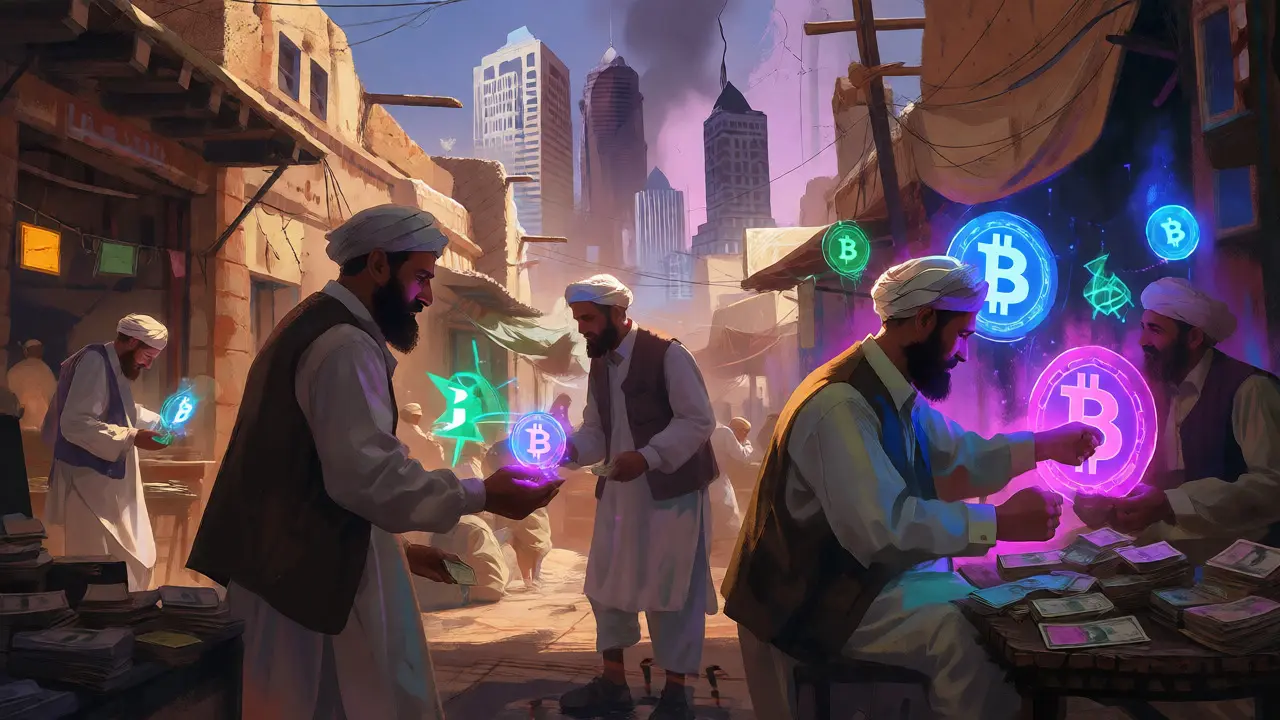
Imagine trying to feed your family when the banks are closed, international sanctions have frozen your assets, and the only way to get money from a relative abroad is through Bitcoin or USDT. Now imagine getting arrested for doing it. This isn't a hypothetical scenario; it's the reality for thousands of Afghans since the Taliban took control in August 2021. While much of the world debates whether crypto is the future of finance, Afghanistan has become a case study in how quickly a high-adoption market can be crushed by state enforcement.
The story starts with a paradox. After the Taliban takeover, traditional banking in Afghanistan collapsed. International funds were frozen, and the local currency plummeted. People needed a lifeline, and they found it in cryptocurrency. By mid-2021, Chainalysis ranked Afghanistan as the 20th highest country in the world for grassroots crypto adoption, with over $962 million in on-chain transactions driven largely by remittances. But this surge didn't last long. In June 2022, the Taliban-led central bank declared digital currency trading "illegal and fraudulent," citing Islamic law prohibitions against uncertainty (gharar) and gambling. What followed was a systematic crackdown that moved from warnings to business closures, and finally, to prison sentences.
The Shift from Adoption to Enforcement
You might wonder why the Taliban, who initially seemed tolerant of informal economic activities, turned so aggressively against crypto. It wasn't just about religion. It was about control. Cryptocurrency allowed Afghans to bypass the state-controlled financial system entirely. For a regime seeking to consolidate power and monitor every transaction, an unregulated digital economy was a threat. Plus, there was the issue of fraud. Authorities claimed that unlicensed exchanges were scamming people, though critics argue these were often the only viable options available.
The enforcement ramped up significantly in 2023. Police in Herat province, a major trading hub near the Iranian border, became the epicenter of the crackdown. In September 2023, police shut down 16 cryptocurrency exchanges in Herat alone. Sayed Shah Sa'adat, head of the counter-crime unit, confirmed these actions were part of a nationwide effort to enforce the ban. Before this, in May 2023, eight traders were arrested and detained for 28 days in Herat’s central prison. The message was clear: using crypto wasn't just risky; it could cost you your freedom.
Why Herat Became the Battleground
Why Herat? It’s simple geography and economics. Herat is close to Iran, where cross-border trade is heavy, and many Afghans work abroad in neighboring countries or further away in Europe and North America. These workers send money home via crypto because traditional wire transfers are slow, expensive, or non-existent due to sanctions. When the Taliban cracked down here, they weren't just hitting random businesses; they were targeting the primary channel for remittances.
By August 2022, more than 20 crypto-related businesses had already been shut down in Herat. This represented a massive contraction from the estimated 40-50 active exchanges operating during the peak adoption period in late 2021. The closure of these exchanges didn't stop demand-it just drove it underground. Traders began operating discreetly, often meeting in person or using encrypted messaging apps to arrange peer-to-peer deals. This shift increased the risk of fraud and made it harder for ordinary citizens to verify the legitimacy of their counterparties.
| Date | Action Taken | Location | Impact |
|---|---|---|---|
| June 2022 | Central Bank declares crypto trading illegal | Nationwide | Initial confusion; widespread public resistance |
| August 2022 | Closure of 20+ crypto businesses | Herat Province | Significant reduction in visible exchange activity |
| May 2023 | Arrest of 8 traders; 28-day detention | Herat City | First documented imprisonment for crypto trading |
| September 2023 | Shutdown of 16 exchanges; staff arrests | Herat Province | Consolidation of enforcement; fear among remaining operators |

The Human Cost of the Ban
Behind the headlines of arrests and shutdowns are real people struggling to survive. With the World Bank reporting in April 2023 that 97% of Afghans live below the poverty line, cryptocurrency wasn't a luxury-it was a necessity. One trader told reporters he earned modest margins of 1-2% on USDT transactions, which was enough to feed his family. After the ban, he couldn't afford basic necessities. Another citizen explained that his family’s survival depended on Bitcoin remittances from his brother in the United States. "There's no other way," he said, despite the personal risk of arrest.
This humanitarian crisis is exacerbated by the fact that NGOs also relied on crypto for aid distribution. Organizations like the Women's Entrepreneurship Day Organization partnered with platforms like Opengrants.io to fund women with weekly food payments in cryptocurrency. When the crackdown intensified, these channels faced disruption, leaving vulnerable populations even more exposed. UNICEF reported in 2023 that over one million Afghan children were at risk of severe malnutrition, making the loss of efficient remittance channels particularly devastating.

Religious Justification vs. Economic Reality
The Taliban’s official stance rests on Islamic jurisprudence. They argue that cryptocurrencies lack intrinsic value and are akin to gambling, violating principles against gharar (uncertainty). However, this interpretation isn't universally accepted among Islamic finance experts. Many scholars distinguish between speculative trading and using crypto as a medium of exchange, especially in contexts where fiat currencies are unstable. The Taliban’s rigid application of this rule ignores the practical realities on the ground.
Furthermore, there are legitimate security concerns. Reports from TRM Labs indicate that groups like the Islamic State Khurasan Province (ISKP) have used cryptocurrency for financing operations, including partial funding of attacks outside Afghanistan. While the Taliban’s crackdown may aim to curb terrorist financing, its broad-brush approach affects ordinary citizens far more than organized militant networks. The result is a situation where the average Afghan pays the price for geopolitical complexities they don't control.
What Happens Next?
Is the ban effective? Evidence suggests it’s driving activity underground rather than eliminating it. Precise measurement is difficult because transactions have shifted to private, peer-to-peer channels. However, the volume has likely decreased due to the increased friction and risk. Some traders have stopped operating entirely, while others take greater risks to keep serving clients.
For now, the enforcement pattern shows a trajectory toward harsher penalties. Initial warnings gave way to business closures, then arrests, and finally extended imprisonment. As long as Afghanistan remains financially isolated and the banking system stays broken, the demand for alternative payment methods will persist. The question isn't whether Afghans want to use crypto-they do-but whether the Taliban can sustain the political and social cost of imprisoning them for it.
Is cryptocurrency completely banned in Afghanistan?
Yes, the Taliban-led central bank officially banned cryptocurrency trading in June 2022, declaring it illegal and fraudulent. Enforcement includes shutting down exchanges and arresting individuals involved in buying, selling, or holding digital assets for commercial purposes.
Why did the Taliban ban cryptocurrency?
The Taliban cite religious reasons, arguing that crypto violates Islamic law principles against gambling and uncertainty (gharar). Additionally, they claim it facilitates fraud and allows transactions to occur outside government oversight, which complicates their efforts to control the economy and combat terrorism financing.
What are the penalties for using crypto in Afghanistan?
Penalties vary but have included fines, confiscation of assets, and imprisonment. In Herat province, traders have been detained for nearly a month, with authorities indicating potential sentences of up to six months for continued violations. Business owners face immediate closure of their operations.
How has the ban affected ordinary Afghans?
It has created significant hardship. With the banking system collapsed and international sanctions limiting traditional transfers, many Afghans rely on crypto for remittances from family members abroad. The ban forces them to use riskier, less transparent methods or lose access to vital income streams entirely.
Are all crypto exchanges closed in Afghanistan?
Most formal exchanges have been shut down, particularly in major hubs like Herat. However, some informal peer-to-peer trading continues underground. The visibility of these trades has dropped dramatically, making it harder for regulators to track activity but increasing the risk of scams for users.