Remember when "free crypto" meant filling out endless surveys or retweeting spammy posts? Those days are gone. The DAR Open Network flipped the script with a system that actually rewards you for playing games. If you’ve been hearing about the DAR airdrop and wondering if it’s worth your time, you’re in the right place. This isn’t just another hype cycle; it’s a structured Play-2-Airdrop ecosystem that has been running since late 2025.
By now, in May 2026, the dust has settled on the initial launch, and we have real data on how the Web3 Quest System works. It’s not magic, but it is smart. You earn points by playing, those points convert to rewards, and the primary reward is the $D token, the fuel of the entire network. Let’s break down exactly how to maximize your earnings without wasting hours on low-value tasks.
How the DAR Quest System Actually Works
The core mechanic here is simple: play games, complete quests, earn points. But there’s a specific structure you need to understand to make money. The system launched on September 1, 2025, replacing vague promises with concrete four-week seasons. Each season operates like a competitive league rather than a free-for-all giveaway.
Here is the flow:
- Complete Quests: You log into supported games within the Dalarnia Open Network ecosystem. These aren’t just one-off titles; the infrastructure allows cross-game asset sharing. You might start in a casual puzzle game and move to a strategy title.
- Earn Quest Points (QPs): Every action-logging in daily, completing weekly challenges, or winning matches-grants you QPs. Think of these as your leaderboard currency.
- Seasonal Ranking: At the end of every four-week season, the system tallies everyone’s QPs. Your rank determines your slice of the prize pool.
- Airdrop Distribution: Rewards are distributed based on performance. In the inaugural season, the pool was 100,000 $D tokens. The higher your rank, the bigger your payout.
This structure solves the biggest problem with previous airdrops: botting. Because earning QPs requires active engagement across multiple game mechanics and often involves skill-based progression (especially in titles like Dalarnia Legends), it’s much harder to automate than clicking a button once.
Why $D Token Matters Beyond the Airdrop
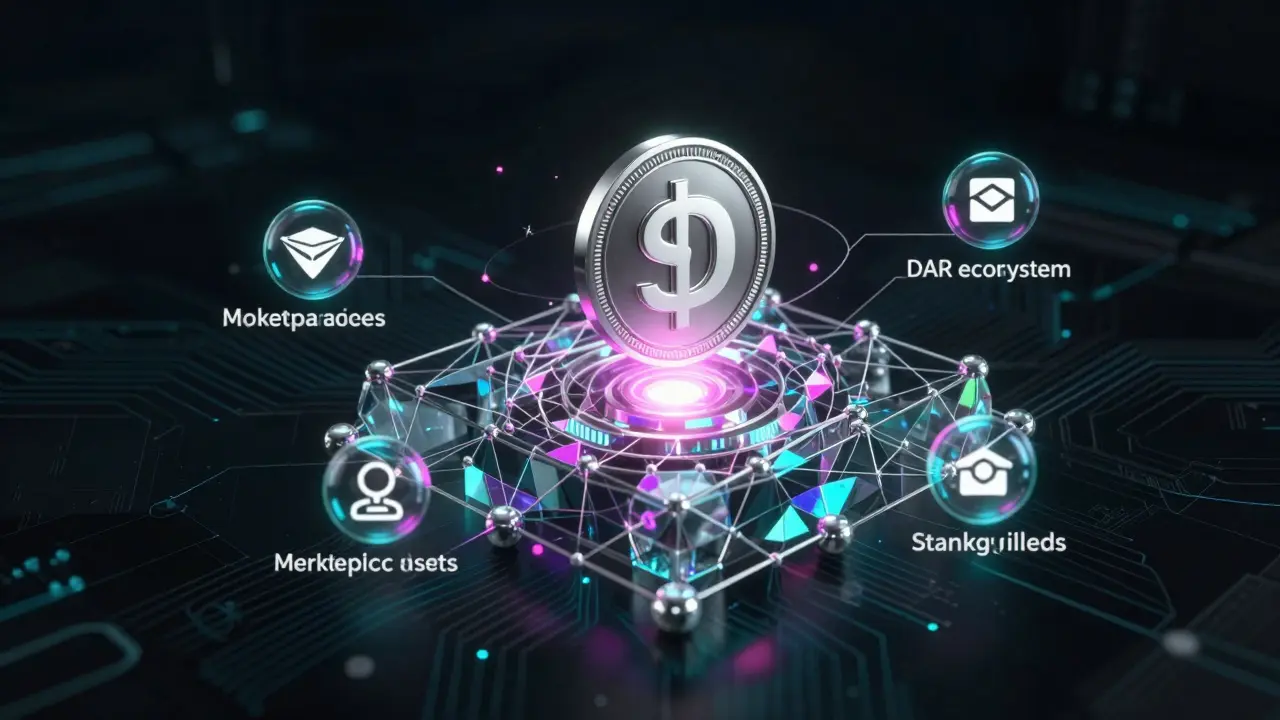
You might be thinking, "I’ll just sell the $D tokens immediately." That’s a valid strategy, but understanding the token’s utility helps you decide whether to hold or trade. The D token is not just a speculative asset; it’s the backbone of the DAR Open Network.
As of mid-2026, the $D token serves several critical functions:
- Governance: Holders can vote on ecosystem upgrades and new game integrations.
- Marketplace Currency: Buying and selling in-game assets across different titles often uses $D as the standard medium of exchange.
- Staking & Yield: You can stake your $D tokens through partners like Bitget Earn to generate passive income. This adds a layer of value retention if you don’t want to sell your airdrop winnings immediately.
- In-Game Utility: Many games use $D for premium features, character upgrades, or entry fees into high-stakes tournaments.
When the system launched in late 2025, the token traded around $0.031. While prices fluctuate with market conditions, the consistent utility means there’s always demand from players who need the token to participate in the ecosystem. This creates a floor price that pure meme-coins lack.
Maximizing Your Earnings: Strategy vs. Grinding
Not all quests are created equal. If you treat every task with the same intensity, you’ll burn out. Here’s how to prioritize your time for maximum ROI (Return on Investment) in terms of hours played versus QPs earned.
Focus on High-Impact Games
The Dalarnia Legends circuit is currently the heavyweight champion of the ecosystem. It introduced the "Legends Circuit," a layered tournament structure. Daily tournaments feed into larger events, culminating in an annual Grand Masters Final with 64 top players. If you have competitive gaming skills, this is where the big QP multipliers are. Casual games offer steady, low-effort points, but tournaments offer exponential rewards.
Leverage Cross-Game Synergies
One of the unique features of the DAR Open Network is its chain-agnostic infrastructure. This means assets and progress can sometimes carry over or interact between games. Check the quest board for "exploration" bonuses. Often, logging into a new game within the ecosystem grants a one-time bonus of QPs. Rotating through three or four different titles each week can net you more points than grinding a single game for 10 hours.
The Assist2Earn Factor
Don’t ignore the social aspect. The platform includes an "Assist2Earn" program. Referring friends isn’t just about getting a one-time bonus; it often boosts your own quest completion rates or unlocks exclusive team-based challenges. Building a small squad of regular players can create a feedback loop where you help each other achieve daily login streaks and weekly goals.
Understanding the Reward Pools and Volatility
Let’s talk numbers. The first season offered 100,000 $D tokens. As the ecosystem grows, these pools tend to increase, but so does competition. By 2026, with more users entering the space, maintaining a top-tier ranking requires consistency.
Also, keep an eye on the token’s market behavior. When the Quest System launched, the $D token saw significant trading volume, exceeding $1.7 million in a single day. This liquidity is good news for you because it means you can cash out your airdrop rewards quickly without slippage eating up your profits. However, volatility means timing matters. If the market is green after a season ends, consider holding some $D for staking yields. If the market is red, converting to stablecoins via Bitget Convert or spot trading might be safer.
| Method | Effort Level | Reward Type | Best For |
|---|---|---|---|
| Daily Quests | Low (5-10 mins) | Small QP amount, Moon Coins | Casual players, consistency |
| Weekly Challenges | Medium (1-2 hours) | Medium QP boost | Regular gamers |
| Tournaments (Legends Circuit) | High (Competitive) | Large QP multiplier, Exclusive NFTs | Skilled players, pros |
| Assist2Earn (Referrals) | Low (Setup only) | Bonus QPs, Token rewards | Social players, community leaders |
Technical Setup: Getting Started in 2026
If you’re new to the DAR ecosystem, the barrier to entry is surprisingly low. The platform is designed to be user-friendly, even for those who aren’t blockchain experts. Here’s what you need to do:
- Create a Wallet: You’ll need a compatible wallet. Since DAR is chain-agnostic, it supports major standards. Ensure your wallet is backed up securely.
- Connect to the Dashboard: Visit the official DAR Open Network portal. Connect your wallet to access the Quest System dashboard.
- Verify Identity (If Required): Some competitive tiers may require basic KYC to prevent sybil attacks (multiple fake accounts). Keep your ID handy.
- Select Your Games: Browse the integrated library. Start with one or two titles to learn the mechanics before expanding.
- Track Your Progress: Use the built-in analytics to see which quests give the best QP-to-time ratio. Adjust your strategy weekly.
Security is paramount. Never share your seed phrase. The official DAR team will never ask for your private keys. Phishing sites targeting airdrop hunters are common, so always double-check URLs.
Future Outlook: What’s Next for DAR?
The roadmap for DAR Open Network extends well beyond simple airdrops. The integration of AI-powered infrastructure suggests smarter matchmaking, personalized quest recommendations, and potentially automated reward distribution that adapts to player behavior in real-time.
We also expect to see more AAA-quality games joining the network. As developers realize they can share assets and reach a unified player base, the quality of content will rise. This means the "Play-2-Airdrop" model will evolve into a genuine "Play-2-Earn" economy where skilled gamers can make a living, not just pocket change.
For now, focus on the current season. Consistency beats intensity. Log in daily, complete the easy wins, and save your energy for the weekly tournaments. The $D token is a valuable asset, and the Quest System is one of the most transparent ways to earn it right now.
Is the DAR airdrop still available in 2026?
Yes, the DAR Open Network operates on a seasonal basis. While the initial launch was in late 2025, the Web3 Quest System continues with regular four-week seasons throughout 2026. New players can join at any time, though rankings reset or adjust per season rules.
Do I need to buy $D tokens to participate?
No, the core Play-2-Airdrop mechanism is free to enter. You earn Quest Points by playing games. However, buying $D tokens can enhance your experience through staking for yield or purchasing in-game advantages, but it is not mandatory for receiving airdrop rewards.
What is Dalarnia Legends?
Dalarnia Legends is a flagship game within the DAR ecosystem featuring a competitive tournament structure called the Legends Circuit. It offers high-value Quest Points and exclusive rewards for skilled players, serving as a major driver of engagement in the network.
How are Quest Points converted to $D tokens?
Quest Points determine your rank at the end of each four-week season. Based on your rank, you receive a proportional share of the season's reward pool, which is distributed in $D tokens. Higher ranks receive significantly larger portions of the pool.
Can I use my DAR rewards on other platforms?
Yes. The $D token is tradable on major exchanges like Bitget. You can swap, stake, or use it for peer-to-peer transactions. The ecosystem also supports conversion of other crypto rewards into $D, making it a central hub for your web3 gaming earnings.