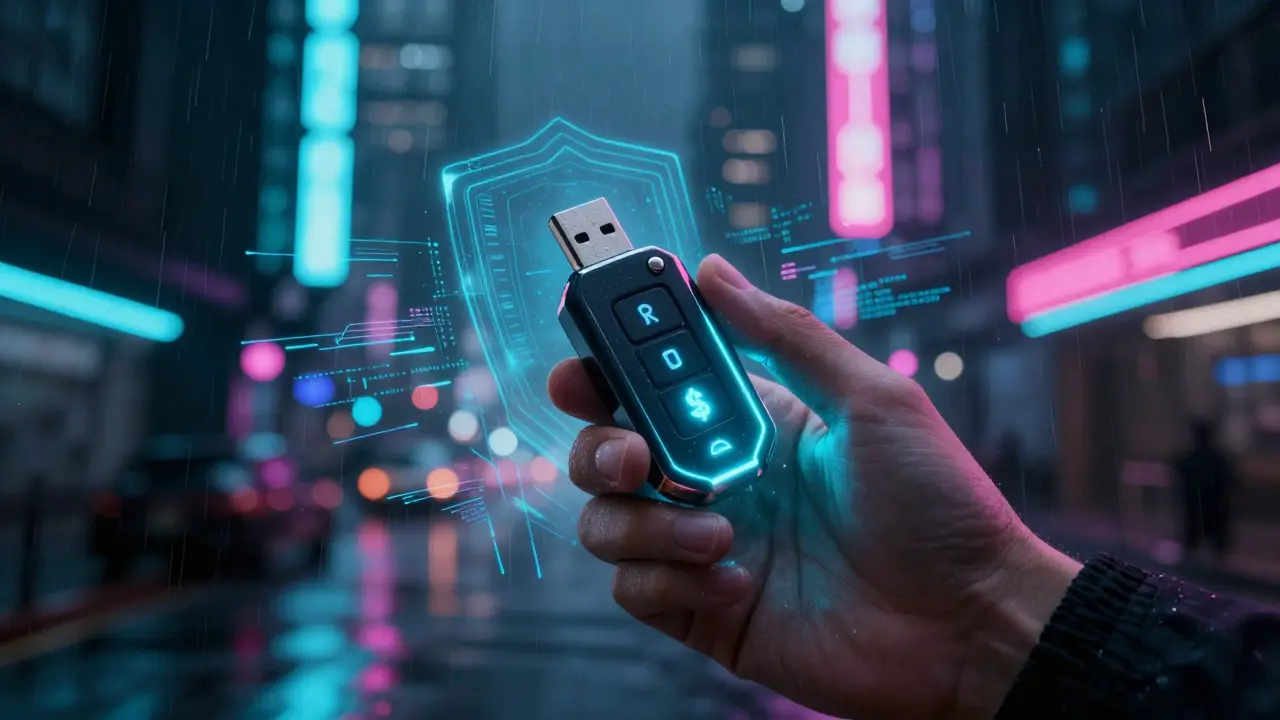
Imagine waking up to find your exchange account drained because a hacker tricked you into entering a six-digit code on a fake login page. It happens every day. Most people think adding a second layer of security makes them invincible, but not all two-factor authentication is created equal. If you are managing a blockchain portfolio or sensitive digital assets, the gap between a free app on your phone and a physical piece of plastic in your pocket is the difference between "probably safe" and "cryptographically secure."
The Core Difference: Where Does the Secret Live?
To understand why one is better than the other, we have to look at where the "secret"-the piece of data that proves you are you-is stored. Hardware 2FA Keys is a physical device that uses public-key cryptography to authenticate a user's identity without ever exposing a private key to the internet. Commonly known as security keys, brands like YubiKey use standards like FIDO2 to ensure the secret stays locked inside a tamper-resistant chip.
On the flip side, Software Authenticators are applications that generate Time-Based One-Time Passwords (TOTP) based on a shared secret stored in the device's memory. When you scan a QR code to set up Google Authenticator or Authy, you are essentially downloading a seed. Your phone and the server both have this seed, and they use it to sync a clock and spit out the same six digits every 30 seconds.
The problem? Your phone is a general-purpose computer. It runs apps, connects to public Wi-Fi, and can be infected with malware. A hardware key is a single-purpose tool. It doesn't have an operating system for a hacker to break into; it only knows how to sign a cryptographic challenge.
Why Hardware Keys Stop Phishing Dead in Its Tracks
If you've ever seen a perfectly cloned website that looks exactly like Binance or Coinbase, you know how easy it is to be fooled. With a software authenticator, you see the code on your phone, you type it into the fake site, and the hacker instantly relays that code to the real site to log in as you. The software doesn't know where the code is going.
Hardware keys use WebAuthn, a modern web standard that creates a cryptographic link between the key and the specific domain (like coinbase.com). When you tap your key, the device checks the URL. If the URL is coinnbase-secure.com (a fake), the key simply refuses to sign the request. There is no code for you to accidentally give away, making these keys virtually immune to phishing.
| Feature | Hardware 2FA Keys | Software Authenticators |
|---|---|---|
| Cryptography | Asymmetric (Public/Private) | Symmetric (Shared Secret) |
| Phishing Protection | High (Domain-bound) | Low (User-entered codes) |
| Cost | $20 - $80 per device | Usually Free |
| Remote Attack Risk | Near Zero | Possible via Malware/OS exploit |
| Setup Speed | Medium (Physical purchase) | Instant (App download) |
The Convenience Trap of Software Apps
Most people stick with software because it's easy. You don't have to carry an extra gadget, and if you have a cloud-synced app like Authy, you can recover your accounts if you lose your phone. But this convenience is exactly where the vulnerability lies. Cloud synchronization means your 2FA seeds are living on someone else's server. If that server is breached, or your cloud account password is weak, your "second factor" is no longer a secret.
Even if you use a local-only app, a sophisticated piece of mobile malware can scrape the memory of your device to steal the TOTP seeds. Hardware keys move the risk from the digital realm to the physical realm. The only way to steal a YubiKey is to physically take it from your pocket, which is a much harder task for a hacker in another country to achieve.
Practical Implementation: Setting Up Your Defense
If you're moving from a password-only setup or a basic app, don't just jump in blindly. The biggest risk with hardware keys isn't theft-it's losing the key and locking yourself out of your own life. Since the private key never leaves the hardware, there is no "Forgot my Key" button.
To do this right, follow these steps:
- Buy Two Keys: Purchase a primary key for your keychain and a backup key to keep in a secure safe or deposit box.
- Register Both: When a service (like GitHub or your crypto exchange) asks for a security key, register both the primary and the backup immediately.
- Save Recovery Codes: Most services provide a list of one-time use recovery codes. Print these out and store them physically; do not keep them in a text file on your desktop.
- Audit Your Accounts: Check which of your high-value accounts support U2F or FIDO2. If they only support TOTP, some hardware keys (like the YubiKey 5 series) can actually emulate a software authenticator, giving you the best of both worlds.
The Future: Passkeys and Biometrics
We are currently seeing a shift toward Passkeys. This is essentially the industry trying to give us hardware-level security without the annoying USB stick. Passkeys use the same public-key cryptography as hardware keys but leverage the secure enclave in your smartphone (like Apple's FaceID or Android's fingerprint scanner) as the "hardware."
While passkeys are a huge leap forward from TOTP codes, the "gold standard" for those with significant blockchain holdings remains a dedicated, air-gapped hardware key. Relying on a phone's biometric chip is great for 99% of people, but for those protecting millions in assets, removing the authentication process from a multi-purpose device is the only way to truly sleep at night.
Can I use both a hardware key and an app?
Yes, and it's often recommended. You can set a hardware key as your primary method and a software authenticator as a backup. However, be aware that some services will downgrade your security level to the weakest method you have enabled. If a hacker can't bypass your hardware key but can trick you into giving up a TOTP code, the hardware key's protection is bypassed.
What happens if I lose my hardware 2FA key?
If you didn't register a backup key or save your recovery codes, you may be permanently locked out of your account. This is why the "two-key system" is critical. If you lose your main key, you use the backup key to log in, then remove the lost key from your account settings and register a new one.
Are software authenticators like Google Authenticator completely useless?
Not at all. They are infinitely better than SMS-based 2FA, which can be defeated by a simple SIM-swap attack. For a regular user who isn't a high-value target for sophisticated hackers, a software authenticator provides a great balance of security and convenience.
Does a hardware key protect me from all hacks?
It protects you from credential theft and phishing, but it doesn't protect you from "session hijacking." If you have a malicious browser extension that steals your active session cookies after you've already logged in, the hacker can enter your account without needing a 2FA code. Always keep your browser clean and updated.
Which is better for crypto exchanges?
Hardware keys are vastly superior for crypto exchanges. Because the financial stakes are so high and the industry is plagued by sophisticated phishing campaigns, the domain-verification feature of hardware keys is the only reliable defense against professional attackers.
Michael Harms
April 15, 2026 AT 04:53This is some solid advice for anyone getting into crypto! I always tell people to just grab a YubiKey early on so they don't have to scramble once their portfolio actually grows. Total game changer for peace of mind.
Shantal Sanjur
April 16, 2026 AT 11:24Oh sure, just buy a piece of plastic from a company that's probably being funded by the same people who want to track your every move. I'm sure the "tamper-resistant chip" isn't just a back door for the alphabet agencies to walk right into your wallet. But please, keep believing the marketing brochures while the rest of us actually think for ourselves.
John and Lauren Busch
April 18, 2026 AT 01:20YubiKeys are great until you realize you've lost yours and you're just staring at a login screen for an hour. Classic.
Sandeep Bhoir
April 19, 2026 AT 17:21Funny how people think their phone is a fortress just because they have a passcode. A basic piece of malware can mirror your screen or intercept TOTP seeds without you even noticing a lag in performance. Hardware keys are the only thing that actually makes sense if you aren't just gambling with pocket change.
Mark Pfeifer
April 19, 2026 AT 17:30The point about session hijacking is a critical addition here. Many users believe the 2FA is a magical shield for the entire session, but cookie theft bypasses the need for the key entirely. It's a necessary reminder that 2FA is just one layer of a larger security posture.
Sean Mitchell
April 20, 2026 AT 22:33Absolutely tragic that we've reached a point where a simple USB stick is the only thing standing between us and total financial ruin! The sheer fragility of our digital existence is positively Shakespearean in its irony. I find it utterly exhausting that the burden of security falls entirely on the user's ability to not lose a tiny piece of plastic!
Thomas Jewett
April 21, 2026 AT 08:09Listen here you need to understand that real Americans don't trust these fancy gadgets that are probably made in some factory overseas by people who hate us and want to steal our hard earned money and if you think a little chip is gona save you then you are just as blind as the sheep who believe the mainstream media narratives that are destroying the fabric of this great nation with their lies and their globalist agendas which is why we need to get back to basics and stop relying on this foreign tech that just makes us more vulnerabel to the very people who are trying to dismantle our sovereignty from the inside out!!
Robert Preston
April 22, 2026 AT 04:48For those wondering, the YubiKey 5 series is definitely the way to go because it handles the TOTP emulation mentioned in the post. It allows you to use one physical device for sites that don't yet support FIDO2/WebAuthn, which effectively replaces those clunky apps on your phone while keeping the seed off the general OS.
Luke George
April 22, 2026 AT 08:20The government probably wants us using passkeys so they can tie our biometric data directly to our financial accounts for the new social credit system. Hardware keys are a stopgap at best.
Anna Grealis
April 23, 2026 AT 13:46who even cares bout a usb key when the exchange just gets hackd anyway... totaly pointless
Karen Mogollon Gutierrez
April 23, 2026 AT 17:08It is an utter travesty that the industry has neglected the user experience to such a degree! The anxiety induced by the prospect of permanent lockout due to the loss of a physical token is simply unacceptable for a modern financial interface. One must wonder why a more elegant, yet equally secure, solution has not been universally implemented by the major exchanges.
Tracy Sperandio
April 24, 2026 AT 08:47Get that security tight, people! Lock down your assets like they're the crown jewels! It is absolutely exhilarating to finally have tools that actually put the power back in our hands instead of leaving us vulnerable to some script kiddie in a basement. Let's get those backups sorted and sleep like babies tonight!
Ankit Sindhu
April 25, 2026 AT 02:51I highly recommend the two-key system. Keeping a backup in a fireproof safe is a small price to pay for the security it provides. It's a habit that pays off immensely in the long run.
nathan jones
April 25, 2026 AT 14:55just use a key and chill
Alex Long
April 26, 2026 AT 04:36Worst advice ever. Just lose your key and boom, you're broke. Great plan.
Evan Iacoboni
April 27, 2026 AT 20:02The comparison between asymmetric and symmetric cryptography here is the key takeaway. Most people don't realize that TOTP still relies on a shared secret that exists in two places, whereas FIDO2 never shares the private key. That's the fundamental shift that makes hardware keys so much more resilient.
Keri Pommerenk
April 28, 2026 AT 01:47really glad this was laid out so clearly. having a backup key is such a lifesaver and it's a great tip to print those recovery codes too