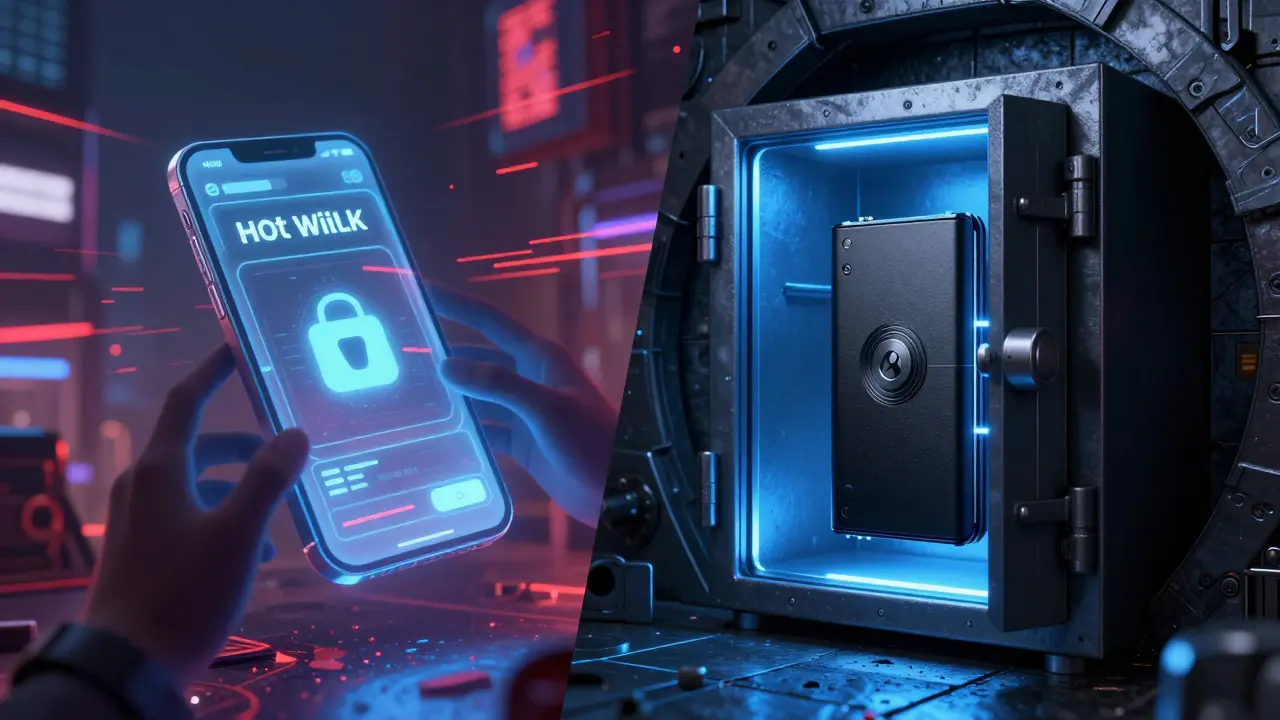
Imagine leaving your house keys in a bowl on the front porch versus locking them inside a heavy steel safe buried in your backyard. That is essentially the difference between using a hot wallet and a cold wallet. One offers instant access but invites thieves to look right at you. The other keeps your assets hidden away, safe from prying eyes, but requires effort every time you want to spend.
In 2026, the choice isn't just about convenience; it's about survival. With hackers stealing billions annually by targeting compromised private keys, understanding where your digital assets live is the single most important decision you will make as a crypto user. You don't need to be a tech expert to get this right, but you do need to know which tool fits which job.
What Actually Stores Your Money?
First, let’s clear up a massive misconception. Neither hot nor cold wallets actually store your cryptocurrency. Your Bitcoin or Ethereum lives on the blockchain-a public ledger visible to everyone. What these wallets actually hold are your private keys. Think of these keys as the cryptographic signatures that prove you own those assets and allow you to move them. If you lose the key, you lose the money. If someone else gets the key, they take the money.
A hot wallet is a software-based solution that maintains constant internet connectivity. It could be an app on your phone, a browser extension like MetaMask, or even the wallet provided by an exchange like Coinbase. Because it is always online, it can sign transactions instantly. This makes it perfect for daily spending, trading, or interacting with decentralized finance (DeFi) apps. However, being connected to the internet means it is exposed to malware, phishing attacks, and remote hacking attempts.
On the flip side, a cold wallet is a hardware device that stores keys offline. Devices like Ledger Nano X or Trezor Model T act like dedicated USB drives that never connect directly to the internet. When you want to send funds, you plug the device into your computer, approve the transaction physically on the device's screen, and then broadcast it. This "air-gapped" architecture creates an impenetrable barrier against remote attacks. Hackers cannot steal your keys because your keys never leave the secure chip inside the device.
The Security Reality Check
Let’s talk numbers, because feelings don’t stop hackers. According to TRM Labs' October 2023 report, nearly $7 billion was stolen in crypto breaches during 2022-2023 alone. The culprit? In almost 70% of cases, attackers exploited compromised private keys or seed phrases. This highlights why the storage method matters so much.
Hot wallets are convenient, but they are vulnerable. Phishing remains the biggest threat. In 2024, phishing accounted for 38% of all wallet breaches. Imagine clicking a link in a fake Uniswap notification thinking you’re claiming an airdrop, only to have a malicious script drain your MetaMask balance. It happens more often than you think. Additionally, clipboard hijacking-where malware copies your pasted address and replaces it with the hacker’s address-affected 18% of Windows-based hot wallet users last year.
Cold wallets eliminate these remote risks entirely. Kaspersky’s 2024 blockchain security study found that air-gapped transaction signing prevents 98.7% of malware-based attacks. Since 2018, there has not been a single documented case of a properly secured hardware wallet being compromised remotely. No virus, no hack, no phishing link can touch your keys if they never touch the internet.
| Feature | Hot Wallet | Cold Wallet |
|---|---|---|
| Internet Connection | Always Online | Offline (Air-Gapped) |
| Vulnerability to Remote Hacks | High | Near Zero |
| Primary Risk | Phishing & Malware | Physical Loss/Theft |
| Transaction Speed | Instant (2-5 seconds) | Slower (45-90 seconds) |
| Best For | Active Trading & DeFi | Long-Term Storage |
Cost, Convenience, and User Experience
Security often comes with a trade-off in convenience. Hot wallets are free. You download MetaMask or Trust Wallet, set it up in 15 minutes, and you’re ready to go. They support thousands of cryptocurrencies across hundreds of networks. If you are actively trading, swapping tokens, or providing liquidity, a hot wallet is essential. DappRadar data from Q1 2025 shows active traders average 12.7 transactions per week using hot wallets compared to just 0.8 for cold wallet users.
Cold wallets require an upfront investment. As of mid-2025, a Ledger Nano X costs around $149, while a Trezor Model T runs about $219. Setup takes longer-expect 45 to 90 minutes to unbox, verify, and back up your device properly. But here is the catch: many users rush this step. Ledger reported that 68% of new users skip verifying their backup during first-time setup. This is dangerous. If you lose your device and haven't verified your seed phrase works, your money is gone forever.
There is also the risk of physical loss. BitGo’s 2024 custody report noted a 3.7% annual loss rate for hardware wallets due to damage, theft, or misplacement. I’ve seen stories of people losing devices in Ubers or having them destroyed in house fires. Unlike a hacked account, you can’t call customer support to recover a lost cold wallet. That’s why storing your recovery seed phrase in a fireproof, waterproof container is non-negotiable.
Who Should Use Which?
You don’t have to choose one exclusively. Most experienced crypto holders use both. Think of it like cash management. You keep a small amount of cash in your pocket for coffee (hot wallet) and the rest in a bank vault (cold wallet).
Use a Hot Wallet if:
- You are actively trading or using DeFi protocols.
- You hold smaller amounts under $5,000.
- You need quick access to funds for daily expenses.
- You are new to crypto and still learning how transactions work.
Use a Cold Wallet if:
- You are holding long-term investments (HODLing).
- Your portfolio exceeds $5,000 in value.
- You want peace of mind knowing hackers can’t touch your assets.
- You are storing significant amounts of Bitcoin or Ethereum.
Dr. David Wagner, a cryptography professor at UC Berkeley, advises that any amount exceeding $5,000 should never reside in hot storage for more than 72 hours. Even Charlie Lee, the creator of Litecoin, keeps 95% of his crypto in cold storage, using hot wallets only for the 5% he needs for daily operations.
Common Mistakes That Cost People Millions
Even the best hardware won’t save you if you make basic errors. Here are the top pitfalls I see users fall into:
- Ignoring Firmware Updates: Jonathan Levin from Chainalysis warned that 68% of compromised Ledger devices in 2024 had outdated software. Always check for updates before connecting your device.
- Digital Backups of Seed Phrases: Never, ever take a photo of your seed phrase or save it in a cloud note. If your phone or email is hacked, your cold wallet becomes a hot wallet. Write it down on paper or etch it into metal.
- Buying Used Hardware: Never buy a second-hand Ledger or Trezor. A previous owner could have tampered with the device to record your PIN when you enter it. Buy only from official manufacturers.
- Overusing Hot Wallets: Leaving large balances in a browser extension wallet is risky. Only keep what you plan to spend in the next few days.
The Future: Hybrid Solutions
The line between hot and cold is blurring. In May 2025, Coinbase announced its “Vault” service, which combines cold storage security with hot wallet accessibility using multi-signature technology. This requires two out of three signatures to authorize a transaction: your mobile device, a cold storage element, and an institutional custodian. Experts predict that by 2027, air-gapped mobile wallets using NFC-based signing will become mainstream, offering the security of cold storage with the ease of a smartphone.
However, until that technology matures, the old rules still apply. If you want safety, go cold. If you want speed, go hot. Ideally, use both wisely.
Is a cold wallet completely unhackable?
A cold wallet is virtually unhackable via remote attacks because it never connects to the internet. However, it is not immune to physical theft, loss, or damage. If someone steals your device and knows your PIN, they can access your funds. Also, if you interact with a malicious website while the device is plugged in, you might accidentally approve a bad transaction. The security lies in keeping the device offline and verifying every transaction manually.
Can I use a hot wallet for long-term storage?
Technically yes, but it is highly discouraged for significant amounts. Hot wallets are vulnerable to phishing, malware, and exchange hacks. For holdings over $5,000, experts recommend moving them to a cold wallet after 72 hours. Hot wallets are best reserved for active trading and daily spending.
What happens if I lose my cold wallet device?
If you have your recovery seed phrase (the 12-24 word list), you can restore your wallet on a new device. The funds are tied to your keys, not the physical hardware. However, if you lose both the device and the seed phrase, your crypto is gone forever. There is no customer support that can recover it.
Are hardware wallets expensive?
Entry-level models like the Ledger Nano S Plus or Trezor One cost around $69-$79. More advanced models like the Ledger Nano X or Trezor Model T range from $149 to $219. While this is an upfront cost, consider it insurance for your digital assets. Compared to the risk of losing thousands in a hack, the price is minimal.
Which is safer: MetaMask or Ledger?
Ledger is significantly safer for storage because it is a cold wallet. MetaMask is a hot wallet and is excellent for interacting with dApps and DeFi, but it carries higher security risks due to internet exposure. Many users combine them by using MetaMask to initiate transactions that are then signed securely by a Ledger device.
Albert Lee
May 16, 2026 AT 16:56Wow this is such a crucial topic for everyone out there trying to navigate the crypto space safely. I really appreciate how you broke down the difference between hot and cold wallets because it can be so confusing for newcomers. The analogy about the house keys was spot on and made everything click for me instantly. It is scary to think about how much money people lose just by not understanding these basic security concepts. We need more content like this that actually educates instead of just pushing hype. Thank you for sharing this valuable information with the community.
Tobias Gjerlufsen
May 18, 2026 AT 12:53You are all idiots if you think hardware wallets are safe. They are just another vector for attack and the companies behind them are lying to you about their security protocols. I have seen too many breaches and the truth is that no wallet is truly secure in this digital age. You are better off burning your crypto than trusting these devices. Wake up sheeple before you get drained.
Jesse Alston
May 19, 2026 AT 10:57Hey Tobias, I totally get why you might feel skeptical but that is not entirely accurate. Hardware wallets like Ledger and Trezor have been the gold standard for years precisely because they keep keys offline. While no system is 100% perfect, the risk profile is vastly different from keeping funds on an exchange or in a browser extension. Most losses happen due to user error like phishing scams rather than the device itself being hacked. It is important to distinguish between remote attacks and physical theft or social engineering. Using a cold wallet significantly reduces your exposure to the most common threats we see today. Plus, verifying firmware updates adds another layer of protection. Stay safe out there! 🛡️
Tobias Gjerlufsen
May 19, 2026 AT 16:22Jesse stop feeding the narrative. You are clearly paid by Ledger or something. The fact remains that supply chain attacks are real and you never know who has tampered with the device before it reaches you. Also software bugs exist and they get exploited eventually. Your optimism is naive at best and dangerous at worst. People listen to you and lose their life savings because they trust your BS advice. Do better.
Jesse Alston
May 20, 2026 AT 15:43I am not paid by anyone, I just care about helping people stay safe online. Supply chain attacks are rare when you buy directly from the manufacturer which is what every guide recommends. The vast majority of users do exactly that and remain secure for years. Dismissing the entire category because of edge cases ignores the reality for millions of users. It is about risk management not absolute perfection. Keep learning and stay curious! 🌟
Ellie Riddell
May 20, 2026 AT 21:52I mean if you want to live in fear then sure lock your coins in a box and bury them in the backyard. But come on let us look at the convenience factor here. I use my MetaMask daily for NFTs and DeFi and I have never had an issue. Maybe I am just lucky or maybe I am just smart enough not to click suspicious links. Either way the panic mongering is exhausting. Chill out guys.
Bianca Vilas Boas Lourenço
May 22, 2026 AT 07:45Oh please Ellie tell me you are not one of those reckless traders who leaves thousands in a hot wallet 😂. That is literally asking to get rug pulled. I lost $500 last month to a fake Discord link and now I sleep with one eye open. Cold wallet or bust folks. No excuses. 💀📉
Ellie Riddell
May 24, 2026 AT 00:32Bianca honey nobody is judging your choices but maybe take a breath? I am talking about small amounts for active use not my life savings. Context matters. You seem overly dramatic about losing five hundred dollars. Grow a thicker skin and learn from it instead of shaming others for their methods. Not everything needs to be a tragedy.
Matt Davis
May 24, 2026 AT 19:35The article is fundamentally flawed in its assumption that cold wallets are superior. This is a classic case of marketing speak disguised as financial advice. In reality the security of any wallet depends on the user's operational security not the hardware itself. A poorly configured hot wallet can be safer than a compromised cold wallet setup. Furthermore the cost barrier excludes many legitimate users from proper security measures. We should be focusing on improving software security standards not pushing expensive hardware solutions onto the masses. It is elitist nonsense.
Shelby Cantu
May 26, 2026 AT 11:45Matt makes some valid points about accessibility. Cost is definitely a barrier for many people. However I still believe education is key. Everyone should start with a hot wallet to learn the basics but upgrade to cold storage as their portfolio grows. It is about scaling your security with your holdings. Simple and effective approach.
Matt Davis
May 28, 2026 AT 02:02Shelby you are missing the point entirely. It is not just about cost it is about the false sense of security these devices provide. Users become complacent thinking they are invincible which leads to poor hygiene practices elsewhere. The industry profits from this fear while doing little to improve underlying protocol vulnerabilities. Stop buying into the hype train.
Shelby Cantu
May 29, 2026 AT 02:42I hear you Matt but I think most people just want peace of mind. If a cold wallet gives them that and keeps their funds safe then it is a win in my book. Complacency is a risk everywhere not just in crypto. We cannot blame the tool for human error. Let us focus on empowering users with knowledge instead of tearing down solutions that work for many.
Ankush Pokarana
May 30, 2026 AT 23:13the nature of security is often misunderstood by the general public who equate complexity with safety however true security lies in simplicity and adherence to fundamental principles of cryptography and key management which are often overlooked in favor of flashy features and marketing claims that promise instant protection without requiring any effort from the user themselves leading to a false sense of confidence that ultimately proves detrimental when faced with real world threats that exploit human weakness rather than technical vulnerabilities
Sudarshan Anbazhagan
June 1, 2026 AT 07:15Indeed Mr Pokarana raises a profound philosophical point regarding the dichotomy between perceived security and actual security in the realm of digital asset storage where the illusion of safety provided by technological artifacts often masks the underlying fragility of human behavior and cognitive biases that inevitably lead to catastrophic failures despite the best intentions of well meaning advisors and educators who strive to impart wisdom upon an increasingly distracted and impatient populace
Ankush Pokarana
June 1, 2026 AT 12:51precisely Sudarshan we must recognize that technology is merely a tool and its efficacy is determined by the wisdom of its wielder thus encouraging users to cultivate mindfulness and discipline in their digital habits is far more impactful than simply recommending expensive hardware solutions that may give a false sense of immunity against sophisticated social engineering attacks designed to bypass even the most robust cryptographic safeguards
Destiny Kilby
June 2, 2026 AT 18:46I find the discussion around hybrid solutions intriguing yet underdeveloped in mainstream discourse. The potential for multi-signature setups to bridge the gap between convenience and security is significant but requires greater adoption and simplification for average users. Until then traditional methods remain the most reliable option for preserving wealth in volatile markets.
Jerry CUNNINGHAM SR
June 4, 2026 AT 00:34Destiny brings up an excellent point about hybrid models. As someone who manages assets for clients I have seen firsthand how multi-sig arrangements can enhance security without sacrificing usability. It is about finding the right balance for each individual's needs and risk tolerance. Education and professional guidance play a crucial role in implementing these strategies effectively.
Destiny Kilby
June 4, 2026 AT 15:24Thank you Jerry for validating that perspective. Professional oversight certainly mitigates risks associated with complex setups. However the democratization of these tools remains a challenge. We need interfaces that make advanced security accessible to non-technical users without compromising integrity. That is the next frontier for the industry.
Ruben Michel
June 5, 2026 AT 23:44The notion that one can simply 'buy' security through hardware acquisition is a vulgar misconception prevalent among the uninitiated. True custodianship of digital assets demands an intellectual rigor and disciplined adherence to protocol that transcends mere consumerism. Those who rely solely on branded devices without understanding the cryptographic foundations upon which they rest are merely engaging in performative security theater rather than genuine asset preservation.
Michelle Bonahoom
June 6, 2026 AT 11:16yeah whatever ruben you sound like a robot nobody cares about your big words just keep your own money safe and stop lecturing everyone else about how stupid they are for using easy tools. we are not all cryptography experts and we dont have time to read textbooks every day. sometimes you just need to move fast and break things ok bye.