
State Channel Transaction Calculator
Enter Your Transaction Details
How State Channels Work
State channels allow you to make multiple transactions instantly and cheaply off-chain, only settling the final balance on the blockchain. This is perfect for repeated interactions between known parties.
"State channels don't make blockchains faster for everyone. They make them fast for the right people — the ones who transact again and again."
Results
Imagine sending a payment to a friend, playing a real-time blockchain game, or streaming micropayments for content - all with no waiting, no gas fees, and no blockchain congestion. That’s not science fiction. It’s what state channels make possible today.
Blockchains like Ethereum and Bitcoin are secure, but slow. Ethereum takes about 13 seconds per block. Bitcoin? Around 10 minutes. That’s fine for sending money once in a while, but useless if you’re playing a game where players make 10 moves a second, or running a subscription service that charges pennies every minute. Enter state channels: a hidden engine behind the fastest blockchain applications you’ve never heard of.
What Exactly Are State Channels?
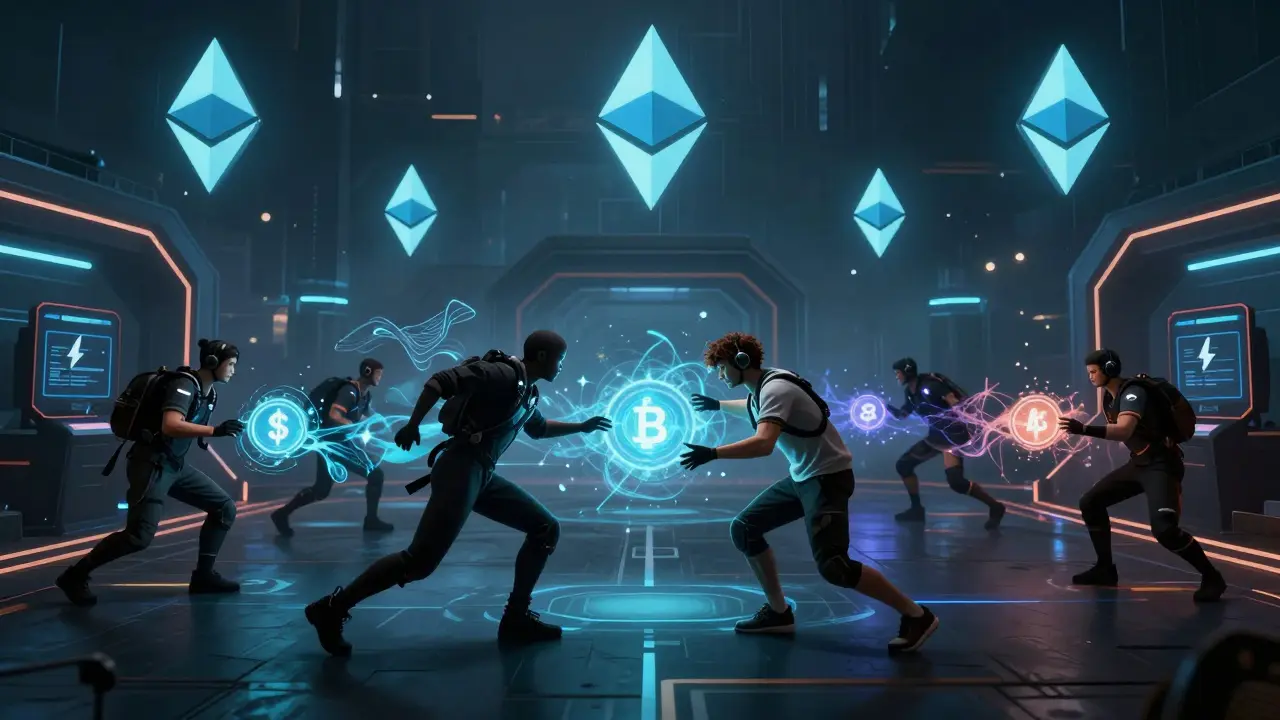
A state channel is a private, two-way tunnel between two or more people who want to transact frequently. Instead of broadcasting every single transaction to the blockchain, they exchange signed updates off-chain - like passing notes in class. Only the opening and closing of the channel get recorded on the blockchain. Everything in between? Instant, free, and invisible to the public ledger.
Think of it like opening a tab at a bar. You and your friend agree to a starting balance - say, 1 ETH. Every time you buy a drink, you sign a receipt showing who owes what. No one at the bar sees these receipts. At the end of the night, you settle the final balance with the bartender (the blockchain). The bar doesn’t need to track every drink. Just the start and end.
State channels aren’t just for money. They can handle NFT trades, game moves, smart contract interactions - anything that changes a digital state. The key is that all participants must agree on each update. If one tries to cheat by submitting an old receipt, the others can prove the real latest state and punish them.
How Do They Achieve Instant Finality?
Traditional blockchain transactions wait for confirmation. State channels skip that entirely. As soon as both parties sign a new state update, it’s final. No blocks. No miners. No delays. The speed? Between 100 and 500 milliseconds - faster than loading a webpage.
This works because every state update is cryptographically signed. Each new version invalidates the last. If Alice sends Bob a signed update saying, “I owe you 0.3 ETH,” and then later sends another saying, “I owe you 0.5 ETH,” only the second one counts. The first one is dead weight.
Security comes from the blockchain’s finality. If someone tries to close the channel with an old state, the other party has a window - usually 1 to 7 days - to challenge it by submitting the latest signed state. The smart contract on-chain checks the signatures and enforces the correct outcome. Fraud isn’t prevented. It’s just punished.
This system gives you the speed of a centralized app with the security of a decentralized blockchain. No middleman. No trust needed. Just math and cryptography.
Real-World Examples: Where State Channels Shine
State channels aren’t theoretical. They’re already powering real applications.
Bitcoin’s Lightning Network is the most famous example. Launched in 2018, it lets users send instant, low-cost Bitcoin payments. As of late 2023, it handles over 85,000 active payment channels with a total capacity of 5,300 BTC - roughly $150 million. People use it for coffee, tips, and even automated IoT device payments.
Ethereum’s Raiden Network brought state channels to smart contracts. In its 2019 testnet, it processed 1,000 transactions per second between two users - far beyond Ethereum’s 15-30 TPS limit. Developers used it for gaming, real-time auctions, and pay-per-use APIs.
One of the biggest wins? Immutable X, a gaming platform that processed over 20 million NFT transactions in Q1 2023 with zero gas fees for players. Behind the scenes? State channel logic. Gamers didn’t feel the blockchain. They just played.
Enterprise use cases are growing too. A 2022 case study from a supply chain company showed transaction times dropped from 15 seconds to near-instant, and costs fell from $0.50 per transaction to $0.001. That’s a 99.8% cost cut. For companies moving thousands of micro-transactions daily - tracking shipments, verifying certifications, paying logistics partners - that’s life-changing.
State Channels vs. Other Layer 2 Solutions
There are other ways to scale blockchains - like rollups. So why use state channels?
Let’s compare:
| Feature | State Channels | Optimistic Rollups | zk-Rollups |
|---|---|---|---|
| Transaction Speed | Instant (under 0.5s) | Seconds to minutes | Seconds to minutes |
| Finality | Immediate | 7-day challenge period | Minutes (after proof verification) |
| Cost per Transaction | Near zero | Very low | Very low |
| Best For | Repeated interactions between known parties | General-purpose DeFi apps | High-security payments, complex logic |
| Participant Requirements | Must be online to monitor fraud | No need to be online | No need to be online |
| Complexity | High - needs custom logic per use case | Medium - reusable frameworks | High - requires ZK proofs |
State channels win on speed and finality. Rollups win on ease of use and support for open participation. They’re not competitors - they’re tools for different jobs. Need to send 100 payments per second between two gaming players? State channel. Need to let thousands of users swap tokens in a DeFi pool? Rollup.
Why Aren’t State Channels Everywhere?
They’re powerful - but hard to build.
First, all participants must stay online. If you go offline and someone tries to cheat, you lose money. Solutions like watchtowers (third-party services that monitor for fraud on your behalf) help, but they add complexity and cost.
Second, they only work well between the same people. Trying to use a state channel to pay a random person on the internet? Not practical. You’d have to open a new channel every time - which defeats the purpose.
Third, the code is fragile. A single bug in the dispute logic can let someone steal funds. Developers report spending weeks debugging edge cases - like what happens if one party’s device crashes, or if a signature is malformed.
According to a 2023 survey, only 22% of blockchain developers have implemented state channels. Most say they’re “highly valuable” but too complex to build safely. That’s why they’re mostly used in controlled environments: gaming, enterprise partnerships, and micropayment streams - not public DeFi apps.

What’s Changing in 2025?
State channels aren’t stuck in the past. New upgrades are making them easier to use.
In late 2023, Ethereum’s Paris hard fork introduced EIP-4844 - blob transactions that reduce the cost of publishing channel data to the chain. That means cheaper openings and closings.
The Raiden Network is now integrating EIP-4337 (account abstraction), which lets users interact with state channels using simple wallet apps - no need to understand signatures or private keys. Imagine clicking “Pay Now” in a game and it just works, like Venmo.
Industry analysts at Delphi Digital predict state channel usage will grow 200% annually through 2025. Why? IoT devices, real-time gaming, and automated machine-to-machine payments are exploding. These need microsecond-level speed. Rollups can’t deliver that.
And Vitalik Buterin? He still calls state channels “the most efficient Layer 2 solution for repeated interactions.” That hasn’t changed.
Who Should Use State Channels?
State channels aren’t for everyone. But if you fit this profile, they’re perfect:
- You’re building a game where players make dozens of moves per minute.
- You’re offering a subscription service that charges cents per use (like streaming music or reading articles).
- You’re tracking supply chain events between trusted partners - suppliers, warehouses, distributors.
- You need near-zero fees and instant settlement, and you control the user base.
If you’re trying to build a public DeFi app with thousands of random users? Look at rollups instead. State channels are for closed loops, not open crowds.
Getting Started: What You Need to Know
If you’re a developer and want to try state channels:
- Start with Raiden Network’s documentation. It’s the most mature Ethereum implementation.
- Use a testnet first. Never deploy to mainnet without testing dispute scenarios.
- Learn Solidity and cryptographic signature verification. One mistake can cost funds.
- Consider using watchtower services to reduce the burden on users.
- Study the 2020 Trail of Bits audit - they found timing attacks in early dispute systems. Don’t repeat those mistakes.
It takes 2-4 weeks of focused learning to build something safe. But the payoff? Transactions that feel instantaneous, costs that vanish, and users who never know the blockchain was involved.
Are state channels the same as payment channels?
Payment channels are a type of state channel, but only for transferring money. State channels can handle any kind of digital state - NFTs, game positions, smart contract variables. So all payment channels are state channels, but not all state channels are payment channels.
Can I use state channels with my existing wallet?
Not yet easily. Most wallets don’t support state channels out of the box. But with Ethereum’s account abstraction (EIP-4337), new wallets are being built to hide the complexity. Soon, you’ll be able to use them like any other app - just click and pay.
Do state channels work on Bitcoin too?
Yes. Bitcoin’s Lightning Network is the largest real-world state channel system. It handles billions of dollars in off-chain payments daily. The core idea is the same: lock funds on-chain, transact off-chain, settle final balance on-chain.
What happens if one party goes offline?
If one party disappears, the other can still close the channel by submitting the latest signed state. But if they submit an old state, the online party has a challenge window (usually 1-7 days) to prove the real latest state. If no one responds, the channel closes with the last known valid state - which could mean losing funds if you didn’t monitor it.
Are state channels secure?
Yes - as long as the implementation is correct. The security comes from the underlying blockchain. If someone tries to cheat, the system punishes them by taking their deposit. But bad code, poor signature handling, or missing dispute logic can create vulnerabilities. That’s why audits and testnet testing are non-negotiable.
State channels don’t make blockchains faster for everyone. They make them fast for the right people - the ones who transact again and again. In a world where speed and cost matter more than hype, they’re quietly becoming the backbone of the next generation of blockchain apps.
nicholas forbes
December 6, 2025 AT 15:49State channels are the silent workhorses of blockchain, and honestly? Most people don’t even realize they’re using them. Lightning Network has been quietly moving billions without fanfare. The real win isn’t the tech-it’s how invisible it makes the blockchain.
Regina Jestrow
December 8, 2025 AT 00:03I’ve been playing a blockchain game that uses state channels, and I swear I forgot I was on Ethereum until I checked my wallet. The moves were instant, no gas, no lag. It felt like playing a normal mobile game. That’s the magic.
Lore Vanvliet
December 9, 2025 AT 02:07Why are we still talking about this like it’s new? Bitcoin’s Lightning Network has been live since 2018 and it’s already handling more volume than most DeFi protocols. We’re glorifying a solution that’s been quietly dominating for years. Wake up.
Stanley Wong
December 9, 2025 AT 22:05I get why people love state channels but I also think we’re ignoring the human cost. If you’re not online to monitor your channel and your device crashes or you lose your phone, you’re basically gambling that someone else won’t try to cheat you. That’s not user friendly. That’s tech elitism wrapped in cryptography.
And watchtowers? They’re just centralized middlemen with fancy names. We’re trading one trust model for another. The blockchain promised to remove intermediaries, not replace them with paid bots.
It’s elegant math, sure, but does it serve the average person? Or just the ones who can afford to run nodes and stay awake 24/7?
Nicole Parker
December 10, 2025 AT 12:55There’s something deeply poetic about state channels. They’re like friendships with rules. You and your friend agree on a balance, you trade updates back and forth, and only when it’s over do you settle. No one else needs to know. It’s intimate. It’s private. It’s human.
And that’s why I think they’ll outlast the hype. Not because they’re fast, but because they respect boundaries. They don’t scream for attention. They just work, quietly, between people who trust each other enough to keep the ledger honest.
Cristal Consulting
December 11, 2025 AT 11:21Love this breakdown. For devs: start with Raiden testnet. Don’t skip the dispute simulations. I’ve seen too many teams lose funds because they assumed users would always be online. Spoiler: they won’t.
Jerry Perisho
December 13, 2025 AT 11:18State channels are perfect for IoT. Imagine a smart fridge paying a delivery drone for milk automatically. No blockchain lag. No fees. Just trustless microtransactions. This isn’t future tech. It’s happening now in pilot programs.
Manish Yadav
December 14, 2025 AT 01:19Why do Americans think they invented everything? Bitcoin’s Lightning Network is global. We in India use it too. Stop acting like this is your exclusive club.
Noriko Robinson
December 14, 2025 AT 01:25State channels are underrated but I’m worried about the onboarding. Most people can’t even manage their private keys. Asking them to monitor channels for fraud? That’s a recipe for disaster. We need wallets that do this automatically-like a security guard you don’t even know is there.
ronald dayrit
December 15, 2025 AT 22:20It’s fascinating how state channels force us to redefine what ‘trust’ means. On-chain, we trust code. Off-chain, we trust the other party to not lie. But the system doesn’t require faith-it requires proof. And that proof is always waiting, buried in signatures, ready to explode if someone tries to cheat. It’s not about belief. It’s about consequences.
That’s the real innovation. Not speed. Not cost. It’s the architecture of accountability.
Yzak victor
December 17, 2025 AT 05:09Used this for my streaming site. Users pay 1 cent per minute. Before: $0.50 per tx, 15 sec delay. After: free, instant. My hosting bill dropped 90%. If you’re doing micro-payments, this isn’t optional. It’s survival.
Madison Agado
December 17, 2025 AT 09:51It’s ironic. We built blockchains to be open and permissionless, yet state channels are the opposite-closed, exclusive, limited to known parties. Maybe the future isn’t about open access. Maybe it’s about curated trust.
Roseline Stephen
December 19, 2025 AT 06:02Interesting. I wonder if this will ever be mainstream. Or if it’ll always be a niche tool for devs and enterprises.
Mariam Almatrook
December 20, 2025 AT 12:05How quaint. You treat state channels like some revolutionary breakthrough, when in reality, they’re merely a clever workaround for the fundamental inefficiencies of public blockchains. The very fact that users must remain perpetually vigilant to avoid financial loss reveals the fragility beneath the elegance. This is not progress-it is a bandage on a bullet wound. The blockchain was never meant to handle real-time interactions. To pretend otherwise is to confuse optimization with innovation.
And yet, you laud it as the backbone of the next generation. How ironic. The most efficient solution, according to Vitalik himself, requires participants to be online, to monitor, to defend. A system that demands constant attention is not decentralized liberation-it is digital serfdom, disguised in cryptographic robes.
Compare this to rollups, which abstract away the burden. Users sleep. The system endures. Why do you glorify a mechanism that turns users into unpaid security guards? Is this the future you want? A world where your wealth depends on your vigilance, not your code?
And let us not forget: state channels are not scalable in the open. They are siloed. They are cliquish. They are the aristocracy of Layer 2s-reserved for those who know the right people, who have the bandwidth, who can afford the watchtowers. Meanwhile, rollups welcome the masses. Who, then, is truly serving the people?
Do not mistake efficiency for equity. Speed without inclusion is merely a more elegant form of exclusion.