
The first thing you should know is that you can't just apply for a license from scratch if you're a brand-new startup. To keep the market safe, PVARA has set a very high bar for entry. You must already be licensed by a recognized international regulator. We're talking about heavy hitters like the US Securities and Exchange Commission (SEC), the UK Financial Conduct Authority (FCA), or the Monetary Authority of Singapore (MAS). Even regional powerhouses like the UAE's Virtual Assets Regulatory Authority (VARA) are accepted. This means the Pakistani government is essentially outsourcing its initial vetting to these global regulators to ensure only legitimate, stable firms get a foot in the door.
The Step-by-Step Licensing Process
Getting licensed isn't as simple as filling out a web form. It starts with a formal Expression of Interest (EoI). Here is the exact workflow you need to follow to get your application in front of the regulators.
- Prepare your EoI Package: Your application must be a comprehensive PDF. Don't send a brief summary; you need to include your full company profile, a list of all existing licenses, and a detailed breakdown of your services (trading, custody, and payments).
- Prove Your Financials: You'll need to provide hard data on your Assets Under Management (AUM) and your revenue streams. PVARA wants to see that you have the capital to survive market volatility.
- Demonstrate Compliance: You must provide a clear track record of how you handle Anti-Money Laundering (AML) and Know Your Customer (KYC) protocols. If you've had major regulatory failures in other jurisdictions, it's likely a dealbreaker.
- Submit via Email: Send your PDF to the designated PVARA email address. Use the specific subject line: "EoI VASP Licensing [Your Company Name]".
- The Waiting Period: Once submitted, expect a minimum wait of three months. PVARA processes these on a rolling basis, meaning they evaluate you as you come in rather than waiting for a specific application window to close.
Required Documentation Checklist
Missing one document can lead to your application being tossed or delayed. Make sure your dossier contains these specific elements:
| Document Category | Specific Requirements | Purpose |
|---|---|---|
| Regulatory Proof | Copies of SEC, FCA, MAS, or VARA licenses | Verification of legitimacy |
| Operational Model | Pakistan-specific business plan | Market fit and strategy |
| Security Standards | Details on cold storage and encryption | Asset protection |
| Compliance Manuals | AML/CFT and KYC frameworks | Prevention of illicit finance |
| Financials | Audited revenue and AUM figures | Solvency check |
The Great Paradox: PVARA vs. SBP
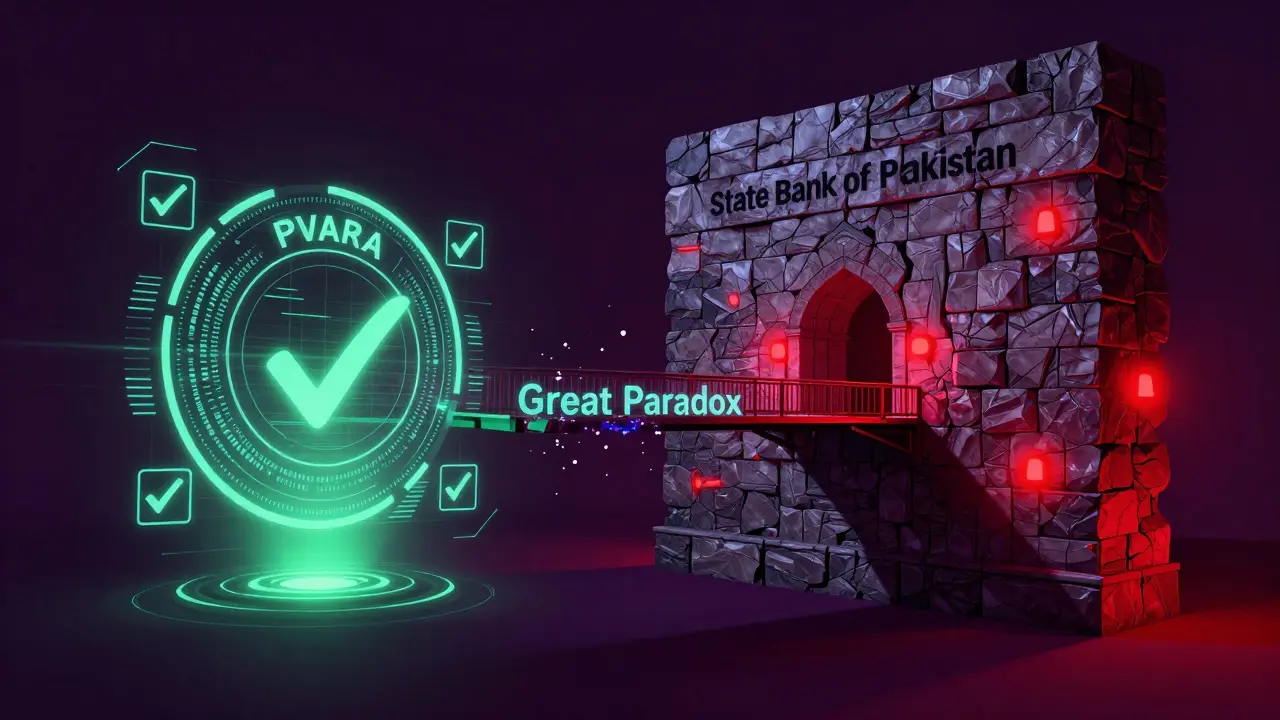
Here is where things get tricky. While PVARA is actively inviting Virtual Asset Service Providers (VASPs) to set up shop, the State Bank of Pakistan (SBP) is still playing hardball. The central bank has repeatedly stated that cryptocurrency remains illegal under existing banking laws. This creates a weird legal grey area: you might have a license from the federal regulator (PVARA), but the banks might still refuse to let you open a corporate account or process fiat on-ramps.
This contradiction is the single biggest risk for any exchange entering the market. You're essentially operating in a space where one government body is saying "Welcome!" while the other is saying "Not so fast." Many analysts are watching to see if the Senate's proposed amendments to the virtual assets bill will finally bridge this gap and force the SBP to align with the newer, more open digital strategy.
Opportunities in Shariah-Compliant Crypto
One of the most interesting parts of the new framework is the focus on Islamic finance. PVARA has set up regulatory sandboxes specifically for products that meet Shariah requirements. Given Pakistan's massive Muslim population, there is a huge untapped market for "Halal" crypto services. This includes tokenization of real-world assets that avoid riba (interest) and the creation of digital assets backed by tangible commodities.
If your business model can adapt to these requirements, you might find it much easier to get traction. The government sees this as a way to blend traditional Islamic banking values with the efficiency of blockchain technology, potentially turning Pakistan into a regional hub for Islamic digital finance.
Mining and the IMF Struggle
You might have heard about the Pakistan Crypto Council (PCC) announcing a Strategic Bitcoin Reserve and plans to allocate 2,000 MW of electricity for mining. While that sounds ambitious, it's currently hitting a wall. The International Monetary Fund (IMF) has raised serious objections. Their concern isn't about the tech, but about the money: they worry that subsidizing electricity for miners would strain the national grid and create fiscal risks for the country.
For an exchange operator, this means that while the trading side of the business is moving toward legalization, the infrastructure side (like mining) is still bogged down in geopolitical negotiations. Don't bet your entire business model on mining in Pakistan until the IMF gives the green light.
Can a new startup apply for a PVARA license?
Currently, no. Eligibility is restricted to firms that are already licensed by recognized international bodies like the SEC (USA), FCA (UK), or MAS (Singapore). This is a safety measure to ensure only experienced operators enter the market.
How long does the licensing process take?
The minimum timeline for license issuance is three months from the date of submission, though this can vary depending on the thoroughness of your due diligence package.
Is cryptocurrency legal tender in Pakistan?
No. Despite the creation of PVARA and the licensing process for exchanges, cryptocurrencies are not recognized as legal tender, and the State Bank of Pakistan still prohibits banks from dealing in digital currencies.
What is a regulatory sandbox in the context of PVARA?
A regulatory sandbox is a controlled environment where firms can test innovative products-specifically Shariah-compliant crypto services-under the supervision of PVARA without immediately needing to meet all standard regulatory requirements.
How do I submit my Expression of Interest (EoI)?
You must send your comprehensive application as a PDF to PVARA's designated email address with the subject line 'EoI VASP Licensing' followed by your company's name.
Next Steps and Troubleshooting
If you're an existing global exchange, your first step is to audit your current compliance manuals. If you're already meeting FCA or SEC standards, you're halfway there. However, the real challenge will be the banking side. We recommend partnering with a local legal expert who understands the tension between PVARA and the State Bank of Pakistan to navigate the on-ramp/off-ramp hurdles.
For those interested in the Shariah-compliant angle, reach out to the Pakistan Crypto Council to explore sandbox opportunities. If your application is rejected, the most common reason is usually a lack of specific "Pakistan-focused" business modeling-don't just send a generic global deck; show them exactly how you plan to serve the Pakistani user base while respecting local laws.
Suvoranjan Mukherjee
April 4, 2026 AT 21:42This is a massive move for the region! Integrating Shariah-compliant frameworks into the VASP model is a masterstroke for capturing the untapped liquidity in the Islamic finance sector. We're talking about a huge potential for RWA tokenization that avoids riba and leverages the efficiency of L2 solutions. Anyone looking at this should definitely dive deep into the regulatory sandbox options to iterate on their product-market fit before full deployment. It's all about that synergy between traditional values and Web3 infrastructure!
Manisha Sharma
April 4, 2026 AT 22:50Typical of them to try and copy what works elsewhere while their own system is a total mess lol. India is way ahead in digital infra and we dont need these half-baked laws to prove it. Its just funny how they think some "authority" can just fix the lack of real economic stability with a few pdfs. Pure comedy.
JERRY ORTEGA
April 6, 2026 AT 14:16the gap between pvara and the state bank is the real killer here man. no point in having a license if you cant actually move money in and out of the system. hope the senate amendments actually happen because without banking rails its just a fancy piece of paper
Arlen Medina
April 7, 2026 AT 10:06USA is the only place that actually knows how to regulate this stuff properly so if they're requiring SEC or FCA licenses they're basically admitting they can't do it themselves. Absolute win for American standards being the global benchmark. Get in there and take over the market!
vijendra pal
April 9, 2026 AT 08:13Omg the IMF is always ruinning everything 🙄 they just want to control everything and stop the growth of crypto in developing nations!! Just let the miners mine and the economy will grow on its own 🚀💰🔥
Bruce Micciulla Agency
April 10, 2026 AT 09:17the fundamental misalignment between the central bank and the new regulator suggests a systemic failure in policy cohesion that likely renders the entire licensing process a theoretical exercise in compliance rather than a viable operational pathway for any serious institutional player who cannot afford the risk of frozen assets or sudden regulatory reversals given the volatility of the local political landscape
david head
April 12, 2026 AT 00:28totally agree with the banking part 🙌 its gonna be a wild ride lol
Adriana Gurau
April 12, 2026 AT 05:24Imagine thinking a PDF submission is "comprehensive" in 2026. The lack of a digital portal for applications is just... quaint 🙄. It's a very low-energy approach to a high-tech industry. Honestly just embarrassing for a federal authority to be operating like a 1990s law firm. 💅
Patty Levino
April 13, 2026 AT 23:01I can see how frustrating it is for startups to be excluded. It's a tough pill to swallow when you have the tech but not the legacy license. Maybe focusing on the sandbox for Shariah-compliant products is a way for smaller, innovative teams to get a foot in the door without needing an SEC license right away. It's worth exploring that niche.
June Coleman
April 14, 2026 AT 15:38Oh look, another government trying to "regulate" a decentralized technology. I'm sure this will go absolutely perfectly and not result in a bureaucratic nightmare that lasts for decades. So inspiring! 🙄
shubhu patel
April 15, 2026 AT 13:37It is quite interesting to see how the legal framework is evolving over time and although the tension between the state bank and pvara seems like a major hurdle it might actually lead to a more robust system once both entities finally reach a consensus on how to handle the on-ramp processes for users in the long run.
Taylor Meadows
April 16, 2026 AT 13:26The energy wasted on this is pathetic. People are chasing digital ghosts while ignoring the spiritual decay of the financial system. You think a license will save you from the inevitable collapse of these artificial structures? Please. Just more noise in a void of meaningless transactions. It's honestly draining to even think about the greed driving this push into a fragile market.