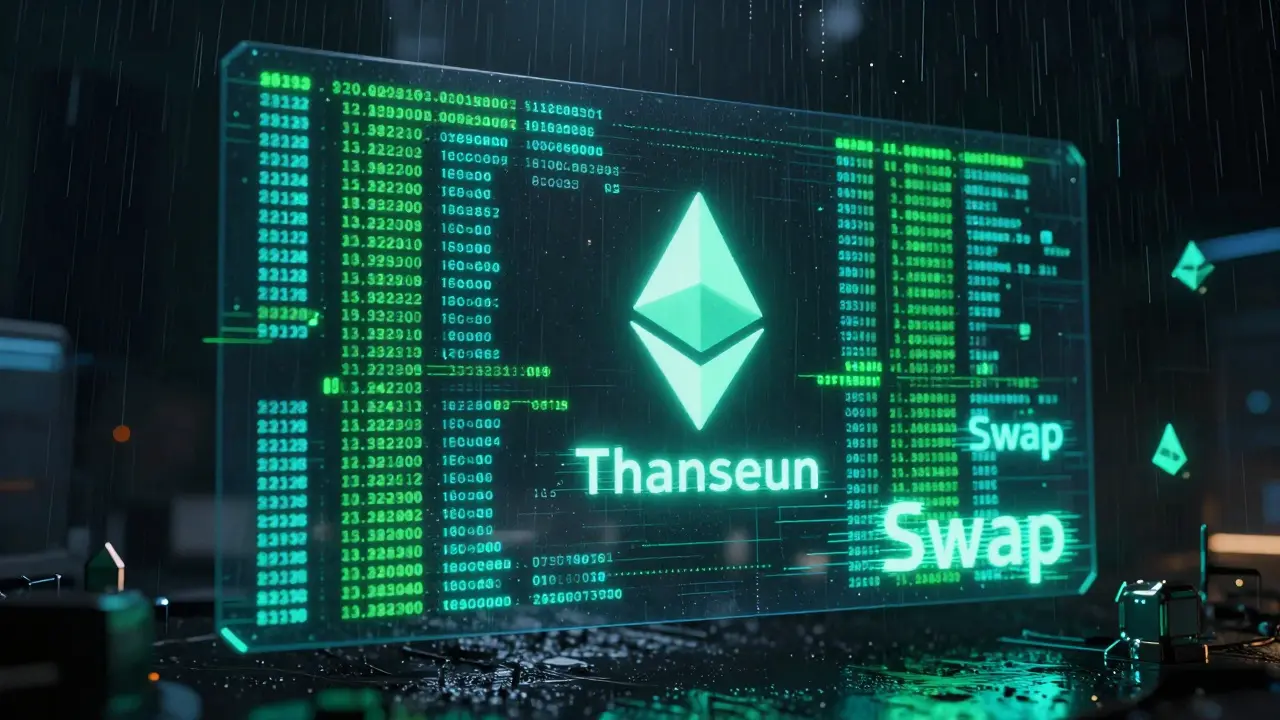
Every time you send crypto, swap tokens, or mint an NFT, you’re not just clicking a button-you’re triggering code that runs on a global computer. That code is a smart contract. And every action it takes-every balance change, every event fired, every call to another contract-is permanently recorded on the blockchain. The question isn’t whether it’s tracked; it’s whether you know how to read what’s been recorded.
What Smart Contract Interaction Tracking Actually Means
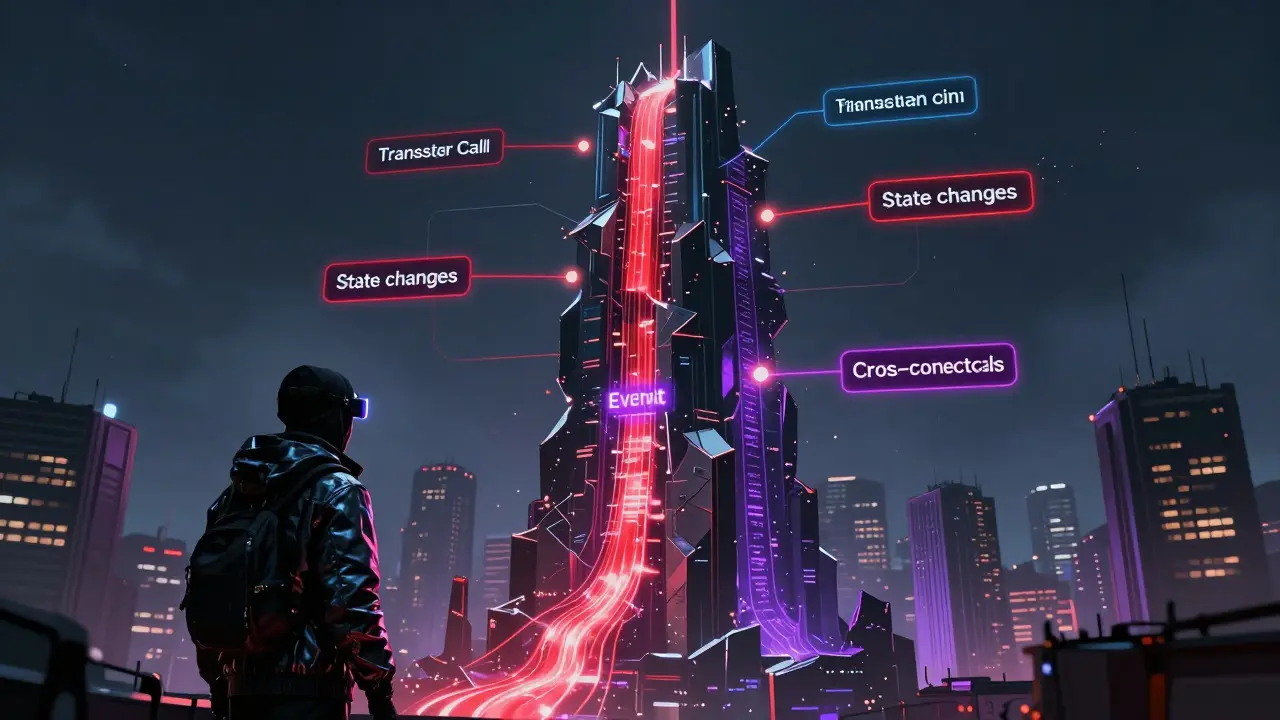
Tracking smart contract interactions isn’t about watching live animations of code running. It’s about reading the digital fingerprints left behind after every transaction. When a contract executes, it doesn’t just change numbers-it leaves behind logs, state changes, and event records. These aren’t optional extras; they’re baked into how blockchains work. Think of it like a bank ledger that never forgets. Every deposit, withdrawal, or transfer is written in ink that can’t be erased. Smart contracts do the same, but with code. When you interact with a DeFi protocol like Uniswap or a staking contract on Ethereum, the contract checks conditions, updates balances, and emits events. All of that is stored forever. The key components tracked are:- Transaction calls: Who called the contract? What function was used? How much gas was spent?
- State changes: What values inside the contract changed? Before and after? For example, how much LP token was added to a pool?
- Event logs: These are the contract’s way of shouting out what happened. Events like
Transfer(address,address,uint256)orSwap(address,uint256,uint256,uint256,uint256)are indexed and searchable. - Cross-contract calls: When Contract A calls Contract B, which then calls Contract C-that chain of actions is part of the interaction trail.
How It Works Under the Hood
On Ethereum, smart contracts use something calledLOG opcodes-LOG0 through LOG4-to emit events. Each event can have up to four indexed parameters, called topics. These topics are hashed and stored in a way that makes them lightning-fast to search. The rest of the data-the actual values like token amounts or addresses-goes into the data payload.
Here’s a real example: When you swap ETH for DAI on Uniswap, the contract emits an event like this:
Swap(address indexed sender, uint256 amount0In, uint256 amount1In, uint256 amount0Out, uint256 amount1Out, address indexed to)indexed fields-sender and to-are stored as topics. That means you can instantly find all swaps made by a specific wallet, without scanning every single transaction on the chain.
Other blockchains handle this differently. Solana uses accounts and program logs. Hyperledger Fabric tracks interactions through endorsement policies and channel-specific ledgers. But the core idea stays the same: everything that happens is recorded, and you can find it if you know where to look.
Tools You Can Use to Track Interactions
You don’t need to write code to track this yourself. Several tools make it simple:- Etherscan: Type in any contract address and click the “Events” tab. You’ll see every logged event-transfers, approvals, swaps-with timestamps and values.
- BscScan and Polygonscan: Same as Etherscan, but for Binance Smart Chain and Polygon.
- Chainlens: Offers deeper analytics, including interaction patterns over time, gas usage trends, and contract risk scores.
- TokenFlow and DeBank: These wallets show you your own interaction history across DeFi protocols, showing you exactly what contracts you’ve touched and when.
Why This Matters: Real-World Use Cases
Tracking isn’t just for tech nerds. It’s critical for real people using blockchain every day.DeFi Users
If you’re yield farming, you need to know if your staked tokens are being used correctly. A tracking tool can show you:- Did your LP tokens get approved to the correct vault?
- Did the contract claim rewards as expected?
- Was there a sudden, unusual withdrawal from the pool?
NFT Collectors
When you buy an NFT, you want to know:- Is this the original mint? Or was it copied from another contract?
- Have royalties been paid on every resale?
- Has the contract been flagged for suspicious activity?
Supply Chains and Healthcare
A pharmaceutical company in Australia uses blockchain to track drug shipments. Each step-manufacturing, customs clearance, hospital delivery-is recorded as a smart contract interaction. If a shipment is delayed, auditors pull the interaction logs to see where the hold-up happened. No guesswork. No paperwork. Just data. Similarly, hospitals in private systems are testing smart contracts to securely share patient records between insurers. Only authorized parties can trigger access events, and every access is logged. If someone tries to peek at a record without permission, the system detects it instantly.Challenges You Can’t Ignore
Tracking sounds simple-until you hit the walls.Cost of Logging
Every event you emit costs gas. If you log every tiny change in your contract, your users will pay a fortune. That’s why smart developers only log what matters: key actions like transfers, approvals, or state changes. Don’t log “user clicked button.” Log “user staked 500 tokens.”Privacy vs. Transparency
What if your contract handles sensitive business data? You can’t just broadcast everything on a public chain. Some companies use private blockchains like Hyperledger Fabric. Others use zero-knowledge proofs-technologies that let you prove something happened without revealing the details. For example: “This contract processed a payment over $10,000” without saying who paid or who received it.Scalability
Ethereum handles about 15 transactions per second. When thousands of users interact with a popular contract, the logs pile up. Indexing that data takes time. Tools like The Graph help by creating decentralized indexes, but they’re not perfect. If you’re building something high-volume, plan your tracking architecture early.Cross-Chain Complexity
If your app works on both Ethereum and Solana, tracking becomes messy. You’re now juggling two different log formats, two different block explorers, two different ways to query data. Solutions like LayerZero and Wormhole are trying to fix this, but cross-chain tracking is still in its early days.
What’s Next for Smart Contract Tracking
The future isn’t just about watching what happened-it’s about predicting what will. AI-powered tools are starting to analyze interaction patterns to flag anomalies. For example:- A wallet that makes 200 tiny transactions in 10 minutes? Might be a bot.
- A contract that suddenly starts sending funds to a new address? Could be a hack.
- A DeFi pool where deposits drop 80% overnight? Might be a rug pull.
What You Should Do Today
If you’re using DeFi, NFTs, or any blockchain-based service:- Find the contract address you’re interacting with.
- Go to Etherscan (or the relevant explorer) and open the “Events” tab.
- Look for events like
Transfer,Approval, orSwap. - Click on one. See the values. See who called it.
- Ask yourself: Does this match what I expected to happen?
- Log only the critical events-don’t overdo it.
- Use indexed topics for fields you’ll search often (addresses, timestamps, statuses).
- Test your event logs with a local blockchain before deploying.
- Document what each event means. Other developers will thank you.
Final Thought
Blockchain is built on trust-but trust isn’t blind. It’s verified. Smart contract interaction tracking is the tool that turns trust into proof. Every transaction, every change, every call leaves a trail. The question isn’t whether you can track it. It’s whether you’re willing to look.Can I track smart contract interactions without coding?
Yes. Tools like Etherscan, BscScan, and DeBank let you view all interactions by simply entering a contract address. You can see events, transfers, and gas usage without writing a single line of code.
Why do some contracts have more events than others?
It depends on how the developer designed it. Some contracts log every small action for full transparency. Others only log major events to save on gas costs. More events don’t mean better-just more detail.
Are smart contract logs private?
No. On public blockchains like Ethereum, all logs are visible to anyone. If your contract handles sensitive data, you shouldn’t store it directly in the contract. Use off-chain storage with on-chain proofs instead.
Can I be tracked if I interact with a smart contract?
Yes. Your wallet address is permanently tied to every interaction. If you’ve used a contract once, anyone can see all your past activity with it. That’s why some users use burner wallets for DeFi.
What’s the difference between a transaction and an event?
A transaction is the action you send to the blockchain-like calling a function. An event is what the contract emits in response. One transaction can trigger multiple events. Events are easier to search and cheaper to store.
Do all blockchains track interactions the same way?
No. Ethereum uses event logs with topics. Solana uses program logs and account states. Hyperledger Fabric uses endorsement and channel-specific ledgers. The goal is the same-record interactions-but the methods differ.
How do I know if a smart contract is safe based on its interactions?
Look for red flags: sudden large withdrawals, unusual contract calls, or events that don’t match the contract’s documented purpose. Use tools like Chainlens or DeFiLlama’s audit scores. If the contract has no interaction history, that’s also a warning sign.
Can I build my own tracking system?
Yes. Use Web3 libraries like ethers.js or web3.py to listen for events in real time. Set up a node or use Infura/Alchemy, then write scripts to filter and store the data you care about. It’s technical, but open-source tools make it doable.
Helen Pieracacos
December 25, 2025 AT 20:03Dustin Bright
December 26, 2025 AT 23:34Melissa Black
December 27, 2025 AT 20:49chris yusunas
December 28, 2025 AT 21:49Sophia Wade
December 29, 2025 AT 05:20Brian Martitsch
December 29, 2025 AT 11:49Ashley Lewis
December 31, 2025 AT 05:17Vyas Koduvayur
January 1, 2026 AT 04:45Jake Mepham
January 2, 2026 AT 09:00Craig Fraser
January 2, 2026 AT 15:36Cathy Bounchareune
January 3, 2026 AT 14:27Alison Fenske
January 4, 2026 AT 00:36