
Have you ever tried to swap tokens on a new Layer 2 network, only to find that the liquidity is so thin it feels like trying to fill a bucket with a teaspoon? That’s exactly where IceCreamSwap on the Blast network sits right now. If you are looking for a bustling marketplace with deep pools and instant execution, this might not be the spot. But if you are curious about how multichain aggregators work on emerging networks, IceCreamSwap offers a fascinating case study.
Launched shortly after Blast's mainnet release in February 2024, IceCreamSwap positions itself as an AI-powered decentralized exchange (DEX). It promises to scan multiple liquidity sources to find you the best rates. However, recent data paints a stark picture of its current viability. Let’s cut through the hype and look at what actually happens when you connect your wallet to this platform today.
What Is IceCreamSwap on Blast?
IceCreamSwap is a multichain decentralized exchange that utilizes unmodified Uniswap V3 smart contracts. The "Blast" version is simply one node in its broader ecosystem, which also includes integrations with Bitgert (Brise), Binance Smart Chain (BSC), XDC, and XoDex. The core idea is simple: use artificial intelligence to route your trades across different liquidity pools to minimize slippage.
On paper, this sounds efficient. In practice, the technology relies heavily on the underlying infrastructure of the chain it runs on. IceCreamSwap does not build its own order books; it borrows the concentrated liquidity model from Uniswap V3. This means liquidity providers (LPs) must allocate capital within specific price ranges. For traders, this can mean better prices-if there is enough money in the pool. Here lies the rub.
The Liquidity Problem: What the Numbers Say
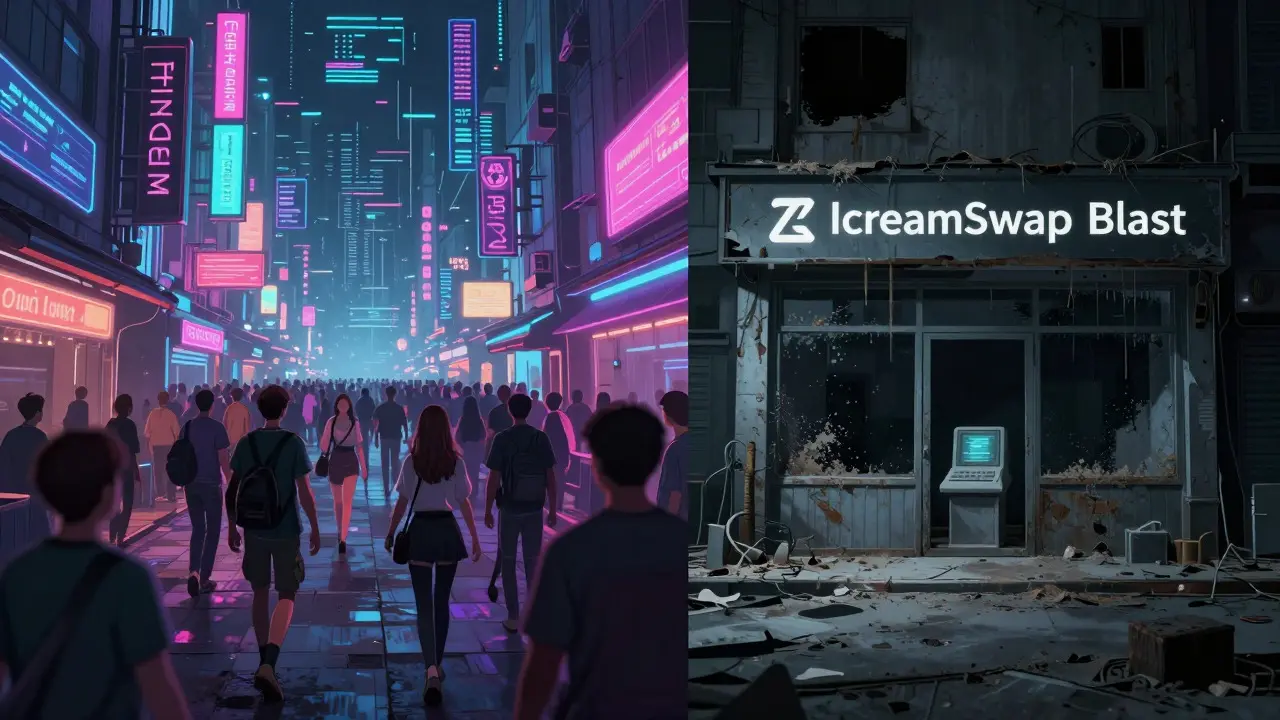
Let’s talk about the elephant in the room. As of late 2025 and heading into 2026, CoinMarketCap reports $0 in 24-hour trading volume for IceCreamSwap on Blast. Zero. Not low, not declining-zero.
This isn’t just a bad day; it suggests a systemic lack of activity. Compare this to Thruster Finance, another DEX on Blast, which reported $23.7 million in daily volume during the same period. When you try to trade on IceCreamSwap, you aren’t competing against other traders; you’re likely interacting with empty or nearly empty pools. This leads to massive slippage, where the price you see is not the price you get, or worse, failed transactions entirely.
| Platform | 24h Volume | Liquidity Depth | Community Activity |
|---|---|---|---|
| IceCreamSwap (Blast) | $0 | Very Low | Minimal |
| Thruster Finance | $23.7M | High | Active (15k+ Telegram members) |
| OmniDex | Visible Activity | Moderate | Growing |
How Does the AI Aggregator Actually Work?
The marketing materials claim an "AI-powered DEX aggregator" scans the blockchain for optimal routes. In reality, this is a standard feature in many modern DEX interfaces. The system breaks down large orders into smaller chunks and executes them across different pools to reduce impact on the market price.
However, an AI router is only as good as the data it has to work with. If the pools on Blast are fragmented and shallow, the AI has no "best rate" to find. It’s like asking a GPS to find the fastest route through a city with no roads. The technology behind IceCreamSwap is sound-it uses battle-tested Uniswap V3 contracts-but the environment it operates in lacks the fuel to make that engine run smoothly.
Security and Trust: Should You Worry?
Since IceCreamSwap uses unmodified Uniswap V3 code, the base layer security is relatively strong. Uniswap’s contracts have been audited by firms like OpenZeppelin and have processed over $1.5 trillion in cumulative volume since 2021. This reduces the risk of a smart contract exploit inherent to custom-built DEXs.
But security is more than just code. It’s about governance, transparency, and community oversight. IceCreamSwap (Blast) suffers from a lack of visibility. There are no specific security audits mentioned for the Blast integration itself, and the GitHub repositories for this specific chain deployment are not prominently linked or updated. Without active developer engagement or a transparent audit trail for the Blast instance, users are taking a blind leap of faith.
User Experience: Connecting and Trading
If you decide to give it a shot, here is what the process looks like:
- Connect Your Wallet: You’ll need a Web3 wallet like MetaMask. Ensure it is configured for the Blast network (Chain ID: 81457, RPC URL: https://rpc.blast.io).
- Approve Tokens: Like any DEX, you must approve the token spending allowance. This costs a small gas fee.
- Execute Swap: Enter the amount and confirm. Due to low liquidity, you may need to set high slippage tolerance (e.g., 5-10%) to ensure the transaction goes through, which can cost you more in price difference than in gas fees.
The interface is familiar to anyone who has used Uniswap or SushiSwap. It’s clean, but the lack of real-time price charts and depth maps makes it hard to assess if a trade is even worth making before you click "Swap."
Why Is Volume So Low?
Several factors contribute to IceCreamSwap’s struggle on Blast:
- Token Unlock Pressure: In July 2025, Blast released 10.5 billion tokens to early investors and contributors. This created massive sell pressure across the ecosystem, draining liquidity from smaller DEXs.
- Competition: Established players like Thruster Finance captured the majority of user attention and liquidity incentives.
- Lack of Incentives: Unlike some competitors that offer yield farming rewards or liquidity mining programs to bootstrap their platforms, IceCreamSwap has remained quiet on Blast-specific incentives.
Is IceCreamSwap on Blast Dead?
Not necessarily dead, but certainly dormant. The parent project, IceCreamSwap, still maintains a presence on other chains and has around 18,500 Twitter followers. However, the Blast integration appears to be a side note rather than a priority. Unless the team injects significant liquidity or partners with Blast’s native yield mechanisms (like T-Bill yields), it will remain a niche tool for very small trades.
For most users in 2026, the recommendation is clear: stick to platforms with proven volume. Use IceCreamSwap on Blast only if you are testing the waters, holding very small amounts, or specifically need to access a token pair that exists nowhere else. For serious trading, the slippage risks outweigh the convenience.
Is IceCreamSwap on Blast safe to use?
The smart contracts themselves are based on Uniswap V3, which is highly secure. However, safety also depends on liquidity and platform stability. With $0 reported volume, the risk isn't necessarily a hack, but rather failing transactions or extreme slippage due to lack of funds in the pools.
Why is the trading volume zero?
Zero volume indicates extremely low user adoption. Traders prefer exchanges with deeper liquidity like Thruster Finance. Without active liquidity mining incentives or marketing, users migrate to platforms where they can execute larger trades efficiently.
Does IceCreamSwap charge fees?
As a non-custodial DEX, there are no platform fees in the traditional sense. You pay standard Ethereum Layer 2 gas fees for transactions. Additionally, liquidity providers earn a portion of the trading fees, but with low volume, these earnings are negligible.
Can I provide liquidity on IceCreamSwap Blast?
Technically, yes. Since it uses Uniswap V3 architecture, you can create concentrated liquidity positions. However, given the lack of trading volume, impermanent loss could exceed any potential fee income, making it a risky strategy for LPs currently.
What is the best alternative to IceCreamSwap on Blast?
Thruster Finance is currently the dominant DEX on Blast with significantly higher volume and liquidity. Other options include OmniDex. These platforms offer better price execution and active community support.
Ryan Robinson
August 12, 2026 AT 00:40honestly this is such a relief to read because i was getting so tired of people hyping up blast dexes that dont even have any volume. it feels like everyone just copy pasted the same marketing bs about ai aggregators without looking at the actual charts. zero volume means zero liquidity which means you are basically donating your money to gas fees and slippage. i tried swapping on there last week and lost like 15 percent on a small trade because the pool was empty. thruster finance is literally doing all the work here and icecreamswap is just sitting there collecting dust. its not even worth connecting your wallet to unless you really want to test how bad slippage can get.
Aryan MISHRA
August 13, 2026 AT 13:31The fundamental flaw in IceCreamSwap's architecture on Blast is the absence of organic market maker incentives! Uniswap V3 concentrated liquidity requires active range management, yet there is no yield farming program to attract LPs! Consequently, the order book remains fragmented and inefficient! Traders must prioritize platforms with robust TVL and high-frequency trading activity! Thruster Finance demonstrates superior capital efficiency through strategic incentive alignment! Do not deploy capital into dormant protocols!
Earl Kott65
August 15, 2026 AT 01:02Oh wow, talk about a ghost town! 👻 I mean, who actually uses this thing? It’s like showing up to a party where nobody brought drinks! 🍸 The AI router sounds fancy until you realize it’s routing you into a brick wall! 🧱 Zero volume is hilarious, honestly! 😂 It’s not just low, it’s non-existent! You’d think with all the hype around Blast, someone would have filled these pools by now! But nope, just empty promises and failed transactions! 💀 Stick to Thruster if you don’t want to cry over your slippage! 😭
Phil Babb
August 16, 2026 AT 13:36You need to look at the bigger picture here!! The technology is solid!! Uniswap V3 contracts are battle tested!! Yes the volume is low right now but that changes!! You have to support emerging ecosystems!! Don't let the haters tell you otherwise!! Blast is growing!! IceCreamSwap is part of that growth!! Keep faith in the multichain vision!! The AI aggregation will shine once the liquidity arrives!! Stay strong traders!! 💪🔥
Ethan Yuwono
August 17, 2026 AT 14:43i think we should be careful about dismissing it entirely though. the security aspect is valid since they use unmodified code. maybe it serves a niche purpose for very specific token pairs that aren't listed elsewhere. it's quiet but perhaps that's intentional for certain types of trades. we should observe before condemning completely.
Jack Delasquez
August 18, 2026 AT 19:00yo i tried this last month and my tx failed like 5 times in a row. super frustrating. the interface looks clean but under the hood its a mess. why would anyone use this when thruster has millions in volume? makes no sense to me. prob gonna stick to uni or thruster from now on. save yerself the headache.
Harman Singh
August 20, 2026 AT 10:38why does everyone care so much about volume?? its just numbers on a screen. i feel like you guys are missing the point of decentralization. who cares if its zero volume right now?? maybe it will pick up later. you are all so negative and draining the energy out of the thread. lets just hope for the best instead of complaining.
Qolbina Islami
August 21, 2026 AT 16:50This is exactly what happens when foreign developers try to build on American infrastructure without understanding the market!!! They promise AI and deliver nothing!!! We need real innovation not these copied clones!!! Support local projects that respect our time and money!!! Blast deserves better than this garbage!!! Wake up people!!!
SUBHAM CHOUDHURY
August 22, 2026 AT 06:19Hey everyone, let's keep the discussion positive. Even if the volume is low, it's good to have options. Maybe the team is working on something new behind the scenes. Let's give them some time and space to grow. No need to be too harsh. Everyone starts somewhere. Good luck to the devs!
Joy Kwant
August 22, 2026 AT 21:27It is morally irresponsible to promote a platform with zero transparency and zero volume. Users deserve better than blind leaps of faith. The lack of audits for the specific Blast integration is a red flag that cannot be ignored. We should demand accountability from these projects. Until then, stay away and protect your assets.