Have you ever tried to send a small amount of cryptocurrency only to pay more in network fees than the actual transfer? You are not alone. This is the classic "blockchain trilemma" in action: networks struggle to balance security, decentralization, and speed. To solve this, the industry split into two distinct architectural approaches: Layer 1 blockchains and Layer 2 solutions. Understanding the difference between them is no longer just for developers; it’s essential for anyone holding digital assets in 2026.
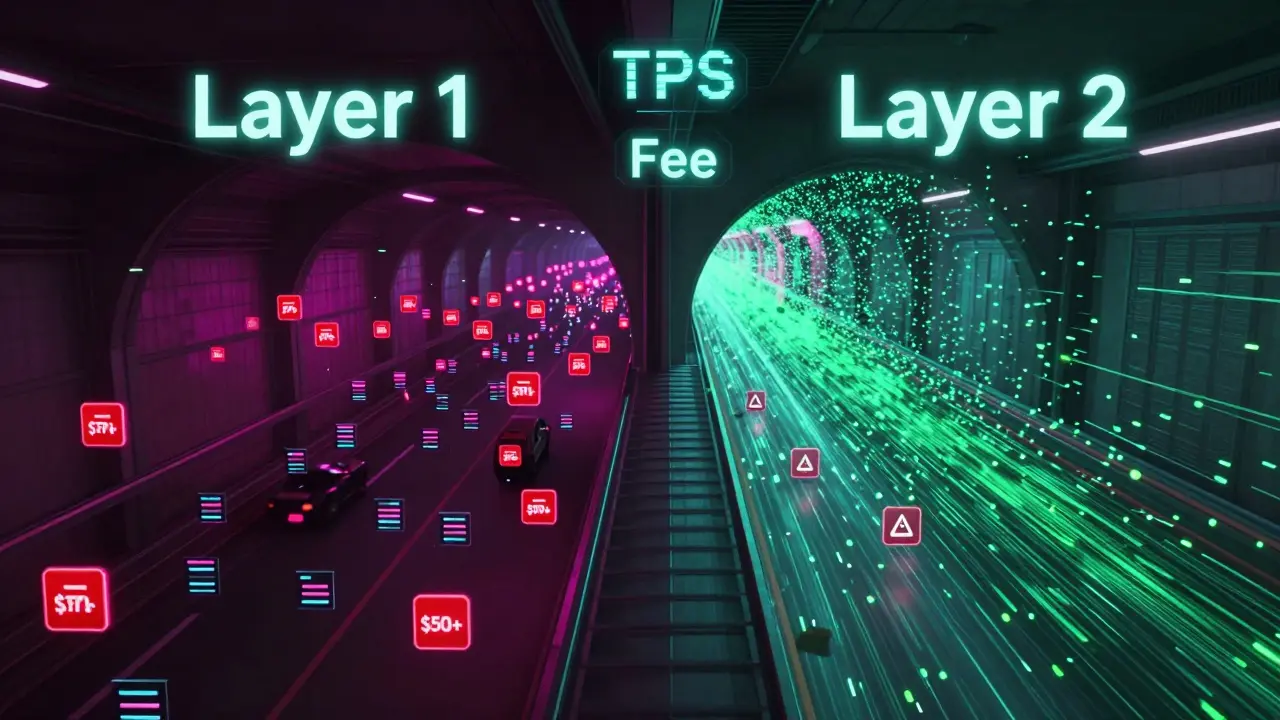
Think of Layer 1 as the main highway system-the foundational infrastructure that handles consensus and security. Think of Layer 2 as the express lanes or toll roads built on top of that highway to handle traffic faster and cheaper. In this guide, we break down exactly how they differ, which one you should use for your specific needs, and why the future of blockchain is increasingly multi-layered.
The Core Difference: Foundation vs. Scaling
To understand the comparison, we first need to define what each layer actually does. A Layer 1 blockchain is a foundational network that manages its own consensus mechanism and security independently. Examples include Bitcoin, Ethereum, and Solana. These networks process transactions directly on their main chain. Every node in the network must verify every transaction, which ensures high security but limits speed.
In contrast, a Layer 2 solution is a secondary protocol built on top of a Layer 1 network to enhance scalability. It does not have its own independent consensus mechanism for finality. Instead, it inherits security from the underlying Layer 1. Popular examples include Arbitrum, Optimism, and the Lightning Network. Layer 2s bundle thousands of transactions off-chain and then post a summary proof back to the main Layer 1 chain.
The fundamental trade-off here is clear: Layer 1 offers maximum security and decentralization at the cost of speed and price. Layer 2 offers speed and low costs by introducing additional complexity and trust assumptions (like relying on sequencers or operators).
Performance Metrics: Speed and Cost in 2026
Let’s look at the hard numbers, because that’s usually why people care about this distinction. As of late 2024 and early 2025 data trends continuing into 2026, the performance gap remains significant.
| Metric | Layer 1 (e.g., Ethereum Mainnet) | Layer 2 (e.g., Arbitrum, Optimism) |
|---|---|---|
| Transactions Per Second (TPS) | 15-30 TPS | 2,000-9,000+ TPS |
| Average Transaction Fee | $1.50 - $50+ (varies with congestion) | $0.001 - $0.05 |
| Block Time / Finality | 12-15 seconds (blocks), minutes for full finality | Near-instant confirmation; settlement varies |
| Primary Use Case | Security settlement, large value storage | Daily payments, gaming, high-frequency DeFi |
Ethereum’s Layer 1 processes roughly 15 to 30 transactions per second. During peak times, like an NFT mint or a market crash, gas fees can spike dramatically. We’ve seen fees hit over $200 during extreme congestion events in previous years. Meanwhile, Layer 2 solutions like Arbitrum One and Optimism routinely handle thousands of transactions per second. If you are buying a coffee token or trading a small NFT, paying $0.02 on a Layer 2 versus $15 on Layer 1 is a game-changer.
However, speed comes with a catch regarding finality. On Layer 1, once your transaction is confirmed, it is immutable. On some Layer 2s, specifically Optimistic Rollups like Optimism, there is a "challenge period." While you can spend your funds immediately, withdrawing them back to Layer 1 used to take up to 7 days. Newer technologies like zk-Rollups (such as StarkNet or zkSync Era) use cryptographic proofs to reduce this withdrawal time to minutes, but the technology is still maturing.
Security and Decentralization: Who Do You Trust?
This is where the rubber meets the road. Security is not binary; it exists on a spectrum. Layer 1 networks derive their security from a massive, decentralized set of validators or miners. For example, Ethereum has over 800,000 validators securing the network. Bitcoin has tens of thousands of public nodes. This makes attacking these networks economically unfeasible.
Layer 2 solutions inherit this security, but they introduce new points of failure. Most Layer 2s rely on a component called a sequencer to order transactions. In many cases, especially in earlier deployments, this sequencer was operated by a single centralized entity. If that operator goes rogue, they could theoretically censor transactions or delay processing until the fraud proof window expires.
Furthermore, moving assets between layers requires bridges. Bridges have historically been the weakest link in the blockchain ecosystem. Major hacks, such as the Ronin Bridge incident in 2022 ($613 million lost) and the Wormhole exploit ($320 million lost), highlight the risks. When you bridge assets from Layer 1 to Layer 2, you are trusting the bridge’s smart contracts and validators. Always remember: higher yield or lower fees often come with higher counterparty risk.
Types of Layer 2 Solutions Explained
Not all Layer 2s are created equal. They use different technical methods to achieve scaling. Knowing which type you are using helps you assess risk.
- State Channels (e.g., Lightning Network): These allow users to open a private channel to transact off-chain. Only the final state is recorded on the main blockchain. This is perfect for micro-transactions and instant payments but requires both parties to be online simultaneously to open/close channels.
- Sidechains (e.g., Polygon PoS): Sidechains are independent blockchains that run parallel to the main chain. They have their own consensus mechanism and security. They are fast and cheap but do not inherit the same level of security as the main Layer 1. If the sidechain’s validators collude, they can steal funds.
- Optimistic Rollups (e.g., Arbitrum, Optimism): These assume transactions are valid by default. They post transaction data to Layer 1 but execute them off-chain. If someone suspects fraud, they can submit a "fraud proof" during a challenge period. This is the most mature L2 tech today, widely compatible with Ethereum tools.
- zk-Rollups (e.g., StarkNet, zkSync): These use zero-knowledge cryptography to generate a mathematical proof that all transactions are valid. This proof is verified on Layer 1. They offer faster finality and stronger security guarantees than optimistic rollups but require specialized hardware and development knowledge.
Which Should You Choose?
Your choice depends entirely on your goal. There is no "best" option, only the right tool for the job.
Choose Layer 1 if:
- You are storing long-term value (HODLing). The ultimate security of the base layer is paramount.
- You are running a validator node or participating in core governance.
- You want maximum interoperability without worrying about bridge risks or liquidity fragmentation.
Choose Layer 2 if:
- You are engaging in daily activities: trading, gaming, or social interactions on-chain.
- You are a developer building an application that requires high throughput and low user friction.
- You want to participate in DeFi or NFT markets without paying exorbitant gas fees.
For most retail users in 2026, the practical workflow is hybrid. You keep your primary savings in a self-custody wallet on Layer 1 (like Ethereum or Bitcoin). When you want to spend or trade, you bridge a smaller amount to a trusted Layer 2. This minimizes exposure to bridge risks while maximizing usability.
The Future: Convergence and Interoperability
The line between Layer 1 and Layer 2 is blurring. Ethereum’s recent upgrades, like Dencun (EIP-4844), introduced "proto-danksharding," which reduced the cost of posting data to Layer 1 by 90%. This made Layer 2s even cheaper and more efficient. Meanwhile, some Layer 1s, like Solana, are attempting to scale natively through parallel processing, aiming to make Layer 2s obsolete for certain use cases.
We are also seeing the rise of "Intent-Centric" architectures and account abstraction, which hide the complexity of Layer 2s from the end-user. Soon, you might not even know you are using a Layer 2; your wallet will simply route your transaction to the cheapest, fastest network available. However, until true interoperability is solved, understanding these layers remains critical for managing your digital assets safely.
Is Layer 2 safer than Layer 1?
Generally, no. Layer 1 networks like Bitcoin and Ethereum have the highest level of security due to massive decentralization. Layer 2s inherit this security but add extra layers of complexity, such as sequencers and bridges, which can introduce new vulnerabilities. While modern Layer 2s are very secure, they technically carry more risk than the base layer.
Why are Layer 2 transaction fees so much lower?
Layer 2s batch thousands of transactions together and process them off-chain. They only post a compressed summary or proof to the expensive Layer 1 network. By sharing the cost of that single Layer 1 transaction among thousands of users, the fee per individual transaction drops to fractions of a cent.
What is the biggest risk of using Layer 2?
The biggest risks are bridge exploits and centralization. Bridges are complex smart contracts that have been hacked repeatedly. Additionally, many Layer 2s rely on centralized sequencers to order transactions. If the operator acts maliciously, they can censor transactions or delay withdrawals, although fraud proofs eventually protect against theft.
Do I need to learn Solidity to build on Layer 2?
If you are building on EVM-compatible Layer 2s like Arbitrum or Optimism, yes, standard Solidity skills apply, and migration is often seamless. However, if you are building on zk-Rollups like StarkNet, you may need to learn new languages like Cairo, as they use different cryptographic constraints.
Will Layer 2 replace Layer 1?
No, they serve different purposes. Layer 1 will likely remain the settlement layer-the source of truth for security and finality. Layer 2s will act as the execution layer where most user activity happens. They are complementary, not competitive. The future is multi-layered.
Melissa L
June 27, 2026 AT 23:28i dont get why ppl are so obsessed with this layer stuff. its just crypto bro speak for 'slow vs fast'. i just want to buy my coffee without paying $50 in gas fees lol. the article says l2 is cheaper but then it talks about bridges and sequencers which sounds like a hack waiting to happen. i trust my bank more than some random bridge contract that could get drained overnight. maybe if they made it simpler i would care but right now its all too confusing.
Abby Martin
June 29, 2026 AT 07:15Oh, please. The idea that you need a "guide" to understand basic infrastructure is insulting to anyone who has actually paid attention to the space since 2017.
Let’s be clear: Layer 1 is not just "slower," it is the bedrock of truth. You don’t build your house on a foundation of sand and call it an improvement because the paint dries faster. The entire point of Ethereum’s transition to proof-of-stake was to secure the settlement layer, not to compete with Visa on TPS metrics. When you move to Layer 2, you are voluntarily accepting centralization risks from sequencers and bridge operators who have zero accountability compared to the thousands of validators securing the mainnet.
It is morally irresponsible to suggest that retail users should just "bridge smaller amounts" as if bridge exploits are minor inconveniences rather than catastrophic failures of design. We are handing over our financial sovereignty to entities that can censor transactions or delay withdrawals at will. This isn't progress; it's a regression into trusted third parties disguised as decentralization.
Maurice Flynn
June 30, 2026 AT 07:05Look, I think we're all just trying to find peace in a chaotic system, man. The highway analogy is pretty solid. If L1 is the interstate, sure, it's safe, but sometimes you just need to take the exit ramp to get somewhere quickly. It's not about right or wrong, it's about utility.
I've been running nodes for years, and honestly, seeing the ecosystem evolve feels like watching a garden grow. Some plants need deep roots (L1), others need sunlight and speed (L2). Maybe instead of judging the architecture, we should appreciate that there's room for both. It keeps things interesting, doesn't it? :)
nancy jarecki
July 1, 2026 AT 23:51The epistemological framework presented here is fundamentally flawed due to its reliance on superficial performance metrics while ignoring the ontological security guarantees provided by Nakamoto consensus derivatives. To equate the probabilistic finality of optimistic rollups with the deterministic finality of a base layer is a category error of the highest order. Furthermore, the suggestion that zk-Rollups merely require "specialized hardware" trivializes the immense computational complexity involved in generating SNARKs/STARKs proofs. This guide reads like a marketing brochure for VC-backed scaling solutions rather than a rigorous technical analysis. One must question the incentives behind such reductive comparisons.
Robert Hundley
July 3, 2026 AT 18:05Hey everyone! Just wanted to drop by and say this breakdown is super helpful for folks new to the scene. I love how they explained the TPS difference. It really puts things in perspective when you see $0.02 vs $15. Makes me excited to try out some DeFi on Arbitrum this weekend. Who else is ready to save on gas? :) Let's keep building!
Mélanie Boulay
July 4, 2026 AT 23:10While I appreciate the attempt to simplify complex technological architectures for a broader audience, it is imperative to acknowledge that the dichotomy between Layer 1 and Layer 2 is not merely a matter of speed versus cost, but rather a nuanced negotiation of trust assumptions and security boundaries that requires careful consideration of one's individual risk tolerance and long-term strategic objectives within the decentralized finance ecosystem. It is important to remember that no single solution offers a perfect balance, and thus, users must remain vigilant regarding the specific implementation details of any secondary protocol they choose to engage with, ensuring that their personal values align with the operational practices of the respective development teams.
Routh Middaugh
July 6, 2026 AT 14:19I think we can all agree that the technology is moving fast!! And that's exciting!!! But let's not forget the human element!!! Bridges are risky!!! Sequencers are centralized!!! We need more transparency!!! Not just faster transactions!!! What about privacy??? What about censorship resistance??? These are real concerns!!! We shouldn't trade security for convenience!!! Is it worth it??? Maybe for small buys!!! But for savings??? Probably not!!! Think before you bridge!!!
Ryan Peters
July 7, 2026 AT 00:47This is exactly what happens when you let foreign tech companies dictate our financial infrastructure. American innovation built Bitcoin. Now we're told to use these clunky, inefficient layers because domestic developers can't scale properly. It's pathetic. Real blockchain is sovereign. It's independent. Not some parasitic layer leeching off another network. Wake up. Stop using these compromised protocols. Support native scaling or go home.
ross harris
July 7, 2026 AT 16:46Listen up, you digital serfs. You think you're free because you moved your tokens to a 'faster' chain? Ha! You've just swapped the iron cage of high gas fees for the velvet ropes of centralized sequencers. It's a gilded prison. The 'express lanes' are owned by corporations that can ban you with a keystroke. Meanwhile, you're cheering for lower fees like a rat pressing a lever for a pellet. The trilemma isn't a bug; it's the feature that keeps you poor. Keep bridging your soul away.
Carl Belgrave
July 8, 2026 AT 00:22Amateurs. All of you. You're discussing 'trade-offs' like it's a choice. There is only one way to do this properly, and it's the way we did it first. Security. Period. Everything else is noise. If you can't handle the fees, you don't deserve the freedom. Weak hands will always seek shortcuts, and those shortcuts lead to ruin. Stick to the mainnet or get out of the game.
Carl Hanzel
July 8, 2026 AT 21:45You're all missing the point entirely. It's not about the tech. It's about control. Every time you use a Layer 2, you're admitting that the base layer failed. And who benefits from that failure? The same elites who sold you the dream of decentralization. They want you fragmented. They want you confused. They want you dependent on their bridges. Don't fall for it. Stay mad. Stay skeptical. Nothing here is real.