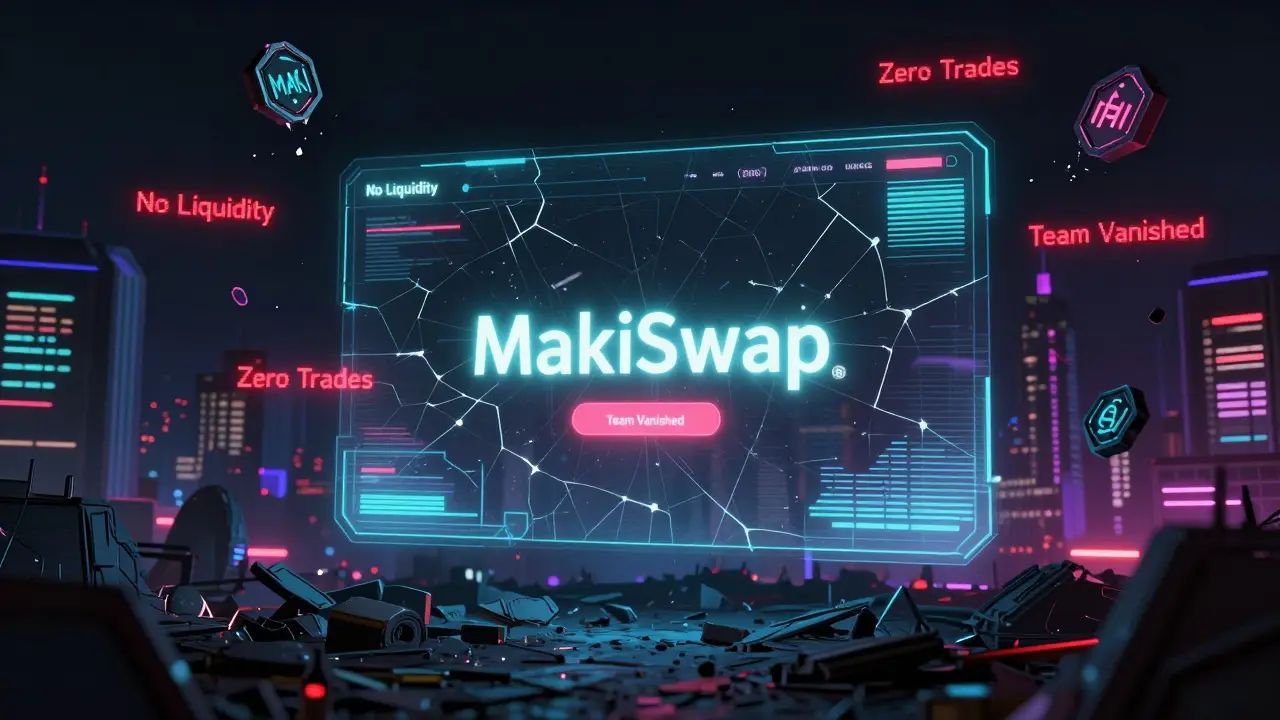
When you hear the name MakiSwap, you might think of a fresh, fast, and cheap way to trade crypto on the Huobi Eco Chain. But here’s the truth: as of March 2026, MakiSwap isn’t just inactive - it’s effectively dead. No trades. No liquidity. No updates. Just a token worth pennies and a website that looks like it’s waiting for someone to shut it down.
What MakiSwap Actually Is (And Isn’t)
MakiSwap was launched in 2021 as a decentralized exchange (DEX) built on the HECO blockchain. Unlike centralized platforms like Binance or Coinbase, it didn’t hold your funds. You connected your wallet - MetaMask, Trust Wallet, or something similar - and swapped tokens directly through smart contracts. That’s the standard model for DEXs like Uniswap or PancakeSwap.
But here’s where it falls apart. MakiSwap never grew beyond a small group of early adopters. It never attracted real liquidity. It never added new features. And by late 2025, its trading volume dropped to $0.00. Zero. Not $10,000. Not $100. Nothing. Not a single trade happened in 24 hours.
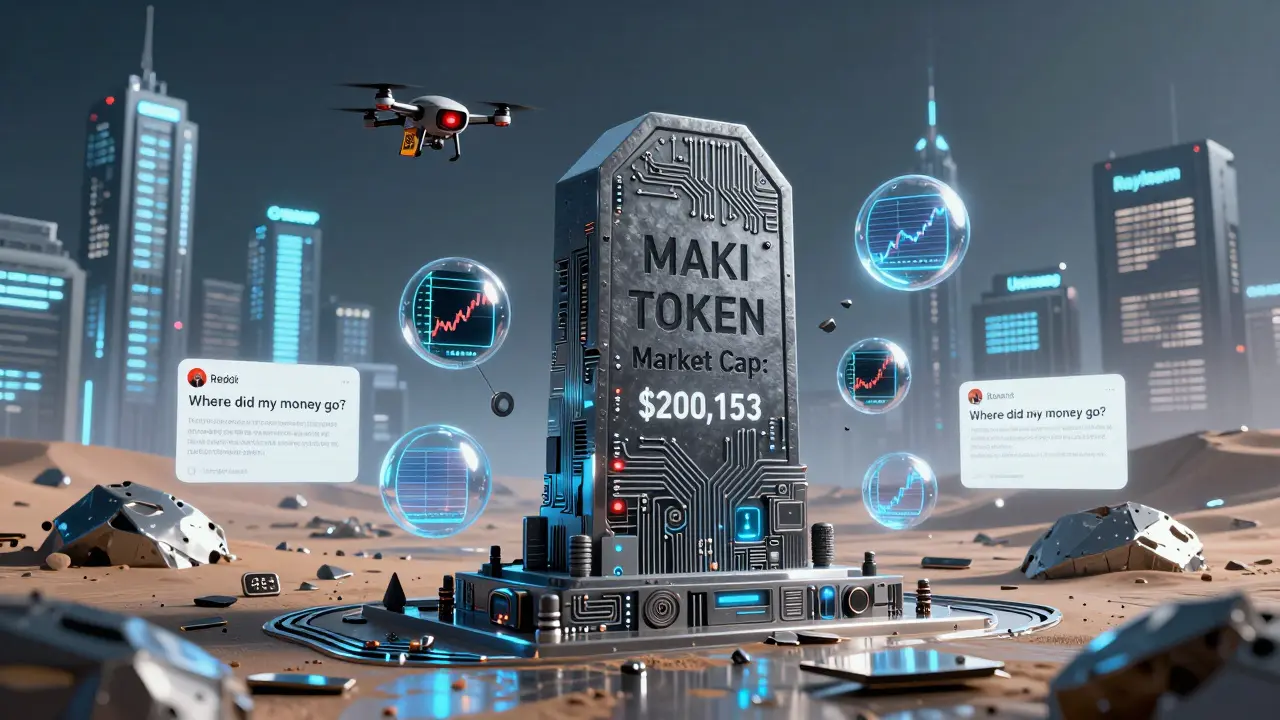
The native token, MAKI, was supposed to power governance and fee discounts. Today, it trades at around $0.0029. That’s down 99.76% from its peak. The total market cap? Just $200,153. For comparison, Uniswap’s UNI token has a market cap over $1 billion. PancakeSwap’s CAKE is worth more than $600 million. MakiSwap isn’t just behind - it’s irrelevant.
Why MakiSwap Failed
Three big reasons killed MakiSwap: isolation, neglect, and suspicion.
First, it was locked to HECO. HECO itself is a niche blockchain with less than 1% of total DeFi activity. Most traders use Ethereum, BSC, or Solana. If you’re not on one of those, you’re fighting an uphill battle. MakiSwap didn’t offer cross-chain bridging. It didn’t integrate with other DeFi protocols. It didn’t even have a mobile app. You were stuck on one chain with no way out.
Second, the team vanished. The last major update was in 2021. No blog posts. No GitHub commits. No Twitter updates. No Discord activity. The Unilayer team, which supposedly built it, hasn’t said anything in years. When a project goes silent like that, it’s not a pause - it’s an exit.
Third, users are warning each other it’s a scam. WikiBit, a major crypto review site, labeled MAKI as an "air coin project" and flagged it as a potential Ponzi scheme. Why? Because early investors were promised high yields from liquidity mining - but the rewards dried up, and no one could withdraw funds. Reddit threads are full of people asking: "Where did my money go?" and "Why won’t they respond?"
The Numbers Don’t Lie
Let’s look at the data - because numbers don’t lie.
- Trading volume (24h): $0.00
- Active trading pairs: 0
- MAKI token price: $0.0029 (down 99.76% from ATH)
- Circulating supply: 68,971,000 MAKI
- Market cap: $200,153
- Alexa rank: #1,469,379 (meaning almost no one visits the site)
- TVL (Total Value Locked): $0
- Customer support: Non-existent
Compare that to PancakeSwap: over $1 billion in TVL, 1,200+ trading pairs, 500,000+ daily users. MakiSwap doesn’t just lose - it doesn’t even show up on the scoreboard.

What Happens If You Try to Use It Now?
Let’s say you’re curious. You connect your wallet. You try to swap ETH for MAKI. What happens?
First, you need to bridge your funds to HECO. That costs gas fees on Ethereum and another fee on HECO. Then you find the MakiSwap interface - which hasn’t changed since 2021. You select your tokens. You click swap. The transaction goes through… but nothing happens. No tokens arrive. No confirmation. The pool has zero liquidity. The trade can’t execute.
Or worse - you try to add liquidity. You deposit $100 worth of tokens. The platform says you’re earning yield. But when you check your balance next week? It’s gone. No one responds to your support ticket. No one answers your email. The smart contract code? Never audited. No one knows if it’s safe.
And here’s the kicker: since MakiSwap is non-custodial, you’re fully responsible. If you lose your private key? Your money is gone forever. If the contract has a bug? Your funds are stuck. There’s no customer service. No refund policy. No legal recourse.
Who Should Avoid MakiSwap?
If you’re new to crypto - avoid it. You don’t need the added risk of a dead platform.
If you’re looking for yield farming - avoid it. There’s no liquidity to farm. No rewards to claim.
If you’re holding MAKI - consider selling. Even if you take a loss. The projections from WalletInvestor, PricePrediction, and TradingBeast all point downward. No one expects a rebound. The smart money left years ago.
If you’re trying to trade HECO tokens - use a real DEX. HECO has other exchanges with real volume. Why risk your money on a ghost platform?
What’s the Real Lesson Here?
MakiSwap isn’t a failed crypto project. It’s a warning.
Too many crypto projects launch with flashy websites, whitepapers, and promises. They attract early investors with high APYs. Then they disappear. The token crashes. The website stays up - but it’s just a digital tombstone.
The best DEX platforms - Uniswap, PancakeSwap, Curve - didn’t win because they had the fanciest UI. They won because they had:
- Real users trading every day
- Deep liquidity pools
- Active development teams
- Transparent audits
- Community governance
MakiSwap had none of that.
Don’t fall for the hype. Don’t chase the 100x. If a platform has zero trading volume, zero updates, and zero support - it’s not a project. It’s a graveyard.
What Should You Use Instead?
If you want to trade crypto without a middleman, go with what works:
- Uniswap (Ethereum) - The OG DEX. Highest liquidity. Most tokens.
- PancakeSwap (BSC) - Low fees. High volume. Active community.
- Raydium (Solana) - Fast, cheap, growing fast.
- Curve (Ethereum) - Best for stablecoin swaps.
All of these have real traffic, real teams, and real audits. MakiSwap has none.
Is MakiSwap still operational in 2026?
No. As of March 2026, MakiSwap has zero trading volume, zero active pairs, and zero development activity. The platform is effectively dead. No trades occur, no liquidity exists, and the team has not communicated since 2021.
Can I still withdraw my funds from MakiSwap?
Technically, yes - if you still have tokens in your wallet connected to the platform. But if you deposited funds into MakiSwap’s liquidity pools or staking contracts, you may not be able to withdraw them because the pools are empty. There is no customer support to help you. You’re on your own.
Is MAKI token a scam?
Multiple crypto review platforms, including WikiBit, have flagged MAKI as a potential Ponzi scheme due to overwhelming user complaints about unrecoverable funds and lack of transparency. The token has lost 99.76% of its value and shows no signs of recovery. Most analysts advise against holding or trading it.
Why did MakiSwap fail when other DEXs succeeded?
MakiSwap failed because it was limited to the HECO blockchain, which has minimal DeFi activity. It never added cross-chain support, never improved its interface, never audited its code, and never engaged its community. Meanwhile, competitors like Uniswap and PancakeSwap kept innovating, adding liquidity, and growing user bases. MakiSwap did none of that.
Should I invest in MakiSwap or the MAKI token?
No. All major price prediction platforms (WalletInvestor, PricePrediction.net, TradingBeast) forecast continued decline for MAKI. With zero trading volume, no development, and fraud allegations, there is no realistic upside. Investing now would be speculative at best and a total loss at worst.
Jamie Hoyle
March 3, 2026 AT 10:41Let me be the first to say it: MakiSwap didn’t fail because it was on HECO - it failed because the devs were lazy assholes who thought ‘build it and they will come’ was a strategy. No audits? No updates? No Discord mods? That’s not incompetence - that’s fraud with a website. And now people are still throwing money at it? Please. I’ve seen ponzi schemes with better UX.
Brian T
March 4, 2026 AT 05:17It’s funny how people treat crypto like it’s some kind of moral enterprise. Projects die. Markets shift. HECO was never meant to be a long-term player. MakiSwap was just the first to admit it. The real tragedy? People didn’t exit early enough. Not because they were stupid - because they hoped.
Nash Tree Service
March 5, 2026 AT 12:39One must consider the ontological implications of a decentralized exchange that has ceased to function as an exchange. The contract remains on-chain - yet its purpose has been nullified by human abandonment. Is it still a DEX? Or merely the ghost of one? A digital monument to hubris? One wonders if the smart contracts we deploy are not, in fact, graves for capital.
Jonathan Chretien
March 7, 2026 AT 06:25LOL imagine thinking MakiSwap was gonna beat Uniswap 😂
Denise Folituu
March 7, 2026 AT 19:57How many people lost their life savings on this? I’m not even mad - I’m heartbroken. This is why I don’t trust crypto anymore. People get greedy, devs vanish, and ordinary folks are left holding bags of digital dust. We need regulation. We need accountability. And we need to stop pretending this is ‘financial freedom.’
jack carr
March 9, 2026 AT 03:36I mean… I knew it was dead. But seeing the numbers laid out like this? Yeah. It’s a tombstone. Still, I kinda respect that they didn’t spin it into a ‘coming back’ narrative. Just left it. That’s honesty, I guess. 😅
Ken Kemp
March 10, 2026 AT 04:13Hey - I used MakiSwap back in 2022. I got burned, yeah. But here’s the thing: I learned. I started reading audits. I checked TVL before I deposited. I stopped chasing 500% APYs. This post? It’s not just a funeral - it’s a lesson. If you’re new, read this twice. Then read it again. You’ll thank me later.
Bill Pommier
March 11, 2026 AT 19:22The absence of customer support is not merely an operational failure - it is a systemic betrayal of fiduciary trust. The pseudonymous nature of blockchain does not absolve developers of ethical responsibility. When liquidity pools are rendered inert, and governance tokens are rendered worthless, the moral burden shifts from the investor to the architect. This is not market risk. This is negligence.
Ian Thomas
March 12, 2026 AT 12:48So… we’re supposed to feel bad for MakiSwap? The team didn’t even bother to say goodbye. No ‘thanks for playing,’ no ‘we’re pivoting,’ no ‘we’re out.’ Just… silence. That’s the real horror story. Not the $0.0029 token. The fact that no one cared enough to say ‘we failed.’
Josh Moorcroft-Jones
March 12, 2026 AT 15:43Let’s be real - MakiSwap wasn’t a DEX, it was a liquidity mining trap disguised as a DeFi platform. They didn’t build infrastructure; they built a Ponzi funnel. Early adopters got paid in MAKI tokens that were never meant to be worth anything - they were just bait to lure in more suckers. The entire model was designed to inflate volume artificially until the team cashed out. The fact that people still defend it? That’s the real tragedy. The cognitive dissonance required to believe this was ever legitimate? That’s what kills me.
Melissa Ritz
March 13, 2026 AT 17:20Ugh. I used to think crypto was about innovation. Now I just see people trying to make money off dumb people. MakiSwap? Classic. I’m just glad I got out before the rug pull. Honestly, if you’re still holding MAKI, you’re not an investor - you’re a martyr.
Emily Pegg
March 14, 2026 AT 08:26My cousin lost $8k on this. He still checks the site every day like it’s gonna wake up. I sent him this article. He didn’t reply. I think he’s in denial. 😔
Ethan Grace
March 14, 2026 AT 18:04It’s not about the money. It’s about trust. We gave our private keys to a black box. We trusted code. But code doesn’t care. And when the people behind it vanish? That’s when you realize - crypto doesn’t protect you. It just makes it easier to disappear.
Shawn Warren
March 16, 2026 AT 01:59Stop wasting time on dead projects. The future is in real infrastructure. Real teams. Real audits. Real users. MakiSwap is a footnote. Move on. Build something better.