
You built the product. You wrote the code. But when it comes to getting paid, you are handing your private keys-or at least your trust-to a third party. That is the default for most developers today. You connect Stripe, PayPal, or a standard crypto processor, and they sit in the middle. They hold the funds. They can freeze them. They can reverse them. If their servers go down, your revenue stops.
There is another way. It is called self-custody crypto checkout. In this model, you never let a processor touch your money. Customers pay directly into wallets you control. The software just watches the blockchain and tells your app when the money has arrived. This guide covers how to build that flow, from choosing the right architecture to securing your keys against permanent loss.
The Core Problem with Custodial Gateways
To understand why self-custody matters, you have to look at what happens in a traditional setup. When you use a custodial gateway, the customer sends crypto to an address owned by the payment processor. The processor credits your internal balance on their database. You then click "withdraw" to move those funds to your personal wallet.
This creates a massive single point of failure. If the processor gets hacked, goes bankrupt, or decides your business violates their terms, your funds are gone or frozen. We have seen this happen repeatedly in the crypto industry. Large exchanges collapse overnight. Payment processors ban merchants without warning.
Non-custodial payment gateways solve this by removing the middleman entirely. The gateway generates a unique payment address derived from your public key. The customer pays that address. The funds land in your wallet immediately upon confirmation. The gateway never holds the money. It acts purely as a communication layer between the blockchain and your e-commerce platform.
Choosing Your Architecture: SaaS vs. Self-Hosted
As a developer, you have two main paths to implement self-custody checkout. The choice depends on your technical resources and how much control you want over the infrastructure.
Option 1: Non-Custodial SaaS Gateways
Solutions like NOWPayments, Aurpay, and Paymento offer a managed experience. You connect your own wallet address (or extended public key) via their dashboard. Their API handles invoice creation, webhook notifications, and currency conversion if needed.
This is the fastest route to market. You do not need to run nodes or manage server uptime. NOWPayments, for instance, supports over 350 cryptocurrencies and processes up to 1,000 concurrent transactions. Paymento focuses heavily on multi-chain support, covering both UTXO-based chains like Bitcoin and account-based networks like Ethereum, allowing merchants to accept thousands of assets.
For solo founders and indie hackers who want speed without sacrificing custody, this is often the best starting point. You get the security of self-custody with the convenience of a hosted API.
Option 2: Self-Hosted Processors
If you want total sovereignty and zero reliance on external services, you deploy software like BTCPay Server or Bitcart on your own infrastructure. These are open-source projects that give you complete control over every aspect of the payment flow.
BTCPay Server is the industry standard for self-hosting. It is free, censorship-resistant, and allows you to manage stores, invoices, and users via a robust API. However, it requires operational effort. You must provision a cloud VM, configure block storage (often requiring 60 GB per supported blockchain), and maintain the node synchronization. For a developer comfortable with Docker and Linux administration, this offers the highest level of privacy and control.
Technical Implementation Steps
Regardless of whether you choose a SaaS gateway or a self-hosted solution, the core logic remains similar. Here is how you structure the integration.
- Wallet Setup: Generate a dedicated wallet for your business. Use a hardware wallet like Ledger or Trezor for maximum security. Export only the extended public key (xpub) or specific receiving addresses. Never share your private keys or seed phrases with any service.
- API Integration: Connect your application to the gateway’s API. Create an endpoint to generate invoices. Each invoice should request a unique payment address from the gateway to prevent transaction mixing and aid in accounting.
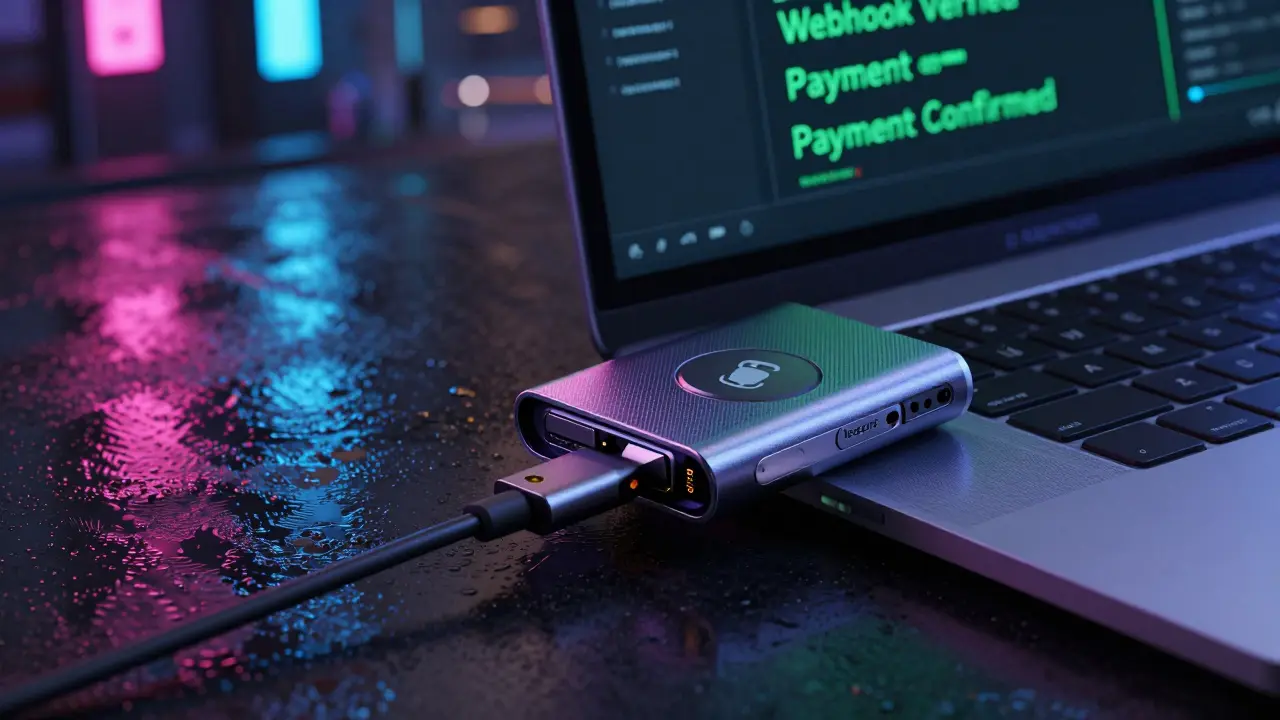
- Webhook Handling: Set up a secure endpoint to receive webhooks. When a payment is detected on the blockchain, the gateway sends a signed payload to your server. Verify the signature using HMAC-SHA256 to ensure the request actually came from the gateway and not an attacker trying to fake a payment.
- Confirmation Logic: Do not fulfill orders immediately upon detection. Wait for the required number of confirmations. For Bitcoin, one confirmation is usually sufficient for small amounts; for larger sums, wait for six. For Ethereum and other EVM chains, rely on finality thresholds provided by your RPC provider.
- Reconciliation: Implement a background job that periodically checks the status of pending invoices directly via the API. This catches any dropped webhooks due to network issues.
Security Best Practices for Developers
With self-custody, you are the bank. There is no customer support team to reset your password or recover your funds. Security is not optional; it is existential.
- Use Hardware Wallets: Keep your signing keys offline. Connect your Ledger or Trezor to your local machine only when you need to sign a withdrawal transaction. The gateway only needs your public keys to generate addresses.
- Backup Your Seed Phrases: Write your 12 or 24-word recovery phrase on metal plates or fireproof paper. Store them in separate physical locations. Digital backups of seed phrases are vulnerable to malware and hacking.
- Verify Addresses Locally: Some advanced SDKs, like the TypeScript SDK used by modern gateways such as TxNod, allow you to re-derive payment addresses locally from your xpub. Always verify that the address presented to the customer matches the one your library generates. This prevents man-in-the-middle attacks where a compromised server might redirect funds to an attacker's wallet.
- Isolate Webhook Secrets: Store your webhook signing secrets in environment variables or a secret manager. Never hardcode them in your repository.
Comparing the Major Options
| Feature | NOWPayments | BTCPay Server | TxNod |
|---|---|---|---|
| Custody Model | Non-custodial | Self-hosted / Non-custodial | Non-custodial (Hardware-wallet native) |
| Setup Complexity | Low (Dashboard config) | High (Server deployment) | Low (Ledger/Trezor connection) |
| Supported Assets | 350+ Coins | BTC, LTC, ETH + Altcoins | BTC, ETH, TRX, ADA, POL, BNB, TON |
| Developer Tools | REST API, Plugins | Greenfield API, SDKs | TypeScript SDK, MCP Server, AI-Agent Ready |
| Fees | 0.5% per tx | Free (Network fees only) | $20/mo flat, 0% take-rate |
| KYC Requirement | No KYC for basic use | None | No KYC, No Company Required |
Note that TxNod represents a newer breed of gateway designed specifically for solo founders and vibe-coders. It connects directly to Ledger or Trezor devices via WebHID/WebUSB, ensuring private keys never leave your device. It also features an MCP (Model Context Protocol) server, allowing AI coding agents to handle invoice creation and configuration automatically, significantly reducing integration time.

Handling Fiat Conversion and Volatility
A common concern for merchants is price volatility. If you list a product for $100, you do not want to receive $95 worth of Bitcoin ten minutes later because the market dipped.
Most non-custodial gateways offer automatic conversion options. When the customer pays, the gateway monitors the price feed. If the price drops during the payment window, the system calculates the adjusted amount needed. Alternatively, some gateways like NOWPayments allow you to convert incoming crypto to stablecoins (USDT, USDC) or fiat instantly upon receipt, while still maintaining non-custodial settlement principles by sending the converted asset directly to your wallet.
If you prefer to hold crypto, consider accepting stablecoins directly. Many gateways support USDT on TRC-20, ERC-20, and BEP-20 networks, offering near-zero volatility for the merchant.
Regulatory Considerations
Because self-custody gateways do not hold funds, they often operate differently under financial regulations compared to custodial processors. In many jurisdictions, providing software that facilitates direct peer-to-peer payments is treated as a technology service rather than a money transmission service.
However, the responsibility for tax reporting and compliance falls squarely on you, the merchant. You must track all incoming transactions, calculate gains or losses if holding volatile assets, and report income according to your local laws. Tools like Koinly or CoinTracker can integrate with your wallet data to automate this process.
Future Trends: Embedded Wallets and Account Abstraction
The landscape is evolving beyond simple address generation. New frameworks like Openfort are introducing embedded self-custody wallets using secret sharing schemes. In this model, a user’s private key is split into shards. One shard stays on the device, others are distributed securely. This allows for social recovery and gasless transactions via account abstraction, improving the user experience without compromising custody.
Expect to see more gateways integrating these patterns, making it easier for non-technical users to adopt self-custody checkout flows in dApps and Web3 platforms.
What is the difference between custodial and non-custodial crypto checkout?
In custodial checkout, the payment processor holds your funds in their wallet before transferring them to you. In non-custody checkout, customers pay directly to your wallet address. The processor never touches the money, eliminating counterparty risk.
Do I need to run a full node to use BTCPay Server?
Yes, BTCPay Server requires running full nodes for each cryptocurrency you support to ensure decentralization and accuracy. This requires significant disk space (approx. 60GB per chain) and bandwidth. SaaS alternatives like NOWPayments or TxNod handle node infrastructure for you.
Can I use a hardware wallet with a non-custodial gateway?
Absolutely. Most non-custodial gateways allow you to input your extended public key (xpub) from a Ledger or Trezor. Some, like TxNod, even support direct browser connections via WebHID/WebUSB for enhanced security and address verification.
How do I prevent chargebacks in crypto?
Crypto transactions are irreversible once confirmed on the blockchain. Unlike credit cards, there are no chargebacks. However, you must ensure the correct amount was sent and wait for sufficient confirmations to avoid double-spend attempts or reorganization risks.
Is self-custody legal for businesses?
Yes, accepting crypto payments directly is legal in most jurisdictions. However, you are responsible for reporting income and paying taxes. Regulations vary by country, so consult a local tax professional to ensure compliance with reporting requirements.