
Imagine earning yield on your crypto while building a digital empire in ancient Greece. That’s the pitch behind SpartaDEX, a hybrid platform that launched in 2023 to solve one of decentralized finance's biggest headaches: keeping liquidity providers engaged. Most users dump their tokens as soon as rewards dry up. SpartaDEX tries to fix this by turning passive liquidity provision into an active strategy game where your financial returns depend on how well you manage your virtual city-state.
But does mixing video games with high-stakes trading actually work? Or is it just a gimmick that distracts from poor liquidity depth? As someone who has tested various Arbitrum-based exchanges, I dug into the mechanics, the risks, and the real user experiences to see if SpartaDEX deserves a spot in your portfolio. Here is what you need to know before connecting your wallet.
What Exactly Is SpartaDEX?
SpartaDEX (often called "Sparta") is a decentralized exchange (DEX) that integrates a real-time strategy game set in ancient Greece. Unlike traditional DEXs like Uniswap, where you simply swap tokens or provide liquidity, SpartaDEX requires you to mint a non-fungible token (NFT) called a Polis. This Polis represents your city-state. Its development level directly impacts your earnings. The higher your Senate level, the more APR you earn from staking your liquidity provider (LP) tokens. At maximum levels, this can boost yields by up to 33.3%.
The platform operates exclusively on the Arbitrum blockchain, a Layer-2 scaling solution for Ethereum. This choice keeps transaction fees low, averaging around $0.10-$0.50 per swap, compared to the $10+ fees often seen on mainnet Ethereum during congestion. Founded by an anonymous team incorporated in Estonia, SpartaDEX positions itself as the first gamified DEX on Arbitrum. It aims to leverage behavioral economics to retain users who would otherwise leave after claiming initial rewards.
How the Gamification Mechanics Work
You might wonder, "Do I actually have to play a game to trade?" The answer is nuanced. You don't play to swap tokens-you use standard DEX interfaces for that. However, to maximize your returns as a liquidity provider, you must engage with the game. Here is the core loop:
- Mint a Polis NFT: You start by creating a free Polis NFT. This acts as your profile and records your progress.
- Provide Liquidity: You must deposit at least $100 worth of assets into whitelisted pools (like WETH/USDC.e). This is your "investment capital."
- Develop Your City: Use in-game resources to upgrade your Polis. Higher Senate levels unlock better reward multipliers.
- Defend Against Raids: Other players can attack your city. If you neglect your military upgrades, you lose resources. This forces regular engagement.
This structure creates a self-reinforcing ecosystem. Gaming activity generates transaction fees for the exchange, while the game mechanics incentivize users to keep their funds locked in liquidity pools longer than they would on a standard DEX. According to internal metrics, most users spend 3-5 hours completing the onboarding process, which involves learning both DeFi basics and Greek city-building strategies.
Tokenomics: SAS and SPARTA Tokens
SpartaDEX uses a dual-token system, which can be confusing for newcomers. Understanding the difference between these two is critical for managing your expectations.
| Attribute | SAS Token | SPARTA Token |
|---|---|---|
| Primary Function | Governance and Utility | Reward Distribution |
| Total Supply | Variable (based on emissions) | Capped at 1 Billion |
| Use Case | Voting on proposals, fee discounts | Paid to liquidity providers and gamers |
| Circulating Supply (Q3 2023) | N/A | ~5.3 Million |
The SPARTA token is what you’ll mostly interact with if you are providing liquidity. It serves as the reward currency. Because its circulating supply was relatively low in early stages, price volatility can be significant. Early adopters reported earning decent APYs, but these numbers fluctuate based on total value locked (TVL) and trading volume. The SAS token is less about direct profit and more about having a say in the platform’s future direction.
Liquidity and Trading Volume: The Reality Check
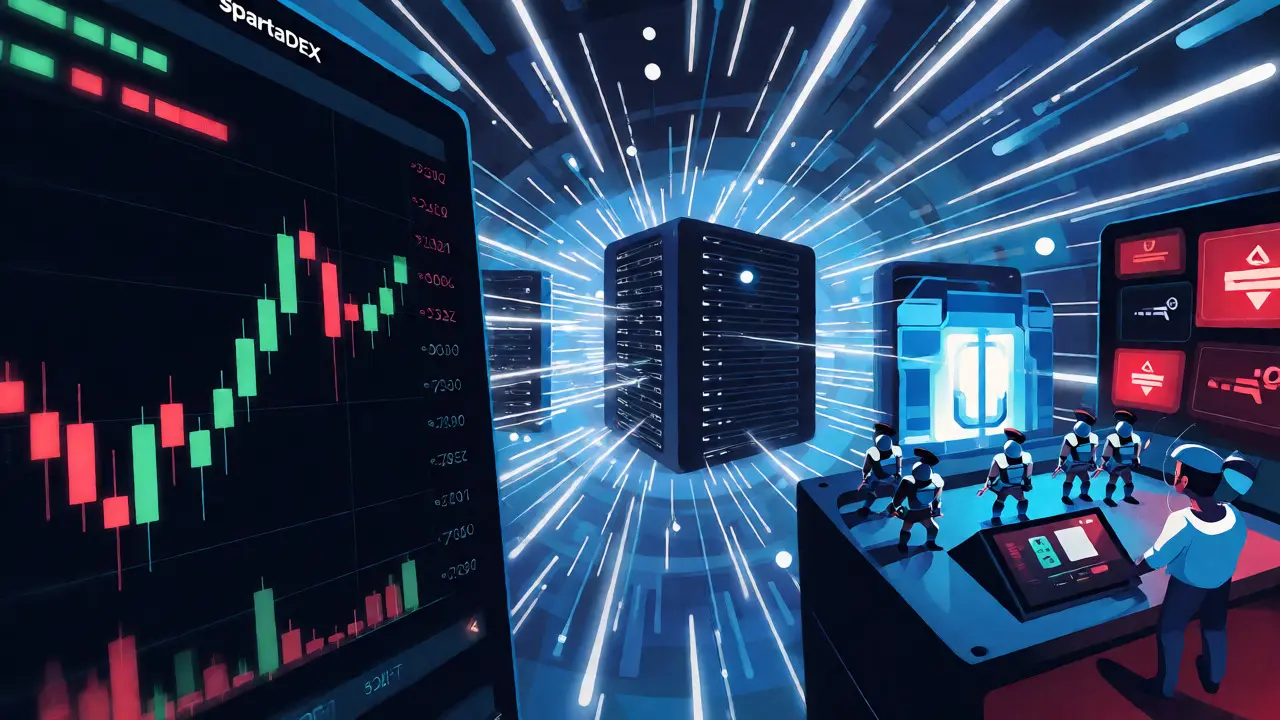
Here is where things get tricky. While the concept is innovative, the actual market data tells a story of a niche player struggling against giants. As of late 2023, SpartaDEX generated approximately $488,000 in daily trading volume. Compare this to Uniswap, which processes over $1 billion daily, or even smaller competitors, and the gap becomes obvious.
This low volume has practical consequences for you as a trader:
- Slippage Risk: With only 8 active trading pairs listed, large swaps can move the price significantly. If you try to trade $10,000 worth of ETH, you might face noticeable slippage.
- Limited Asset Selection: You won’t find the thousands of altcoins available on other platforms. SpartaDEX focuses on major assets like WETH, USDC, and WBTC. If you’re looking for obscure memecoins, this isn’t the place.
- Order Book Depth: Data shows SpartaDEX sits in the 40th percentile for order book depth. This means there aren’t enough buyers and sellers at any given price point to absorb large institutional trades without impact.
Essentially, SpartaDEX is not built for high-frequency traders or whales moving millions. It is designed for retail users willing to lock up moderate amounts of capital ($100-$1,000) to participate in the game economy.
User Experience and Community Feedback
I analyzed reviews from Reddit, Trustpilot, and Twitter to gauge real-world sentiment. The feedback is polarized, which is typical for experimental DeFi products.
The Positives:
Many users praise the "addictive" nature of the gameplay. One Redditor noted earning $127 in rewards during their first month by dedicating just 20-30 minutes daily to manage their Polis. For people who find traditional DeFi boring, the game layer adds a compelling reason to check in regularly. The community Discord, with over 12,000 members, remains active with strategy discussions.
The Negatives:
Customer support response times average 72 hours, which is frustrating when funds are involved. Some beginners complained about the $100 minimum liquidity requirement, stating they lost money to impermanent loss before fully understanding the mechanics. Additionally, gas fees on Arbitrum, while low, still add up during peak gaming hours, eating into small profits.
Security and Risks
Never invest more than you can afford to lose in new DeFi protocols. SpartaDEX faces specific risks that differ from established exchanges.
- Smart Contract Vulnerabilities: Security researcher Alexei Volkov from CertiK warned that integrating complex game logic with financial contracts increases the attack surface. As of recent audits, some contract details remained unclear to the public. Always verify audit reports before depositing large sums.
- Impermanent Loss: Standard DEX risk applies here. If the price of ETH moves significantly against USDC while you are providing liquidity, you could end up with less value than if you had just held the tokens.
- Regulatory Uncertainty: The SEC has recently scrutinized whether governance tokens qualify as securities. SPARTA’s classification remains ambiguous, posing potential legal risks for US-based investors.
- Team Anonymity: The founding team is anonymous. While common in crypto, it reduces accountability if issues arise.

Who Should Use SpartaDEX?
SpartaDEX isn’t for everyone. It fits a specific profile of crypto user.
| User Type | Recommendation | Reason |
|---|---|---|
| Casual Gamer/Investor | Yes | Enjoys strategy games; wants higher yield through engagement. |
| Active Trader | No | Needs deep liquidity, advanced charts, and wide asset selection. |
| Institutional Whale | No | Low volume causes too much slippage for large orders. |
| DeFi Beginner | Maybe | Learning curve is steep; requires understanding both DeFi and game mechanics. |
If you already hold ETH or stablecoins and want to diversify your yield farming strategy, allocating a small portion (e.g., 5-10%) to SpartaDEX could be worthwhile. Just ensure you understand the game rules before locking up funds.
Future Outlook and Roadmap
SpartaDEX announced plans to expand beyond Arbitrum, targeting cross-chain compatibility with Optimism and Base in early 2024. They also introduced AI-powered strategy advisors to help new users navigate the complex mechanics. The long-term success depends on hitting 50,000 daily active users-a ambitious target given current adoption rates of ~8,000 weekly active wallets.
Analysts are split. Some predict significant token appreciation if the GameFi trend continues, while others estimate only a 38% probability of maintaining top-tier status due to fierce competition from larger ecosystems like Yield Guild Games and Illuvium.
Is SpartaDEX safe to use?
SpartaDEX operates on the secure Arbitrum blockchain, but all DeFi platforms carry smart contract risks. The integration of game mechanics adds complexity, potentially increasing the attack surface. Users should check for recent third-party audits and avoid depositing funds they cannot afford to lose. There is no insurance fund comparable to centralized exchanges.
What is the minimum investment required?
To begin playing and earning enhanced rewards, you generally need to provide a minimum of $100 in liquidity to whitelisted pools. This allows you to mint your Polis NFT and start developing your city. Without this liquidity provision, you cannot access the full gamified yield benefits.
Can I trade coins not listed on SpartaDEX?
No, you can only trade assets listed in the active pools. Currently, SpartaDEX supports a limited number of pairs, primarily involving major assets like WETH, USDC, and WBTC. It does not offer the extensive list of altcoins found on larger DEXs like Uniswap or PancakeSwap.
How do I withdraw my funds?
You can withdraw your liquidity and claimed rewards at any time. However, withdrawing liquidity may reset certain in-game progressions depending on the duration of your commitment. Always check the specific pool terms, as some may have vesting periods for bonus rewards.
Is SpartaDEX available in the USA?
As a decentralized protocol, SpartaDEX is technically accessible globally via web3 wallets. However, regulatory restrictions regarding the SPARTA token's classification as a security may affect US users. Consult local regulations before participating, as the SEC's stance on DeFi tokens is evolving.
Final Verdict
SpartaDEX offers a refreshing take on liquidity mining by making it interactive. If you enjoy strategy games and want to experiment with a novel DeFi mechanism, it provides a unique opportunity to earn yield while playing. However, it lacks the liquidity depth and asset variety of industry leaders. Treat it as a speculative addition to your portfolio rather than a primary trading venue. Keep your position sizes small until the platform proves its long-term viability and security robustness.