
When you place a trade on a crypto exchange, you’re not just clicking a button-you’re interacting with a living, breathing system called the order book. It’s the invisible backbone of every trade, and whether it’s thick or thin can make the difference between a smooth transaction and a costly mistake. Most traders don’t think about it until they get slapped with slippage, or their $10,000 buy order ends up costing $10,500. That’s not a glitch. That’s the order book telling you it’s too thin to handle your size.
What Exactly Is an Order Book?
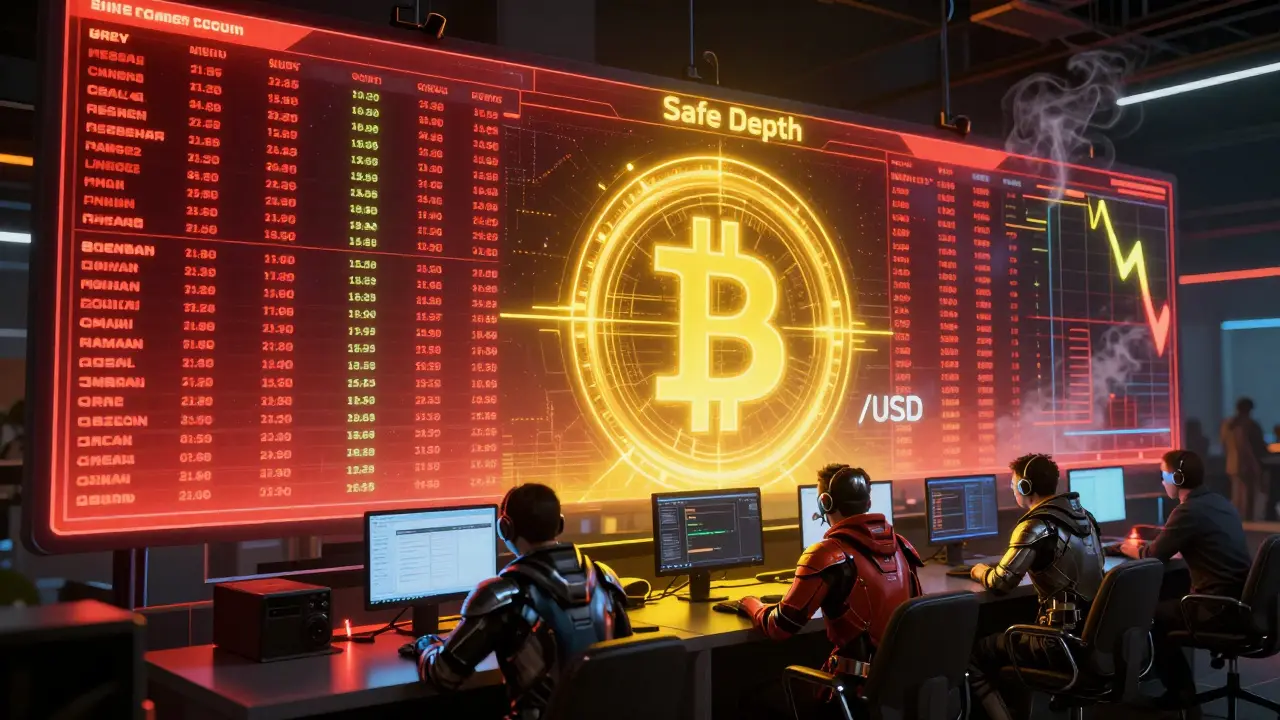
An order book is a live list of all buy and sell orders for a specific asset, sorted by price. On the left, you see bids-the prices people are willing to pay to buy. On the right, asks-the prices sellers want. The closer these two sides are, the tighter the spread. The more volume stacked at each level, the deeper the book. Think of it like a supermarket shelf. A thick order book is like a Walmart aisle full of cans-plenty of stock, easy to grab a dozen without running out. A thin order book is like a corner store with three cans left. If you try to buy two, the price jumps because there’s barely any supply.Thick Order Books: The Gold Standard
A thick order book means there’s a lot of money sitting at multiple price levels. For major pairs like BTC/USD on Binance or Coinbase, you’ll often see millions of dollars worth of buy and sell orders within just 1% of the current price. This is what institutional traders look for. Here’s what thick order books deliver:- Tight spreads: Often under 0.05%-meaning you buy at $68,000 and sell at $68,003, not $68,000 and $68,500.
- Low slippage: A $1 million BTC trade might move the price by only 0.1%. That’s barely a blip.
- Fast execution: Orders fill in milliseconds because there’s enough volume to match you instantly.
- Stable prices: Even during news spikes, thick books absorb shocks. Prices don’t panic-jump.
Thin Order Books: The Wild West
Now flip the script. A thin order book has barely any volume. For a low-cap coin like SHIB/USD or a lesser-known altcoin on a smaller exchange, you might see only $50,000 total across all buy and sell orders within 1% of the price. That’s not enough to handle even a modest trade. What happens when you trade in a thin book?- Wide spreads: Bid-ask spreads can blow out to 2% or more. You buy at $0.000012 and immediately the price drops to $0.000011.
- Massive slippage: A $100,000 buy order on a thin market can push the price up 5%, 10%, even 20%. You end up paying way more than you planned.
- Slow fills: Your order might sit for seconds or minutes while the system hunts for buyers or sellers.
- Extreme volatility: A single large order can trigger a cascade. That’s why thin markets see 300% more extreme price swings than liquid ones.
Real-World Impact: Your Trade, Your Loss
Let’s say you want to buy $500,000 worth of BTC. On Binance during U.S. market hours, you’ll likely get filled with only 0.12% slippage. That’s $600 extra. Acceptable. Now try that same trade at 3 a.m. UTC, when Asian liquidity dries up. The order book thins out. Suddenly, your $500,000 buy order pushes the price up by 0.85%. Now you’re out $4,250 before the trade even settles. That’s not a bad trade. That’s a bad time to trade. The same thing happens on small exchanges. BitMart, for example, has a 3.2/5 rating on Trustpilot. Why? Because 28% of negative reviews mention “slippage issues during large trades.” Meanwhile, Binance’s 4.6/5 rating? Over half of the positive reviews mention “deep liquidity.”
How to Spot a Thick vs Thin Order Book
You don’t need a PhD to read this. Most exchanges show a depth chart-sometimes called a market depth graph. Here’s how to read it:- Look at the bars: Tall green bars on the buy side? Thick book. Tiny red bars on the sell side? Thin book.
- Check the cumulative volume: If the total volume within 1% of the current price is under $100,000, it’s thin. Above $5 million? Thick.
- Watch the spread: A spread wider than 0.5% on a coin with over $100 million daily volume? Red flag.
- Use heatmaps: Some platforms color-code volume density. Bright yellow = lots of orders. Dark blue = ghost town.
Why Thin Markets Still Exist (and Why Traders Use Them)
It’s not all bad. Thin markets aren’t broken-they’re just different. Experienced traders use them deliberately. Some traders target thin markets because:- Big moves happen faster: A small buy order can spike a low-cap coin 10% in minutes. That’s leverage.
- Less competition: No bots, no institutions. Just retail players chasing momentum.
- Low entry cost: You can buy a $10,000 position without moving the price.
Strategies for Thick vs Thin Markets
Your strategy should change based on the book. For thick markets:- Use limit orders. You’ll get better fills than market orders.
- Trade during peak hours: 8 a.m. to 12 p.m. EST for crypto.
- Break large orders into chunks. A $1 million trade? Split it into 10 x $100k orders over an hour.
- Use TWAP (Time-Weighted Average Price) algorithms if your platform supports them. They auto-spread your order over time to minimize impact.
- Avoid market orders. Always use limit orders.
- Don’t trade during off-hours. 2 a.m. to 6 a.m. UTC is the worst time.
- Only trade small amounts. If the order book can’t handle $50k, don’t put in $100k.
- Watch volume spikes. A sudden surge in buy orders might mean a pump is starting-but it could also be a trap.
The Hidden Danger: Fake Depth
Not all thick books are real. High-frequency trading bots can create the illusion of depth-placing and canceling orders in milliseconds. This is called “liquidity spoofing.” You see a big buy wall at $67,900. You move in. Then-poof-it vanishes. The price drops. You’re stuck. A 2023 University of Chicago study warned that HFT algorithms deepen the top of the book but leave the rest hollow. During stress, that fake depth evaporates. That’s why even thick markets can crash fast under pressure. The fix? Don’t just look at the top 3 levels. Check the depth 5%, 10%, even 20% away. If volume drops off sharply after the first few cents, you’re dealing with a shallow book pretending to be deep.What’s Changing in 2026?
The market is getting smarter. Binance now shows a “liquidity score” for every trading pair. Coinbase adjusts fees to reward market makers in thin markets. Amberdata’s real-time depth API is launching soon. The SEC is pushing for minimum liquidity thresholds. Gartner predicts that by 2026, the top 20 crypto pairs will control 85% of total market depth-up from 78% today. That means thin markets are getting thinner. The gap between liquid and illiquid assets is widening. If you’re still trading obscure coins with no volume, you’re not just taking risk-you’re betting against the entire market structure.Final Rule: Depth Is Safety
Thick order books don’t guarantee profits. But they guarantee you won’t get wrecked by slippage, bad fills, or sudden price dives. Thin books? They’re high-risk playgrounds. Fun for a while, but dangerous if you don’t know the rules. Here’s your checklist before every trade:- Is the bid-ask spread under 0.1%? If not, think twice.
- Is there at least $1 million in volume within 1% of the current price? If not, it’s thin.
- Are you trading during peak hours? If not, wait.
- Are you using limit orders? If not, stop.
What does a thick order book mean for crypto traders?
A thick order book means there’s a large volume of buy and sell orders clustered closely around the current price. This allows traders to execute large orders with minimal price impact, tight spreads, and fast fills. It’s the sign of a liquid, stable market-ideal for institutional traders and anyone moving significant capital.
How can I tell if an order book is thin or thick?
Look at the depth chart on your exchange. If the cumulative volume within 1% of the current price is under $100,000, it’s thin. If it’s over $5 million, it’s thick. Also check the bid-ask spread: under 0.05% is thick, over 1% is thin. Most platforms like Binance and TradingView show this visually with color-coded bars.
Why do thin order books cause slippage?
Thin order books have little volume at each price level. When you place a market order, the system fills it by matching with the next available orders-which may be far from the current price. This forces your trade to execute at worse prices, causing your total cost (or proceeds) to deviate from what you expected. A $100,000 trade in a thin market can easily move the price 3-5%.
Can I trade profitably in thin order books?
Yes-but only as a short-term, high-risk strategy. Some experienced traders target thin markets for quick pumps or dumps, using small positions and tight stop-losses. But 67% of traders who’ve lost money in crypto say it happened because they traded in thin markets without understanding the risks. Don’t treat them like liquid assets.
What’s the best time to trade for maximum order book depth?
For crypto, peak liquidity happens during U.S. market hours: 8 a.m. to 12 p.m. EST. That’s when North American and European traders are active, overlapping with Asia’s closing session. Avoid 2 a.m. to 6 a.m. UTC-liquidity drops by up to 40%, turning thick books thin.
Should I use market orders or limit orders?
Always use limit orders unless you’re certain the market is thick and fast-moving. Market orders guarantee execution but not price. In thin markets, they can cost you hundreds or thousands in slippage. Limit orders let you control your entry or exit price-critical for preserving capital.
Tracey Grammer-Porter
January 8, 2026 AT 22:53Been trading crypto for 5 years and this is the first time someone explained order books like a grocery store
Now it clicks why my small trades on Shiba Inu always cost me extra
Wish I’d known this before I lost $2k on a ‘quick pump’
jim carry
January 10, 2026 AT 06:06THICK ORDER BOOKS ARE JUST A CORPORATE LIE TO KEEP RETAIL TRADERS OUT
THEY WANT YOU TO THINK LIQUIDITY IS SAFE WHEN REALLY THEY’RE JUST MANIPULATING THE SPREAD WITH HFT BOTS
YOU THINK YOU’RE PROTECTED? YOU’RE JUST THE BAIT
Katrina Recto
January 10, 2026 AT 10:22Thin books are where the real action happens if you know how to read them
Most people panic when they see a 2% spread
I see opportunity
Mollie Williams
January 10, 2026 AT 21:50There’s something poetic about liquidity being the invisible insurance policy of the market
Like air-you don’t notice it until you’re gasping
And yet most traders treat it like a background metric instead of the foundation of survival
It’s not about winning trades-it’s about not being erased by them
Depth isn’t just volume-it’s patience made visible
And in a world obsessed with speed, the slowest markets are often the safest
Maybe that’s why the smartest traders are the quietest ones
greg greg
January 11, 2026 AT 15:59Okay so let me break this down even further because I think a lot of people are missing the nuance here
It’s not just about the total volume in the order book it’s also about the distribution of that volume across multiple price levels
Like if you have $10 million in total but it’s all stacked at one price point that’s actually more dangerous than having $2 million spread across 10 levels
Because if someone hits that single big wall it collapses like a house of cards
And then you get that flash crash effect where everything drops 10% in 3 seconds
And then the bots come in and scoop up all the panic sells
So it’s not just about quantity it’s about structure
And honestly most retail traders don’t even look past the top 3 levels
Which is like trying to judge a whole building by looking at the front door
And don’t even get me started on fake depth from spoofing
That’s not even trading that’s like playing poker with someone who’s cheating with a stacked deck
And the exchanges? They know it but they don’t care because they make money on volume not on fairness
So you’re basically on your own
Which is why I always use limit orders and never trade during off hours
And I always check the depth chart at least 5% away from the current price
Because if the volume drops off a cliff after 0.5% you’re not in a thick book you’re in a thin book wearing a tuxedo
LeeAnn Herker
January 13, 2026 AT 00:58Thick books? More like thick lies
They say it’s safe but it’s just the big boys playing keep-away with your money
And now the SEC wants to make it even worse with ‘minimum liquidity thresholds’
Like that’s going to help little guys
Newsflash: they’re just making it harder for us to play
Meanwhile the bots and hedge funds are laughing all the way to the bank
And you’re over here checking spreads like it’s a religion
Wake up
It’s all rigged
Denise Paiva
January 14, 2026 AT 10:34Order book depth is not a metric it is a social contract between market participants
When the volume evaporates the contract is broken
And those who ignore this are not victims of bad luck they are victims of ignorance
There is no such thing as a free lunch in markets only those who understand the table are invited to eat
Jacob Clark
January 16, 2026 AT 09:44Okay but have you considered that maybe the whole concept of order books is outdated??
Like why are we still relying on this 1980s tech when we have AI-driven predictive liquidity models now??
And don’t even get me started on how exchanges hide the real depth behind API delays!!
It’s insane that we’re still using visual depth charts like we’re in 2012!!
Also I’ve been using a custom script that scrapes the order book every 100ms and I can tell you 90% of the ‘thick’ books are fake!!
And the worst part? Nobody talks about this!!
Why is no one else talking about this??
Is it because the exchanges pay people to stay quiet??
Someone needs to expose this!!
Jon Martín
January 16, 2026 AT 17:25Y’all need to stop treating crypto like a casino
Thick books aren’t just about avoiding losses-they’re about staying in the game longer
And if you’re not using limit orders? You’re basically handing your money to the bots
Don’t be that guy who blames the market when you didn’t even read the manual
Go check your exchange’s depth chart right now
Yeah I’ll wait
Now ask yourself-am I trading with eyes open or blindfolded?
You got this
Jennah Grant
January 17, 2026 AT 13:41One thing I’ve learned from institutional traders: they don’t chase volatility-they chase predictability
And predictability comes from depth
That’s why you see them only in BTC, ETH, SOL
Not because they’re boring
But because they’re reliable
Thin markets are for gamblers
Thick markets are for builders
Dave Lite
January 17, 2026 AT 21:14Biggest tip I ever got: always check the depth chart before you even look at the price chart
90% of my losses happened because I skipped this step
Now I use TradingView’s depth tool religiously
And I always set limit orders at least 0.2% away from the current price
Also 🤝 if you’re trading under $100k, don’t even bother with coins under $50M daily volume
It’s not worth the headache
Staci Armezzani
January 18, 2026 AT 16:05I used to think slippage was just bad luck
Then I started tracking my trades and realized 80% of my losses came from thin markets
Now I have a checklist before every trade
Spread under 0.1%? Check
Volume over $1M within 1%? Check
Peak hours? Check
Limit order? Double check
It’s not glamorous but it’s saved me tens of thousands
And honestly? That’s the real win
Don Grissett
January 19, 2026 AT 12:18Thick book? More like thick scam
Who even cares about liquidity when you can just pump a coin with a tweet?
Real traders don’t wait for depth-they create it
And if you’re still using limit orders you’re playing chess while everyone else is playing Fortnite
Also why are you even on Reddit if you care about ‘slippage’?
Go buy a textbook
Meenakshi Singh
January 20, 2026 AT 19:41Bro this is basic
But the real danger is not thin books-it’s when you think you’re trading a thick book but it’s actually a spoofed one
Look at the 5% depth not the top 0.1%
And always check the trade history for sudden spikes
Also 🚨 if the order book looks too perfect it’s fake
Most retail traders die because they trust the pretty graph
Not the real data
Stay sharp 🧠
Kelley Ramsey
January 22, 2026 AT 03:10This is sooo helpful!! I literally just lost $800 last week because I didn’t check the depth!!
Now I’m gonna check every single time!!
Thank you for explaining it so clearly!!
Also I just started using TradingView and the depth chart is like magic!!
Can we all agree that liquidity is the real MVP??
Love this post so much!! 💖
Michael Richardson
January 22, 2026 AT 06:58Thick books are for cowards
Real traders thrive in chaos
Why wait for liquidity when you can create your own?
Also US markets are rigged anyway
Trade on Binance or GTFO
Sabbra Ziro
January 24, 2026 AT 06:10I just want to say thank you for writing this with so much care
It’s rare to see someone explain something technical without making people feel stupid
And you didn’t just list facts-you gave us a mindset
That’s what real teaching looks like
Keep doing this
Krista Hoefle
January 24, 2026 AT 08:47Thick book? Lmao
Just trade memecoins and call it a day
Who needs liquidity when you can get 100x?
Also why are you even here if you care about ‘slippage’
Go back to your ETFs
Kip Metcalf
January 24, 2026 AT 11:51Man I used to think order books were boring
Now I check them like a baseball scout
Thick book = chill vibes
Thin book = run for your life
And I only trade after 8am EST
Simple as that