
Trading crypto is easy, but doing it without a middleman is where things get interesting. Most people start with a centralized exchange, but if you want total control over your funds, you move to a Uniswap v3 is a decentralized exchange (DEX) protocol that uses an automated market maker model to let users swap tokens without a central authority. It's not just another swap tool; it's the engine that most of the DeFi world runs on. But with its complex "concentrated liquidity" and fluctuating gas fees, is it actually the best choice for you in 2026?
The Quick Rundown
- Best for: Users who prioritize self-custody and DeFi power users seeking high capital efficiency.
- The Big Win: Massive liquidity for major pairs, meaning less slippage and better prices.
- The Catch: High Ethereum mainnet fees and a steep learning curve for liquidity providers.
- Risk Level: Medium to High (due to MEV risks and impermanent loss).
How Uniswap v3 Actually Works
Forget traditional order books where buyers and sellers wait for a match. Uniswap uses an Automated Market Maker (AMM). Imagine a giant pool of tokens; you put one token in and take another out. The price is determined by a mathematical formula (x × y = k), which ensures there is always a price available, regardless of how many people are trading.
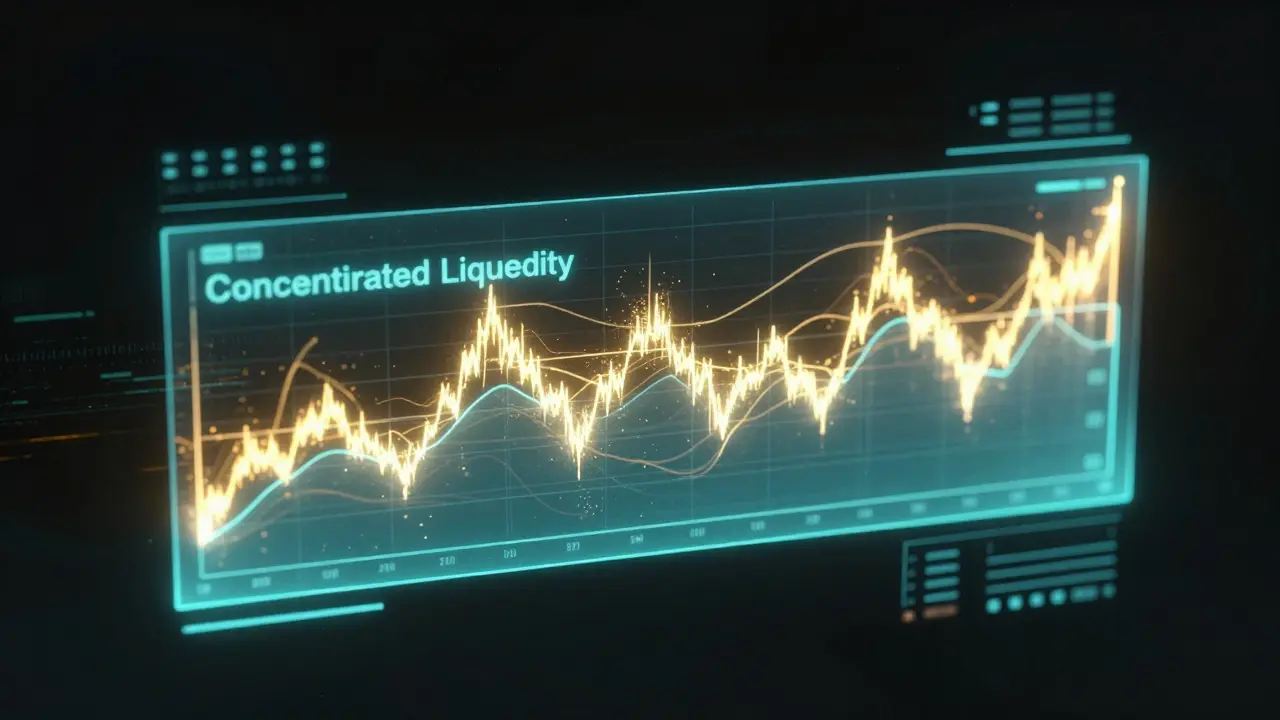
The real magic of v3, however, is Concentrated Liquidity. In older versions, your money was spread across every possible price from zero to infinity. That was wasteful. Now, you can pick a specific price range-say, between $2,200 and $2,800 for ETH-and put your money only there. If the price stays in that window, you earn way more fees. If it leaves the range, your liquidity goes inactive. This makes the protocol up to 4,000× more efficient than v2, which is why traders get such tight spreads on major pairs.
Trading Experience: The Good and the Bad
If you just want to swap one token for another, the experience is painless. You connect your wallet, pick your tokens, and hit swap. The interface is clean, and it automatically reads your wallet balances, so you aren't guessing how much you have. For basic swaps, you can be up and running in minutes.
However, if you're moving large sums, you'll encounter MEV (Maximal Extractable Value). This is where bots "sandwich" your trade to skim a bit of profit, which can cost you about 0.5% to 2% of your trade value. You also have to deal with slippage settings. If you set them too low, your trade might fail during high volatility, wasting your gas fee. If you set them too high, you might get a worse price than expected.
| Feature | Uniswap v3 | Curve | Balancer |
|---|---|---|---|
| Primary Focus | General Purpose / High Liquidity | Stablecoins | Custom Weights / Portfolios |
| Capital Efficiency | Extreme (via Concentrated Liquidity) | Very High (for stables) | Moderate |
| Complexity | Moderate to High | Medium | High |
| Best Use Case | ETH, BTC, USDC swaps | USDT/USDC swaps | Multi-asset index pools |
The Cost of Doing Business: Gas and Networks
One of the biggest hurdles is the cost. If you use the Ethereum Mainnet, you're going to pay. During busy times, a simple swap can cost anywhere from $1.50 to $15. For someone swapping $20 worth of a token, that's a dealbreaker.
Luckily, Uniswap has expanded to Layer-2 (L2) solutions. Using Arbitrum, Optimism, Base, or Polygon drops those costs significantly, often to between $0.02 and $0.50. If you're a retail trader, avoiding the mainnet is the only way to make the platform viable for smaller trades.
Making Money: The Liquidity Provider (LP) Game
Being an LP is where the real money is-and the real risk. You provide the tokens for others to trade, and in return, you earn a slice of the trading fees. You can choose from different fee tiers: 0.01%, 0.05%, 0.30%, or 1.00%. Low tiers are for stable pairs; high tiers are for the wild, volatile tokens.
But beware of Impermanent Loss. Because you're providing a range, if the price of a token skyrockets or crashes, you might have been better off just holding the tokens in your wallet. Some users have reported losing up to 17% of their position value because they picked the wrong price range. It's not a "set it and forget it" investment; you have to actively monitor your positions and adjust them as the market moves.
Governance and the UNI Token
The UNI Token isn't for trading; it's for power. Holding UNI allows you to vote on protocol upgrades and how the treasury is spent. While it's a powerhouse in the DeFi space, it's not without drama. The protocol has faced heat from the SEC regarding unregistered securities, but because the protocol is decentralized (meaning it's code on a blockchain, not a company in an office), it has a strong defense against traditional regulation.
The Final Verdict: Should You Use It?
Uniswap v3 is the gold standard for a reason. If you want the deepest liquidity and the most reliable execution for major crypto pairs, this is it. It's a powerhouse for those who understand the risks of MEV and impermanent loss. However, if you're just looking for a quick, cheap way to trade stablecoins, Curve might be a better fit. And if you're a complete beginner, spend a few hours learning about wallet approvals and slippage before putting a large amount of capital at risk.
What is the difference between Uniswap v2 and v3?
The main difference is concentrated liquidity. In v2, liquidity was spread across the entire price curve. In v3, providers can choose a specific price range for their capital, drastically increasing capital efficiency and reducing slippage for traders.
How do I avoid high gas fees on Uniswap?
The best way is to avoid the Ethereum mainnet. Switch your network to a Layer-2 solution like Arbitrum, Optimism, Base, or Polygon. This can reduce your transaction costs from over $10 down to a few cents.
What is slippage and how do I set it?
Slippage is the difference between the expected price of a trade and the actual price at which the trade executes. In high volatility, you may need to increase your slippage tolerance (e.g., to 0.5% or 1%) to ensure your trade goes through, but be careful not to set it too high or you'll lose money to the price gap.
Is Uniswap v3 safe for beginners?
For basic swapping, yes-it's very intuitive. However, providing liquidity is advanced. Beginners should avoid becoming LPs until they understand impermanent loss and how to manage price ranges, as it is easy to lose capital if the market moves against you.
What happens if the price moves outside my selected range?
If the market price exits your concentrated liquidity range, your position becomes inactive. You stop earning trading fees, and your liquidity is converted entirely into the less valuable of the two assets in the pair until the price returns to your range.
Robert Smith
April 26, 2026 AT 16:38L2s are a lifesaver 🚀💰
Abhishek Verma
April 26, 2026 AT 23:34Imagine actually thinking a "mathematical formula" makes this safe. Cute. It's basically a casino where the house is a bunch of MEV bots eating your lunch while you pretend to be a "DeFi power user."
Iestyn Lloyd
April 27, 2026 AT 02:45It is worth noting that while L2s reduce costs, the security model differs slightly from the mainnet. Most users find Arbitrum a balanced middle ground for liquidity and speed.
Tony Phan
April 27, 2026 AT 21:30Bro the slippage is absolute trash today! I'm getting absolutely wrecked by the sandwich bots. My bags are bleeding and I can't even exit the position because the gas is spiking again. This is pure pain man. Total liquidity drain on my mental health right now.
Tracy McBurney
April 28, 2026 AT 07:07The analysis of impermanent loss here is far too simplistic. One must consider that the volatility of the underlying asset often outweighs the fee accumulation in a concentrated range, rendering the entire "efficiency" argument moot for the average retail participant who lacks the tools for real-time hedging. It is a sophisticated trap for the mathematically illiterate.
Livvy Cooper
April 29, 2026 AT 20:59Why do we even act like this is "innovation"? It's just a way for a few whales to make more money while the rest of us pay gas fees for the privilege of losing our shirts. It's all just a big scam anyway.
Andrew Todd
May 1, 2026 AT 07:19Typical. Only in the US do we actually have the guts to build stuff like this. The rest of the world just copies our code. If you can't handle the risk, just go back to your savings account and stop pretending you're a trader.
Abhishek Verma
May 3, 2026 AT 03:02Oh look, another patriot thinking the flag protects his portfolio from a smart contract bug. Hilarious.
Veronica Bago
May 3, 2026 AT 21:47I just use it for the occasional swap and it works great. Keeping it simple is the way to go!
debra hoskins
May 4, 2026 AT 10:00The obsession with "efficiency" is a sterile delusion. Liquidity is a ghost, a shimmering mirage that vanishes the second the market breathes. Why cling to these rigid price ranges when the chaos of the void is so much more honest?
Rain Richardsson
May 6, 2026 AT 04:59L2s really do help. Maybe check out Base too?
Amanda Macy
May 7, 2026 AT 06:42There is a certain irony in seeking decentralization through a protocol that eventually gravitates toward the same power concentrations as the systems it sought to replace. We trade one master for another, albeit a digital one.
Chloe Fletcher
May 7, 2026 AT 15:26You guys can do this! Just take it slow and learn the basics first. 🌟 Don't let the scary terms like "impermanent loss" stop you from learning about the future of finance! You've got this! 💪✨
Pramendra Singh
May 7, 2026 AT 19:33It is wonderful to see so many perspectives. I believe we can all find a way to use these tools safely if we support each other.
Mitali Rajvanshi
May 9, 2026 AT 16:55I agree with the point about the learning curve. It is better to be cautious than rushed. 🌿