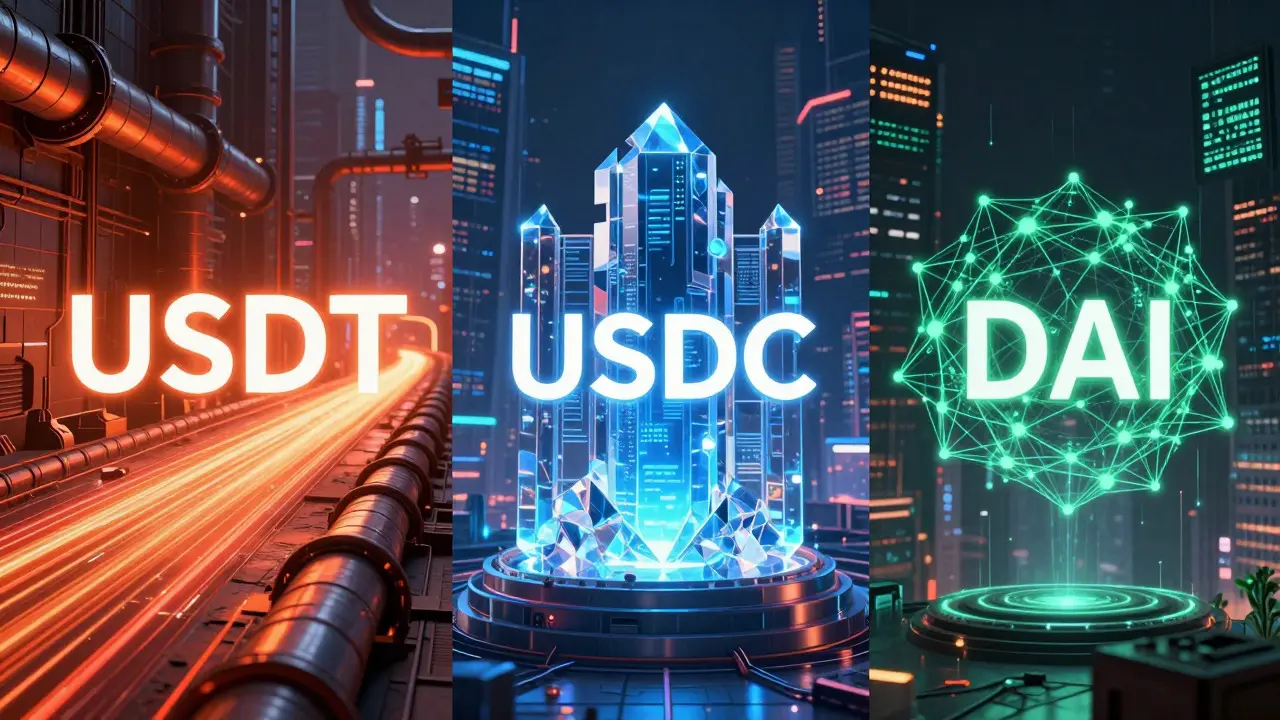
Imagine you need to move $10,000 worth of value from New York to Lagos instantly. You don't want the price swinging while the transfer happens. That is exactly what stablecoins are built for. They promise a steady $1 peg, but not all stablecoins work the same way. In fact, picking the wrong one can cost you in fees, delays, or even frozen funds. As of August 2026, three names dominate this space: USDT, Tether, the largest stablecoin by market cap, known for high liquidity and widespread exchange support, USDC, USD Coin, a regulated stablecoin backed by cash and short-term U.S. Treasuries, favored by institutions, and DAI, a decentralized stablecoin maintained by smart contracts and over-collateralized crypto assets. Understanding the differences between them isn't just academic-it’s practical money management.
Quick Summary: Which Stablecoin Fits Your Needs?
- Use USDT if you prioritize maximum liquidity, low transaction fees on networks like Tron, and broad acceptance across global exchanges.
- Choose USDC if regulatory compliance, transparency, and institutional trust are your top concerns, especially for business payments or holding large sums.
- Pick DAI if you want censorship resistance, deeper integration with decentralized finance (DeFi) protocols, and exposure to yield-generating opportunities without relying on centralized issuers.
The Core Mechanisms: How They Keep Their Peg
Every stablecoin promises to stay close to $1, but the engine under the hood varies wildly. This difference defines their risk profile.
USDT operates as a centralized reserve-backed coin. Tether Limited holds assets that supposedly back every token in circulation. As of early 2025, their attestation showed a mix of 46.3% U.S. Treasury bills, 18.7% secured loans, and other corporate bonds. It’s efficient, but it requires you to trust Tether’s accounting. Think of it like a bank account: you believe the bank has your money because they say so, supported by occasional audits.
USDC takes a stricter approach. Issued by Circle and Coinbase, it relies on fully reserved assets held in segregated accounts at regulated U.S. financial institutions. Their 2025 Transparency Report confirmed 62.4% cash equivalents and 37.6% short-term U.S. Treasuries. Monthly attestations by Grant Thornton LLP provide a layer of verification that appeals heavily to regulators and institutions. It’s the “compliant” choice.
DAI is different. It doesn’t rely on a company holding dollars. Instead, MakerDAO uses Ethereum smart contracts. Users lock up crypto assets-like ETH or USDC-as collateral to mint DAI. The system is over-collateralized, meaning you must lock up more than $1 worth of assets to get $1 in DAI. If the collateral value drops too low, the protocol automatically sells it to protect the peg. It’s algorithmic governance, not corporate balance sheets.
| Feature | USDT (Tether) | USDC (Circle/Coinbase) | DAI (MakerDAO) |
|---|---|---|---|
| Backed By | Mixed reserves (Treasuries, loans, bonds) | Cash & short-term U.S. Treasuries | Over-collateralized crypto assets |
| Issuer Type | Centralized (Tether Limited) | Centralized (Circle & Coinbase) | Decentralized (MakerDAO Governance) |
| Transparency Level | Quarterly attestations | Monthly attestations + real-time data | Fully on-chain, public ledger |
| Censorship Resistance | Low (can freeze addresses) | Very Low (strict OFAC compliance) | High (smart contract governed) |
Liquidity and Market Dominance
If you’re trading, liquidity is king. Can you buy or sell quickly without moving the price? Here, USDT still leads the pack. With a market share of roughly 53.1% in mid-2025, it handles massive volumes. Its 24-hour trading volume averaged $58.7 billion, dwarfing USDC’s $32.4 billion. Why does this matter? Because most major trading pairs on exchanges list against USDT first. If you’re day trading altcoins, you’ll likely find tighter spreads and faster execution with USDT.
USDC has grown significantly, capturing about 30.2% of the market. It’s become the preferred stablecoin for institutional players. According to a 2025 report, 78% of surveyed institutional investors prefer USDC due to its regulatory clarity. If you’re moving millions for a business operation, USDC feels safer because it aligns with traditional finance standards.
DAI holds a smaller slice, around 4%, but its role is specialized. It’s the lifeblood of DeFi. About 78.3% of DAI supply is locked in protocols like Aave and Curve. You won’t use DAI to buy coffee on a random merchant site, but you will see it everywhere when lending or borrowing in decentralized apps.

Costs and Speed: The Practical Reality
Let’s talk about what hits your wallet. Transaction costs depend heavily on which blockchain network you use, not just the stablecoin itself. However, ecosystem preferences shape these costs.
For cheap transfers, many users send USDT via the Tron network. Fees there average just $0.0014, and confirmations take under two seconds. This makes USDT incredibly popular for remittances and peer-to-peer transactions in emerging markets. In contrast, sending USDC or DAI primarily happens on Ethereum, where gas fees can range from $0.45 to over $2.10 depending on network congestion. While Layer 2 solutions like Arbitrum or Optimism have lowered these costs, Ethereum mainnet remains expensive during peak times.
Speed-wise, USDT on Tron is unbeatable for retail users. But for businesses integrating APIs, USDC offers superior developer tools. Circle provides SDKs for seven programming languages and scores high on API reliability assessments. Setting up USDC payments might take longer initially (7-10 days for compliance checks), but it reduces long-term operational friction for regulated entities.
Risk Profiles: What Could Go Wrong?
No asset is risk-free. Each stablecoin carries unique vulnerabilities.
USDT Risks: The biggest concern is counterparty risk. If Tether mismanages its reserves or faces severe legal action, confidence could crack. We saw hints of this in March 2023 when USDT briefly depegged to $0.95 during banking sector turmoil. Additionally, exchanges occasionally delist USDT pairs due to regulatory pressure, disrupting 12.4% of transactions in 2024 according to Chainalysis.
USDC Risks: The trade-off for safety is censorship. Circle freezes addresses sanctioned by OFAC. In 2024, 98.7% of frozen USDC transactions involved sanctioned entities. While this protects the system from illicit flows, it means your funds aren’t truly yours if a regulator steps in. Also, remember the Silicon Valley Bank collapse in 2023? USDC dropped to $0.88 for 12 hours because a chunk of its reserves was trapped in SVB. It recovered, but the scare was real.
DAI Risks: DAI’s risk is technical and market-driven. Since it’s backed by volatile crypto, sharp price drops can trigger liquidations. During the May 2021 ETH crash, DAI spiked to $1.12. More recently, in March 2025, volatility triggered liquidations in 1.7% of positions. Furthermore, managing DAI requires understanding collateral ratios and stability fees, which creates a steep learning curve for new users.
Regulatory Landscape in 2026
By August 2026, regulations have tightened considerably. The implementation of the GENIUS Act in early 2025 created a clear path for “Qualified Stablecoins.” USDC fits this definition perfectly, gaining approval for use by 37 U.S. state-regulated financial institutions. This regulatory moat is widening USDC’s lead in enterprise adoption.
USDT faces ongoing scrutiny. The SEC’s enforcement actions against Tether continue, citing inadequate disclosure of reserve risks. While USDT remains dominant globally, its access to regulated U.S. financial systems is limited compared to USDC.
DAI exists in a gray area. Its decentralized nature makes it hard to regulate. The EU’s MiCA regulations pose potential challenges, possibly classifying certain aspects of DAI as securities. However, its lack of a central issuer also makes it harder to shut down, appealing to those seeking freedom from traditional financial oversight.
Who Should Use Which?
Your choice depends entirely on your goal.
For Traders: Stick with USDT. The depth of order books ensures you can enter and exit positions quickly. Most exchanges offer better trading pairs for USDT, reducing slippage.
For Businesses and Institutions: Choose USDC. The audit trails, regulatory compliance, and lower credit risk make it suitable for payroll, cross-border B2B payments, and treasury management. Companies like Kueski in Mexico switched to USDC to reduce payment costs and satisfy auditors.
For DeFi Enthusiasts: Use DAI. It integrates seamlessly with lending protocols. You can earn yield by supplying DAI to platforms like Aave. Plus, since it’s not centrally issued, you avoid the risk of having your funds frozen by a corporate entity.
A growing trend among sophisticated users is using a multi-stablecoin strategy. Keep USDT for active trading, hold USDC for savings and business operations, and deploy DAI in DeFi yields. This diversification mitigates the specific risks associated with each model.
Is USDT safe to hold long-term?
USDT is generally safe for short-term trading due to its high liquidity, but long-term holders should be aware of regulatory risks and less frequent transparency reports compared to USDC. Tether’s reserves include complex assets like secured loans, which carry higher credit risk than the cash and Treasuries backing USDC.
Why is USDC more expensive to transfer than USDT?
The cost difference usually comes down to the blockchain network used. USDT is widely available on low-fee networks like Tron, where transfers cost fractions of a cent. USDC is most commonly used on Ethereum, where gas fees can be significantly higher, although Layer 2 networks are helping to reduce these costs.
Can my USDC be frozen?
Yes. Circle, the issuer of USDC, cooperates with law enforcement and complies with OFAC sanctions. If your address is flagged, Circle can freeze your USDC holdings. This is a key trade-off for the regulatory compliance that makes USDC attractive to institutions.
How does DAI maintain its $1 peg without cash reserves?
DAI uses an over-collateralization model. Users lock up crypto assets worth more than $1 to mint $1 of DAI. Smart contracts monitor the value of this collateral. If the value drops too low, the collateral is automatically sold to repay the DAI debt, ensuring the system remains solvent and the peg is maintained.
Which stablecoin is best for international remittances?
USDT is often the best choice for remittances, particularly when sent via the Tron network. It offers near-instant settlement and extremely low fees ($0.0014 average). Its widespread acceptance in emerging markets also makes it easier for recipients to convert to local currency.