
Starting a crypto business in Dubai isn’t just about setting up a website or launching a token. If you want to operate legally under Dubai’s new rules, you’re dealing with VARA-the Virtual Assets Regulatory Authority. This isn’t a suggestion. It’s the law. And if you skip this step, you’re not just risking fines-you’re risking your entire operation being shut down.
What Is VARA, and Why Does It Matter?
VARA was created in 2022 to be the only official regulator for virtual assets in Dubai. That means if you’re offering crypto services inside Dubai (not in DIFC or ADGM), you need a VARA license. No exceptions. This includes exchanges, wallet providers, custody services, and even companies issuing NFTs or tokens. VARA doesn’t just oversee trading-it controls everything from how you verify customers to how you store digital assets. Unlike other places where crypto rules are vague or outdated, VARA’s framework is modern, detailed, and built for real-world use. It covers DeFi protocols, tokenized real estate, AI-driven trading bots, and more. If your business touches virtual assets in any way, VARA has rules for you.The Six Types of VARA Licenses You Can Apply For
You can’t just get one blanket license. VARA breaks down services into six specific categories, and you need approval for each one you plan to offer:- Exchange services - Running a platform where users trade crypto for crypto or crypto for fiat.
- Broker-dealer services - Buying or selling crypto on behalf of clients, either with fiat or between different digital assets.
- Custody services - Holding clients’ crypto assets securely. This requires insurance and advanced security systems.
- Transfer services - Enabling the movement of crypto between wallets or accounts for customers.
- Wallet provision services - Offering digital wallets to users, whether hot or cold storage.
- Token issuance - Creating and distributing new tokens. This has two subcategories: Category 1 (direct issuance with VARA approval per token) and Category 2 (must go through a licensed intermediary).
Many companies start with just one or two of these. But if you want to offer multiple services, you’ll need multiple approvals-and higher capital.
How Much Money Do You Need to Start?
Capital isn’t just a suggestion. It’s a hard requirement. VARA doesn’t care how big your idea is-if you don’t have the cash to back it up, you won’t get approved.Minimum paid-up capital ranges from AED 100,000 ($27,000) to AED 1.5 million ($408,000), depending on your service type. But here’s the catch: if you apply for multiple services, the capital doesn’t just add up-it stacks.
For example:
- Broker-dealer service: AED 1 million
- Custody service: AED 4 million
- Exchange service: AED 5 million
If you want all three? You need AED 10 million in paid-up capital. That’s over $2.7 million USD. This isn’t a startup budget. This is institutional-grade funding.
What Else Costs Money?
Beyond capital, there are fees you can’t avoid:- Application fee: AED 40,000 to AED 100,000, depending on how complex your business model is.
- Annual supervision fee: AED 80,000 to AED 200,000 per year. This covers ongoing audits, inspections, and compliance checks.
- Professional services: Legal help, compliance software, cybersecurity consultants, and auditors. These aren’t optional. Most companies spend AED 200,000-500,000 just to get compliant before even submitting the application.
Many teams underestimate this. They think getting the license is the end goal. It’s not. It’s the starting line.
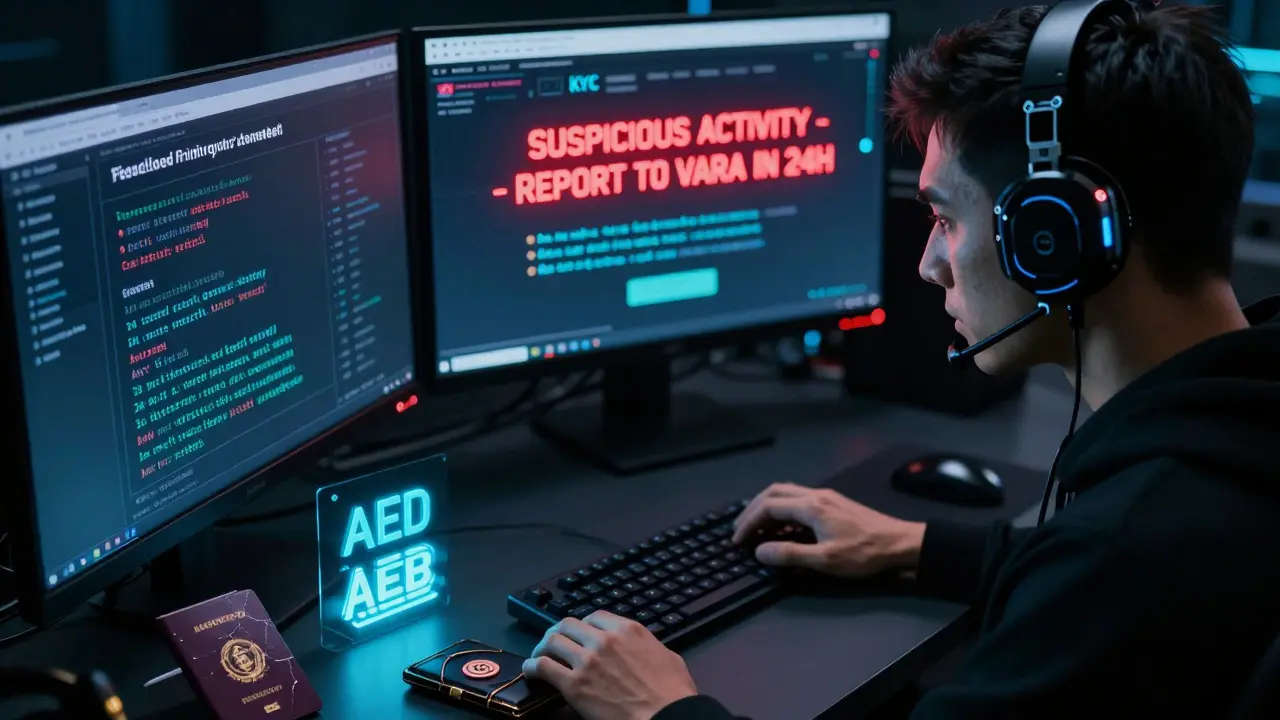
Operational Rules You Can’t Ignore
You need more than money. You need systems.- Legal entity in Dubai: You must be incorporated in Dubai. No offshore companies. No foreign branches. You need a local legal structure.
- Fit-and-proper criteria: Every board member, CEO, compliance officer, and key employee must pass a background check. No criminal records. No ties to sanctioned entities.
- Detailed business plan: You must explain exactly what you do, who your customers are, how you’ll make money, and how you’ll manage risk.
- Security and tech standards: Your systems must meet international cybersecurity standards. This includes encryption, two-factor authentication, penetration testing, and disaster recovery plans.
- Insurance coverage: You need insurance for cyberattacks, theft, and loss of client assets. Policies must be issued by approved providers.
- Record-keeping: Every transaction, every customer interaction, every login, every alert must be stored for at least five years. VARA can audit you anytime.
Anti-Money Laundering: The Biggest Hurdle
VARA takes AML/CFT seriously. And they’re not playing around.You must implement:
- Automated KYC: Real-time identity verification using government-issued IDs, facial recognition, and document validation.
- Source of funds checks: You can’t just accept crypto from anyone. You must prove where the money came from-bank transfers, crypto sales, employment income. No cash deposits.
- Transaction monitoring: Your system must flag unusual activity automatically-large transfers, rapid movement between wallets, mixing services.
- Suspicious activity reporting: If something looks off, you must report it to VARA within 24 hours.
- Staff training: Every employee must be trained quarterly on AML rules. Records of training must be kept.
One company lost its license in late 2024 because their KYC system didn’t catch a client using a fake passport from a country under sanctions. They thought it was a mistake. VARA didn’t.
What’s Banned? The Hard Restrictions
Some things are just not allowed-no exceptions.- Privacy coins: Monero, Zcash, and any other token designed to hide transaction details are completely banned. VARA says anonymity is incompatible with financial integrity.
- Unapproved marketing: You can’t run ads, social media campaigns, or influencer promotions without VARA’s written approval. All ads must include clear risk disclosures.
- Weak cybersecurity: No outdated software. No unpatched systems. No third-party hosting without certification. VARA requires ISO 27001 or equivalent.
These aren’t gray areas. They’re black-and-white rules. Violate them once, and your license is revoked.

How VARA Compares to Other UAE Regulators
Dubai isn’t the only place with crypto rules. DIFC has DFSA. Abu Dhabi has FSRA. And the federal SCA regulates entities outside free zones.Here’s how VARA stacks up:
| Regulator | Area | Focus | Key Advantage |
|---|---|---|---|
| VARA | Dubai (excluding DIFC) | Full virtual asset coverage | Most comprehensive, modern, and transparent framework |
| DFSA | DIFC | Traditional finance + crypto | Strong international reputation, familiar to banks |
| FSRA | ADGM | Hybrid crypto and fintech | Faster approvals for startups |
| SCA | Entire UAE (outside free zones) | Securities and commodities | Only applies if you’re not in a free zone |
If you’re building a crypto business from scratch, VARA is the most complete option. But it’s also the strictest.
What Happens After You Get Licensed?
Getting the license isn’t the finish line-it’s the beginning of ongoing obligations.You’ll face:
- Quarterly compliance reports
- Annual external audits
- Random inspections
- Updates to rules (VARA changes policies every 6-12 months)
- Re-licensing every two years
One firm that got licensed in early 2024 had to upgrade their entire system six months later because VARA introduced new data retention rules. They didn’t plan for that. They lost three months of revenue.
Stay ahead by building compliance into your DNA-not as a cost center, but as part of your product.
Final Reality Check
VARA isn’t here to make things easy. It’s here to make Dubai the safest, most transparent crypto hub in the world. That means high costs, strict rules, and zero tolerance for shortcuts.But if you’re serious about building a crypto business that lasts, there’s no better place. The license gives you access to global investors, institutional clients, and real market credibility. Companies with VARA licenses are getting funded, partnering with banks, and expanding into Asia and Europe.
The question isn’t whether you can afford to get licensed. It’s whether you can afford not to.
perry jody
February 3, 2026 AT 20:59VARA’s rules are insane, but honestly? I’d rather deal with this than some sketchy offshore shell company that vanishes next month. 😅 At least you know where you stand.
Paul Jardetzky
February 4, 2026 AT 19:58Man, I spent 6 months trying to get a license in DIFC last year. VARA’s framework is way more transparent. The capital requirements are brutal, but at least they tell you upfront what you need. No guessing games. 🚀
Paul Gariepy
February 6, 2026 AT 05:30Wait, wait, wait-did you guys see the part about privacy coins being BANNED? Monero? Zcash? Gone?!!?? That’s not regulation-that’s a war on anonymity! And the insurance requirements? You need a fortune just to get started. I’m not even sure I’d risk it. The fees alone could bankrupt a small team. And don’t get me started on the quarterly reports… oh my god, the paperwork… I’m sweating just thinking about it.
Jim Laurie
February 7, 2026 AT 13:14Look, I’ve been in this space since 2017, and I’ve seen regulators come and go. VARA? They’re not playing. They’re building a fortress. And honestly? I respect that. Most places let you slip through the cracks. Here? You either play by the rules or you don’t play at all. The AML stuff? Non-negotiable. The KYC? It’s brutal, but it’s what separates real players from the bots. And the fact they require training records? That’s next-level. Most crypto firms treat compliance like a tax. VARA treats it like oxygen.
Yeah, the capital’s wild. But if you’re serious about scaling globally, this license is your golden ticket. Banks won’t touch you without it. Investors won’t even look. This isn’t a cost center-it’s your credibility engine.
I’ve seen startups burn out because they thought they could wing it. VARA doesn’t care how cool your tokenomics are. If your backend is a mess? You’re out. No second chances. That’s scary… but also kind of beautiful.
It’s like they’re saying: ‘We want crypto to be here, but we’re not gonna let it be a Wild West.’ And honestly? I’m here for it.
Udit Pandey
February 8, 2026 AT 18:08It is a great honor for Dubai to lead the world in responsible cryptocurrency governance. India, despite its potential, still lags behind in regulatory clarity. VARA is not merely a set of rules-it is a beacon of civilization in a sea of chaos. Those who complain about capital requirements are simply not ready for the responsibility of true financial leadership. Let the weak flee to unregulated jurisdictions. The future belongs to those who embrace structure.
Sharon Lois
February 9, 2026 AT 04:36Of course they ban privacy coins. Who do they think they’re fooling? This isn’t about ‘financial integrity’-it’s about surveillance. They want to track every Satoshi you touch. And the ‘approved marketing’ rule? That’s censorship dressed up as compliance. Wake up, sheeple.
mahikshith reddy
February 9, 2026 AT 19:35VARA is the only sane choice. Anyone who thinks this is too hard hasn’t built anything real. The world doesn’t need more anonymous scams. It needs institutions. Dubai is building temples. Others are building sandcastles.
Brendan Conway
February 10, 2026 AT 23:14So… you gotta have a local company, insurance, five years of logs, trained staff, and $2.7M just to start? Huh. Guess I’ll just stick to buying ETH on Binance and calling it a day. 😅
Katie Haywood
February 11, 2026 AT 12:18People act like VARA is some evil monster, but honestly? If you’re doing legit work, this is a gift. The market’s gonna reward compliance. Look at how many US crypto firms got crushed because they didn’t play nice. Here, you get to sleep at night. And that’s worth more than any shortcut.
Matt Smith
February 12, 2026 AT 08:48Oh wow, VARA’s the ‘most transparent’ regulator? 😂 LMAO. They’re just the most bureaucratic. And ‘global investors’? Yeah, right-those same investors who got burned by FTX? They’re gonna trust a Dubai license more than a US one? Give me a break. This is just a fancy tax scam with better branding. 🤡
orville matibag
February 14, 2026 AT 01:17As someone who’s lived in both the US and Dubai, I can say this: VARA’s rules are strict, but they’re clear. In the US, you get lawyers arguing over semantics for years. Here? They tell you what to do, you do it, and you move on. It’s not perfect-but it’s functional. And that’s rare in crypto.