Imagine trying to win a race against someone in a Ferrari while you are running on foot. That is exactly what happens when you try to mine Bitcoin with your laptop today. In the early days of cryptocurrency, anyone could join in. Now, the game has changed completely. The reason? ASIC miners, which stand for Application-Specific Integrated Circuits. These specialized machines have taken over the industry, making old methods obsolete and creating a new barrier to entry for everyday users.
If you are wondering whether buying one of these devices is worth it, or just curious about how the blockchain actually stays secure, you need to understand what an ASIC miner is, how it works, and why it dominates the market. This guide breaks down everything you need to know without the confusing jargon.
What Exactly Is an ASIC Miner?
An ASIC miner is a piece of computer hardware built for one single purpose: mining cryptocurrency. Unlike your computer’s CPU (Central Processing Unit) or a graphics card (GPU), which are designed to do many different tasks like playing games, editing video, or browsing the web, an ASIC is hardwired to solve only one specific mathematical problem.
This specialization is its superpower. By removing all the extra circuits needed for general computing, manufacturers can pack more processing power into a smaller space and use less electricity per calculation. Think of it like a tool made specifically to hammer nails versus a Swiss Army knife. The hammer might not open bottles, but it drives nails faster and harder than anything else.
The first commercial ASIC miner, called Avalon, was released by Canaan Creative in 2013. Shortly after, Bitmain launched the Antminer S1. Since then, these devices have evolved from small circuit boards into industrial-grade machines that look like large metal boxes with loud fans.
How ASIC Miners Work
To understand how an ASIC miner works, you need to know what "mining" actually does. In Proof-of-Work blockchains like Bitcoin, miners compete to solve complex cryptographic puzzles. The first person to solve the puzzle gets to add a new block of transactions to the blockchain and receives a reward in coins.
An ASIC miner performs billions of hash calculations every second. Each attempt is a guess at the solution to the puzzle. Because the device is optimized for this exact task, it guesses much faster than any other hardware. Here is the basic process:
- Receiving Data: The miner connects to the internet and joins a mining pool. It downloads the latest block data from the network.
- Hashing: The internal chips run the specific algorithm (like SHA-256 for Bitcoin) repeatedly, generating trillions of hashes per second.
- Solving the Puzzle: When the miner finds a hash that meets the network’s difficulty target, it broadcasts the solution.
- Reward: If the network accepts the solution, the miner earns newly minted coins plus transaction fees.
The key here is efficiency. An ASIC uses significantly less energy per hash compared to a CPU or GPU. However, because they run at full capacity 24/7, they still consume a lot of total electricity-often as much as a household appliance.
ASIC vs. GPU vs. CPU: The Hardware Battle
You might be asking, "Why can’t I just use my gaming PC?" Let’s compare the three main types of mining hardware to see why ASICs won the war for major cryptocurrencies.
| Feature | CPU (Processor) | GPU (Graphics Card) | ASIC Miner |
|---|---|---|---|
| Versatility | High (General use) | Medium (Gaming, AI, Mining) | None (Mining only) |
| Efficiency | Low | Medium | Very High |
| Cost | Already owned | $300 - $1,500+ | $1,000 - $10,000+ |
| Noise & Heat | Low | Medium | Very High |
| Best For | Altcoins (Monero) | Ethereum Classic, Ravencoin | Bitcoin, Litecoin, Kaspa |
CPU mining is essentially dead for profitable coins. GPUs offer flexibility; if one coin becomes unprofitable, you can switch to another or sell the card for gaming. ASICs offer no such escape hatch. If the coin you are mining crashes in value or the network difficulty spikes too high, your ASIC may become worthless paperweight. But as long as the math favors speed, ASICs will outperform everything else.
Popular Cryptocurrencies Mined with ASICs
Not all cryptocurrencies use ASICs. Some, like Ethereum, switched to Proof-of-Stake to prevent centralization. However, several major coins still rely on ASIC-mined algorithms:
- Bitcoin (BTC): Uses the SHA-256 algorithm. This is the most competitive space, dominated by Bitmain’s Antminer series.
- Litecoin (LTC): Uses the Scrypt algorithm. Often mined alongside Bitcoin using dual-mining features on some ASICs.
- Kaspa (KAS): Uses the kHeavyHash algorithm. A newer entrant that has seen a surge in dedicated ASIC adoption.
- Dogecoin (DOGE): Also uses Scrypt, similar to Litecoin.
- Kadena (KDA): Uses the Hashcash algorithm, allowing for efficient ASIC mining.
Each of these requires a different type of ASIC chip. You cannot buy a Bitcoin miner and expect it to mine Litecoin efficiently. The hardware must match the algorithm.
Pros and Cons of Buying an ASIC Miner
Before spending thousands of dollars, you need to weigh the benefits against the risks. This is not a passive investment; it is an industrial operation scaled down to your garage.
The Pros:
- Unmatched Performance: ASICs deliver hash rates that are millions of times higher than GPUs.
- Energy Efficiency: They produce more hashes per watt of electricity consumed.
- Set and Forget: Once configured, they run automatically with minimal daily interaction.
The Cons:
- High Upfront Cost: Entry-level models start around $1,000, but profitable ones cost much more.
- Noise Pollution: ASICs sound like jet engines. Most people cannot keep them inside their living spaces.
- Heat Generation: They require serious ventilation or cooling systems to prevent overheating.
- Obsolescence Risk: Newer, faster models come out regularly. Your current machine may become unprofitable within a year or two.
- Electricity Costs: If your local power rate is above $0.05-$0.08 per kWh, you might lose money even with a top-tier miner.
Getting Started: What You Need to Know
If you decide to move forward, here is what the setup looks like in practice. First, calculate your profitability. Use online calculators to input your electricity cost, the current price of the coin, and the hash rate of the miner. If the result is negative, do not buy it.
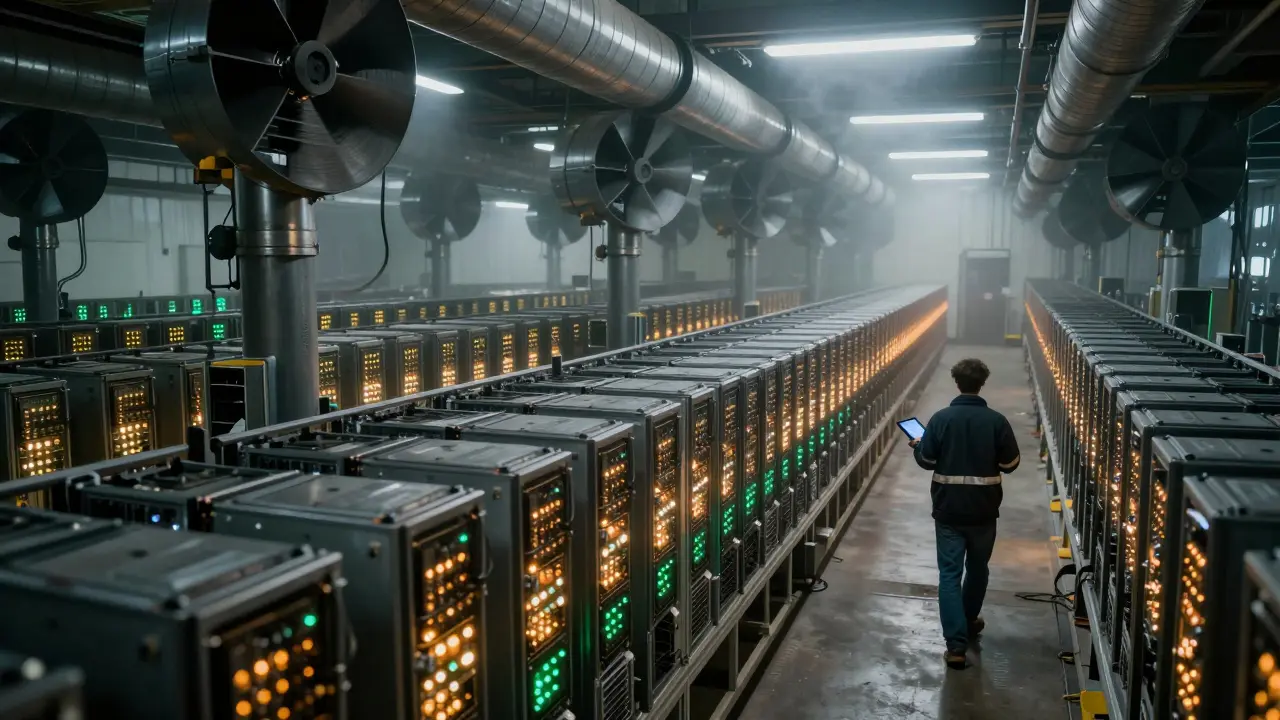
Next, consider your location. Do you have a shed, basement, or warehouse with good airflow? You will likely need to install ducting or industrial fans. Check your electrical panel; most modern ASICs draw between 2,000 and 5,000 watts. Standard home outlets may not handle this load safely without dedicated circuits.
Finally, choose a mining pool. Solo mining Bitcoin is like winning the lottery with one ticket. Pools combine the power of many miners to find blocks more consistently, splitting the rewards among participants. Popular pools include F2Pool, ViaBTC, and Antpool.
The Future of ASIC Mining
The industry is shifting toward larger, institutional operations. Small hobbyists are finding it harder to compete due to rising difficulty and energy costs. However, innovation continues. Manufacturers are focusing on reducing power consumption per terahash and improving chip durability.
Environmental concerns are also driving change. Many mining farms are now locating near renewable energy sources like hydroelectric dams or wind farms to lower costs and reduce carbon footprints. As regulations tighten in some regions, the landscape will continue to evolve, but for Proof-of-Work coins, ASICs remain the backbone of network security.
Can I mine Bitcoin with my computer?
Technically yes, but practically no. The computational power required to mine Bitcoin profitably is far beyond what a standard CPU or GPU can provide. You would spend more on electricity than you would earn in Bitcoin. ASIC miners are required for viable Bitcoin mining.
How much noise do ASIC miners make?
They are very loud, typically ranging from 70 to 80 decibels, similar to a vacuum cleaner or a busy highway. Most users place them in garages, sheds, or industrial warehouses rather than inside living spaces.
Is ASIC mining legal?
In most countries, yes. However, some regions have banned or restricted cryptocurrency mining due to environmental concerns or energy shortages. Always check local regulations before purchasing hardware.
What happens if the cryptocurrency price drops?
If the coin’s price falls below your break-even point (which includes electricity and hardware depreciation), your miner will operate at a loss. Unlike GPUs, ASICs cannot be easily repurposed for other tasks, so they may become obsolete quickly.
Do I need special electrical wiring?
Often, yes. Many modern ASIC miners require 220V or 240V power connections and high-amperage circuits. Using standard 110V/120V outlets may trip breakers or cause fire hazards. Consult an electrician before setting up multiple units.