
Imagine handing someone a sealed envelope. You want to be sure no one opens it on the way, that the letter inside hasn't been changed, and that you are indeed the person who sent it. Now imagine doing this with millions of people at once, without a central post office or security guard. That is exactly what cryptographic encryption in blockchain does.
It might sound like complex math reserved for computer scientists, but the concept is actually quite simple. It is the digital lock and key system that makes Bitcoin, Ethereum, and other blockchains secure. Without it, your digital assets would be as safe as leaving cash on a park bench. In this guide, we will break down how these locks work, why they matter, and what happens if they fail.
The Three Pillars of Blockchain Security
When people talk about blockchain encryption, they often think of one single technology. In reality, it is a team effort involving three distinct cryptographic tools working together. Think of them as the eyes, hands, and memory of the network.
First, there are hash functions. These act as the network's memory check. A hash function takes any amount of data-whether it is a short sentence or a massive file-and turns it into a fixed-length string of characters called a hash. The magic trick here is that even if you change just one comma in the original text, the resulting hash looks completely different. This makes it nearly impossible to tamper with data without everyone noticing.
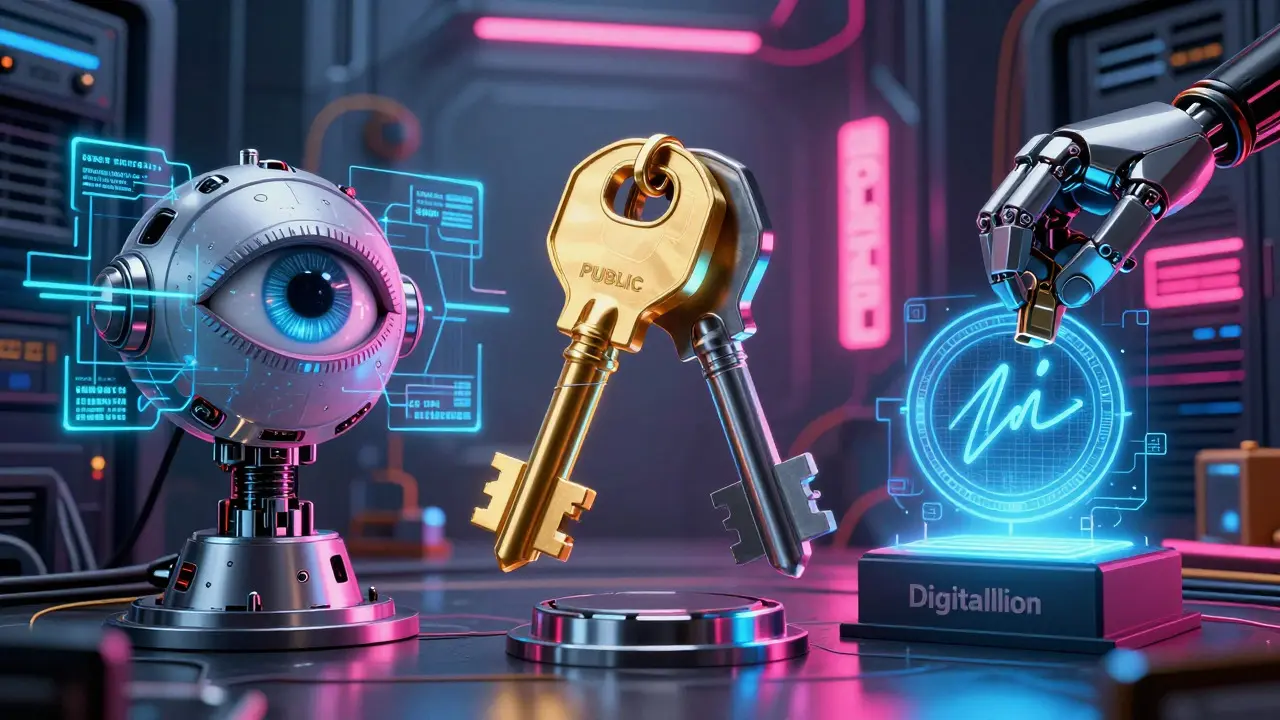
Second, we have asymmetric cryptography, also known as public/private key systems. This handles identity. Instead of using one password for everything, you get two keys. Your public key is like your email address; you can share it with anyone so they can send you messages (or transactions). Your private key is like your password; you keep it secret to prove you own the account. If someone steals your private key, they control your funds. There is no "forgot password" button in most crypto wallets.
Third, there are digital signatures. These act as the proof of intent. When you send money, your wallet uses your private key to create a unique signature for that specific transaction. The network then uses your public key to verify that the signature matches. This ensures that you actually authorized the transfer and haven't tried to spend the same coins twice (a problem known as double-spending).
How Hashing Keeps Data Immutable
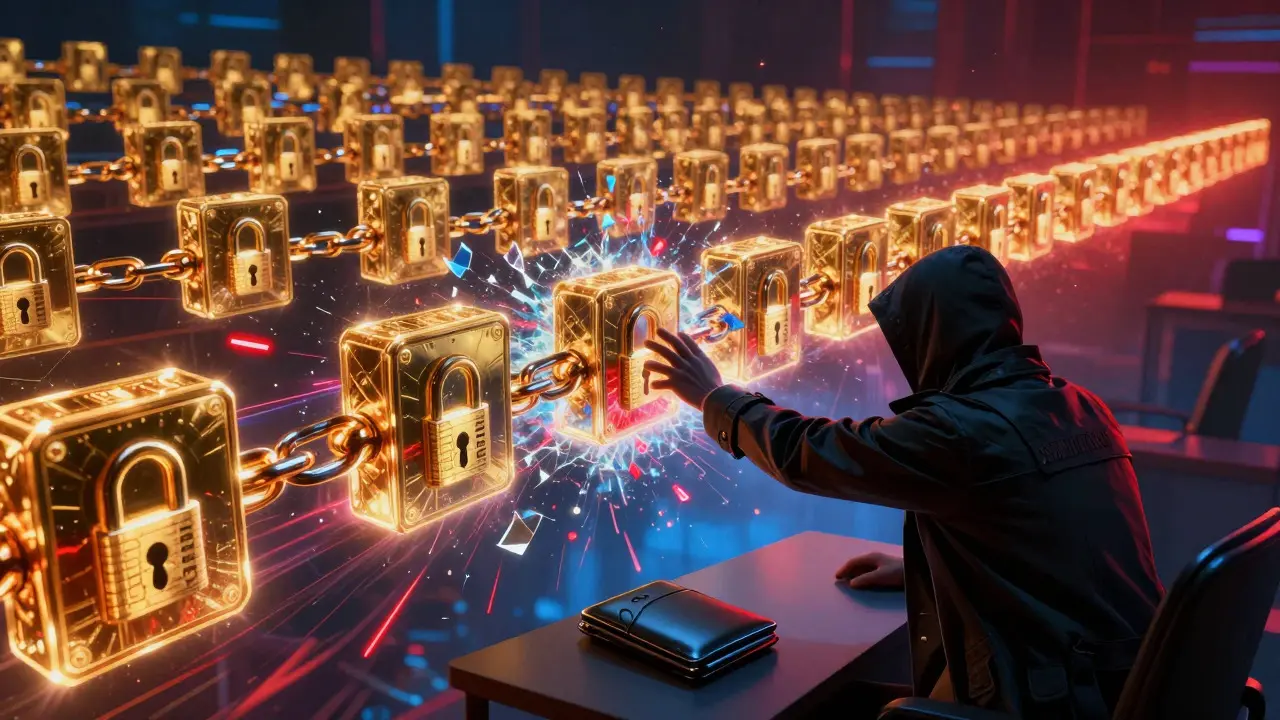
Let's look closer at hashing because it is the reason blockchains are called "immutable." In traditional databases, an admin can go back and edit a record. In a blockchain, every block contains the hash of the previous block. This creates a chain reaction.
If a hacker tries to change a transaction in Block 10, the hash of Block 10 changes. Because Block 11 contains the old hash of Block 10, Block 11 is now invalid. Then Block 12 becomes invalid, and so on, all the way to the latest block. To pull off this hack, the attacker would need to recalculate the hashes for every single subsequent block faster than the rest of the network combined. For large networks like Bitcoin, this requires more computing power than exists on Earth today.
Bitcoin specifically uses the SHA-256 algorithm for this purpose. SHA-256 stands for Secure Hash Algorithm 256-bit. It was designed by the National Security Agency (NSA) and has become the gold standard for data integrity. Other blockchains might use different algorithms, such as Ethash for Ethereum (historically) or Keccak, but the principle remains the same: change the input, and the output breaks.
Public vs. Private Keys: Your Digital Identity
Understanding keys is crucial for anyone interacting with blockchain. Let's clear up a common confusion: your public key is not your wallet address, though they are related. Your private key generates your public key, which then generates your wallet address. It is a one-way street.
- Private Key: A long string of random numbers kept secret. It proves ownership. Lose this, and you lose access to your assets forever. Share this, and you give away your assets.
- Public Key: Derived from the private key. It can be shared openly. It allows others to verify your digital signatures.
- Wallet Address: A shortened, hashed version of the public key. This is what you share when you want to receive funds.
This system relies on mathematical problems that are easy to solve in one direction but incredibly hard to reverse. For example, multiplying two large prime numbers is quick. But taking the result and figuring out which two primes created it can take thousands of years for even the fastest supercomputers. This asymmetry is what keeps your private key safe even when your public key is broadcast globally.
| Feature | Traditional Database | Blockchain Network |
|---|---|---|
| Data Control | Centralized (Admin can edit) | Distributed (Consensus required) |
| Immutability | Low (Records can be altered) | High (Hash chaining prevents edits) |
| Identity Verification | Passwords/Usernames | Cryptographic Signatures |
| Transparency | Opaque (Only admins see logs) | Transparent (Anyone can audit history) |
| Failure Point | Single server breach | Requires majority network compromise |
Common Risks and Vulnerabilities
While the math behind blockchain encryption is robust, the human element is not. Most security breaches in crypto do not happen because hackers broke the SHA-256 algorithm. They happen because users made mistakes.
The biggest risk is weak key management. If you write your private key on a sticky note and leave it on your monitor, no amount of advanced cryptography will save you. Phishing attacks, malware, and social engineering are the primary ways private keys are stolen. Once a key is exposed, the transaction is valid because the network sees a correct digital signature. The network doesn't know if you signed it willingly or under duress.
Another emerging threat is quantum computing. Current encryption methods like RSA and Elliptic Curve Cryptography (ECC) rely on problems that classical computers find hard to solve. However, powerful quantum computers could theoretically solve these problems quickly, potentially allowing them to derive private keys from public keys. While this is still largely a future concern, researchers are already developing "post-quantum" cryptographic algorithms to prepare for this shift. Interestingly, SHA-256 hashing is considered more resistant to quantum attacks than some signature schemes, which is why many experts believe blockchains can adapt by switching signature algorithms while keeping their hashing structure.
Smart contract flaws also pose a risk. Even if the underlying blockchain is secure, the code running on top of it might have bugs. Hackers often exploit logical errors in smart contracts rather than breaking the encryption itself. Regular security audits and formal verification processes are essential to mitigate this.
Best Practices for Staying Secure
So, how do you protect yourself? Here are practical steps based on industry standards.
- Use Hardware Wallets: Store your private keys offline. Devices like Ledger or Trezor keep your keys isolated from internet-connected devices, making them immune to remote hacking attempts.
- Enable Multi-Signature (Multi-Sig): For high-value assets, require multiple keys to authorize a transaction. This means a thief needs to steal more than one device to drain your funds.
- Verify Addresses Manually: Always double-check the first and last few characters of a recipient's address. Clipboard hijacking malware can swap addresses when you copy-paste.
- Keep Software Updated: Use well-maintained wallets and libraries like OpenSSL or Web3.js that receive regular security patches.
- Educate Yourself: Understand that "not your keys, not your coins." If you leave your crypto on an exchange, you are trusting their security, not blockchain encryption directly.
Remember, blockchain encryption provides a strong foundation, but it is only as strong as the weakest link in your personal security chain. By treating your private keys with the same care as physical cash, you leverage the full power of decentralized security.
Is blockchain encryption unbreakable?
Mathematically, current algorithms like SHA-256 are considered computationally infeasible to break with today's technology. However, "unbreakable" is a strong word. Future advances in quantum computing could threaten certain aspects of encryption, though the blockchain community is actively researching post-quantum solutions. Currently, the weak point is usually human error, not the math.
What is the difference between symmetric and asymmetric encryption in blockchain?
Symmetric encryption uses the same key to lock and unlock data, which is fast but risky if the key is intercepted. Asymmetric encryption uses a pair of keys: a public key to encrypt and a private key to decrypt. Blockchains primarily use asymmetric encryption for identity and transactions because it allows for secure communication without sharing a secret key beforehand.
Can I recover my private key if I lose it?
Generally, no. One of the core features of blockchain is decentralization, meaning there is no central authority to reset your password. If you lose your private key or your seed phrase (the backup words), your funds are effectively lost forever. This is why backing up your seed phrase securely is critical.
How does hashing prevent double-spending?
Hashing alone doesn't prevent double-spending; it works in tandem with consensus mechanisms and digital signatures. Each transaction is uniquely identified by a hash. The network validates that the inputs (coins being spent) haven't already been used in a previous transaction recorded in the chain. The immutable nature of the hash chain ensures that once a transaction is confirmed, it cannot be retroactively altered or duplicated.
What is the role of SHA-256 in Bitcoin?
SHA-256 is used in Bitcoin for two main purposes: creating the Merkle tree (which summarizes all transactions in a block) and mining (Proof of Work). Miners compete to find a hash that meets a specific difficulty target, which secures the network and adds new blocks. It ensures that data integrity is maintained across the entire ledger.
Don Fizy
July 31, 2026 AT 18:35Great breakdown of the basics here. Most people just see 'crypto' and think it's magic money, but understanding the hash functions is key to realizing why it's actually secure :). I always tell my friends that if you don't control your keys, you don't really own anything. It's like leaving your house keys with a stranger who claims they'll keep them safe for you.
Dominic Greco
August 1, 2026 AT 13:35Don't believe the hype 🤡 The NSA designed SHA-256 specifically so they could backdoor it when they needed to. They're watching everything. Your 'private key' isn't private if the algorithm itself has a master override built in by the government agencies that created it. Wake up sheeple 👁️👄👁️
Candice Cornett
August 2, 2026 AT 15:32it's not unbreakable. nothing is. humans are the weak link as stated but also the math will fail eventually. quantum computers are coming whether we like it or not and this whole system is built on sand. stop acting like it's a fortress.
Lance Jantz
August 2, 2026 AT 21:57One must consider the philosophical implications of asymmetry in our digital existence. We project our public selves into the void while guarding the dark, chaotic interior of our private keys. It is a modern alchemy, turning the lead of binary code into the gold of trustless verification. Truly profound how we have outsourced our identity to elliptic curves.
Sean Rowland
August 4, 2026 AT 18:03The article fails to adequately address the computational overhead required for such trivial security measures. Furthermore, the notion that 'immutable' data is inherently valuable is a fallacy often perpetuated by those lacking technical depth. One might argue that the energy expenditure alone renders the entire paradigm obsolete before even considering the human error factor which is statistically inevitable.
Phil Babb
August 5, 2026 AT 06:25YES! This is exactly what people need to hear!! Hardware wallets are non-negotiable if you want to be taken seriously in this space!!! Stop using exchanges for long term storage!!! It’s basic security hygiene!!! If you’re still on Coinbase for your main stash, you’re basically waving a flag saying ‘steal me’!!! Educate yourselves!!!
Sus Sawyer
August 6, 2026 AT 23:13I totally agree with the hardware wallet tip. I lost some coins early on because i left them on an exchange that got hacked. Lesson learned the hard way lol. Now i use a ledger and write down my seed phrase on metal plates. Feels overkill but better safe than sorry. The peace of mind is worth it.
Aryan MISHRA
August 8, 2026 AT 02:22The distinction between public key derivation and wallet address hashing is critical; many conflate the two due to superficial understanding. Elliptic Curve Digital Signature Algorithm (ECDSA) remains robust against classical attacks; however, post-quantum cryptography (PQC) migration is imperative for long-term viability. Do not ignore the timeline.
Ryan Robinson
August 9, 2026 AT 09:48honestly its pretty cool how it works once u get past the jargon. i was scared at first but reading stuff like this helps. just dont click weird links and ur good to go. simple as that.
Earl Kott65
August 10, 2026 AT 21:46Oh wow, look at us playing with big boy toys now 😂. You guys really think a piece of plastic called a Ledger saves you from yourself? Spoiler alert: it doesn't. You can still sign a transaction sending all your funds to a hacker if you aren't paying attention. But sure, let's pretend the hardware is the savior. Classic. 🙄