
Genius (GENI) isn’t another Bitcoin or Ethereum. It doesn’t power a major network, and it’s not backed by a well-known team or company. What it does claim to be is something far more unusual: the first hyper-yield, A.I. driven blockchain Certificate of Deposit. If that sounds confusing, you’re not alone. Most people who stumble across GENI are left wondering if it’s a scam, a joke, or something genuinely new.
Let’s cut through the noise. GENI is a cryptocurrency token with a market cap between $287,000 and $311,500. That’s tiny. For comparison, even the smallest legitimate coins usually sit above $1 million. GENI trades at roughly $0.000001 USD - less than one-millionth of a dollar. You’d need over 1 billion GENI tokens just to make $1. And yet, it’s still listed on some tracking sites like CoinGecko and Kriptomat, even though trading volume is barely over $1,000 a day. That’s not a market. That’s a whisper.
What does GENI actually do?
The project says GENI is a "Certificate of Deposit" on the blockchain. Think of a bank CD: you lock money away for a set time and earn interest. Genius says it does the same, but with AI. The AI supposedly finds the best yield opportunities across DeFi protocols and automatically reinvests your returns. Sounds smart, right? Except there’s no proof.
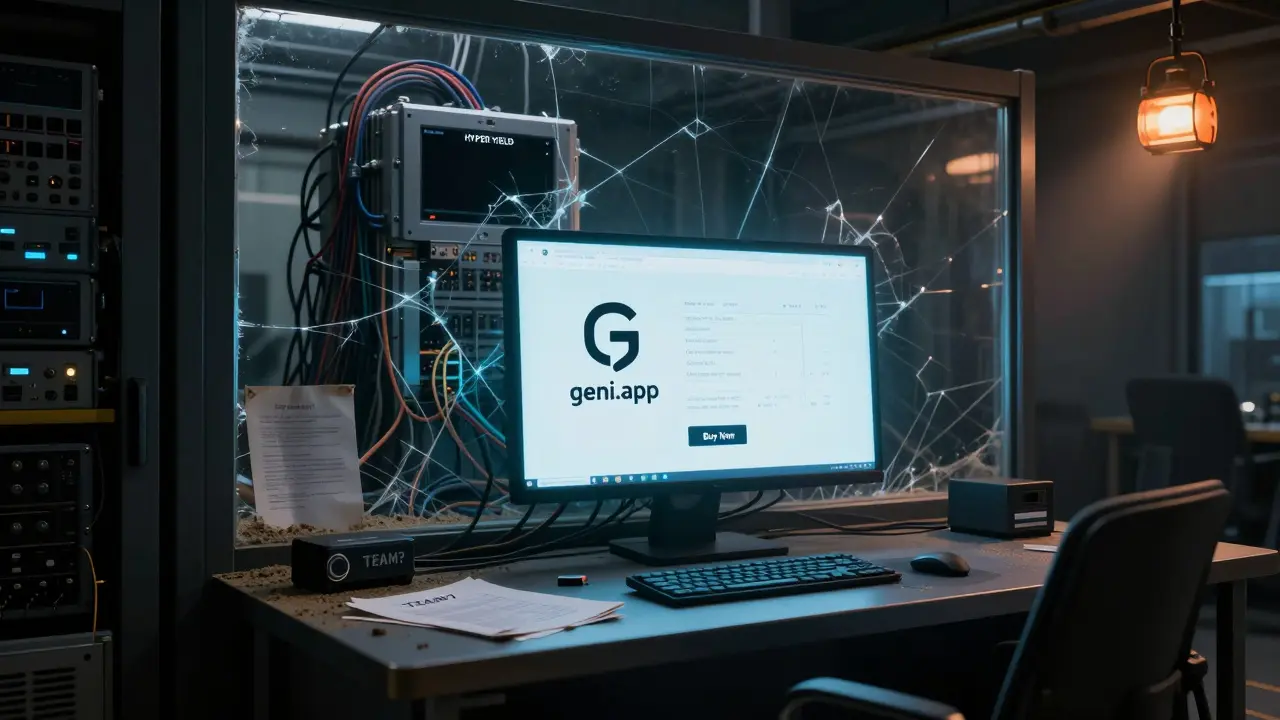
No whitepaper. No detailed technical docs. No public smart contract audit. The GitHub repo exists, but there’s no commit history to show active development. The website, geni.app, is barebones - just a logo, a price chart, and a link to buy. No team bios. No roadmap. No explanation of how the AI works. Not even a diagram. If this were a real financial product, regulators would shut it down for lack of transparency.
Is the "AI" real?
The term "AI-driven" is thrown around a lot in crypto. Sometimes it’s marketing. Sometimes it’s smoke and mirrors. With GENI, there’s zero evidence the AI does anything. No code examples. No performance metrics. No case studies. Even the most basic AI yield optimizer - like Yearn Finance - publishes its strategy logic openly. Genius doesn’t. That’s a red flag.
There’s also no explanation of how the "hyper-yield" works. What’s the APR? How often do you get paid? Is it compounding? Are there withdrawal fees? No answers. The whole thing feels like a PowerPoint slide with buzzwords slapped on a token that was created in minutes using a crypto generator tool.
Price history: wild swings, zero stability
GENI’s price history is a rollercoaster with no rails. Its all-time high was $0.00014178. Its all-time low? $0.00000029. That’s a 488x difference. Today, it hovers around $0.000001. The 24-hour range? From $0.00000095 to $0.00000134. A 41% swing in one day. That’s not volatility - that’s manipulation.
Why does it move so much? Because there’s almost no liquidity. With daily trading volume under $3,000, a single wallet moving 50 million tokens can spike the price 20% overnight. Then it crashes back. That’s why some platforms show a 137% gain while others show a 21% drop. They’re not wrong - they’re just looking at different moments in a rigged game.
Where can you buy GENI?
This is where it gets weirder. Some sites claim GENI is "not traded anywhere." Others list it on obscure exchanges with names like "CryptoDex" or "BitSwapX" - platforms you’ve never heard of and can’t find on CoinMarketCap’s official list. No major exchange like Binance, Coinbase, or KuCoin lists it. That means if you buy GENI, you’re likely using a decentralized exchange (DEX) with no user protection. No chargebacks. No customer support. Just a wallet address and a prayer.
And even if you do find a place to buy it, you’ll need to use a token that’s already trading - like ETH or USDT - to swap for GENI. That adds fees, slippage, and risk. You’re not investing. You’re gambling on a token with no real use case.
Who’s behind Genius?
No names. No LinkedIn profiles. No past projects. The Twitter account @Genicrypto has 1,200 followers and posts mostly price updates and memes. The Facebook page is inactive. No press releases. No interviews. No developer updates. That’s not how real projects grow. Real teams build communities. They answer questions. They post weekly progress reports. Genius does none of that.
The absence of transparency isn’t just annoying - it’s dangerous. In crypto, anonymity isn’t privacy. It’s a warning sign. If no one knows who’s running the project, how can you trust them with your money?

Should you invest in GENI?
If you’re looking for a serious investment, the answer is no. There’s no fundamental value here. No utility. No adoption. No development. Just a token with a fancy name and a promise it can’t back up.
But if you’re the type of person who throws $10 into a meme coin because it’s funny or because you think you’ll get lucky - then maybe GENI is for you. Just know this: you’re not buying a financial product. You’re buying a lottery ticket with a blockchain label.
Most people who buy GENI do so because they saw a post saying "1000x potential!" or "AI-powered passive income!" Those claims are empty. They’re designed to lure in people who don’t know how to read a whitepaper or check a token’s contract address. And once you buy, there’s no exit strategy. The liquidity is too thin. You’ll be stuck.
Why does GENI even exist?
There’s a reason low-cap tokens like this keep popping up. They’re cheap to create. A developer can mint 300 billion tokens in minutes. They list it on a DEX. They pump it on Telegram groups. They get a few early buyers. Then they vanish. The token becomes a ghost. The money goes to whoever sold early. The rest are left holding worthless digital scraps.
GENI fits that pattern perfectly. It has the hallmarks of a rug pull: vague claims, no team, no code, low volume, and zero transparency. It’s not unique. It’s not innovative. It’s just another ghost in the graveyard of failed crypto projects.
What’s the bottom line?
Genius (GENI) is not a cryptocurrency you should hold, trade, or research as an investment. It has no real technology, no team, no community, and no future. The "hyper-yield AI CD" story is fiction. The price is manipulated. The liquidity is nonexistent.
If you’re curious about blockchain-based passive income, look at established DeFi protocols like Aave or Compound. They have audits, transparent code, and years of track records. GENI has none of that.
Don’t get fooled by the name. "Genius" doesn’t mean smart. In crypto, it often means the opposite.
Jeff French
February 27, 2026 AT 22:48Ifeanyi Uche
February 28, 2026 AT 07:34Tanvi Atal
March 1, 2026 AT 05:38Sony Sebastian
March 1, 2026 AT 21:13Elana Vorspan
March 2, 2026 AT 04:13Cathy Sunshine
March 3, 2026 AT 05:09Richard Cooper
March 3, 2026 AT 19:33Dee Resin
March 4, 2026 AT 15:38Brian Lemke
March 6, 2026 AT 01:17Megan Lavery
March 6, 2026 AT 17:36Mae Young
March 8, 2026 AT 04:59Trenton White
March 8, 2026 AT 21:16Jeff French
March 9, 2026 AT 02:13Brian Lemke
March 10, 2026 AT 14:25