
Imagine trying to buy a stock, trade gold, or hedge against inflation without leaving your crypto wallet. That’s the promise of synthetic asset platforms. They let you hold digital tokens that mirror real-world prices. But not all platforms deliver on that promise equally. Enter Oikos (New), denoted by the ticker OKS. It is a restructured cryptocurrency token operating on the Binance Smart Chain, designed to back synthetic assets representing fiat currencies, commodities, and indices.
If you’ve stumbled upon OKS in your portfolio or seen it listed on an exchange, you might be asking: Is this still a viable project? What happened to the old version? And why does the price barely move? The short answer is that Oikos (New) exists, but it operates in a state of near-total market silence. As of May 2026, it has negligible trading volume, minimal liquidity, and a history marked by a dramatic restructuring. Before you consider interacting with this token, you need to understand exactly what it is, where it came from, and why it currently sits at the bottom of the crypto rankings.
The Shift from Old to New: Understanding the 75:1 Swap
To understand Oikos (New), you first have to look at its predecessor. The original protocol launched with a token called Oikos (Old). That version had a total supply of roughly 256 million tokens. Over time, the project underwent a significant overhaul. This wasn’t just a minor update; it was a complete economic restructuring known as a token swap.
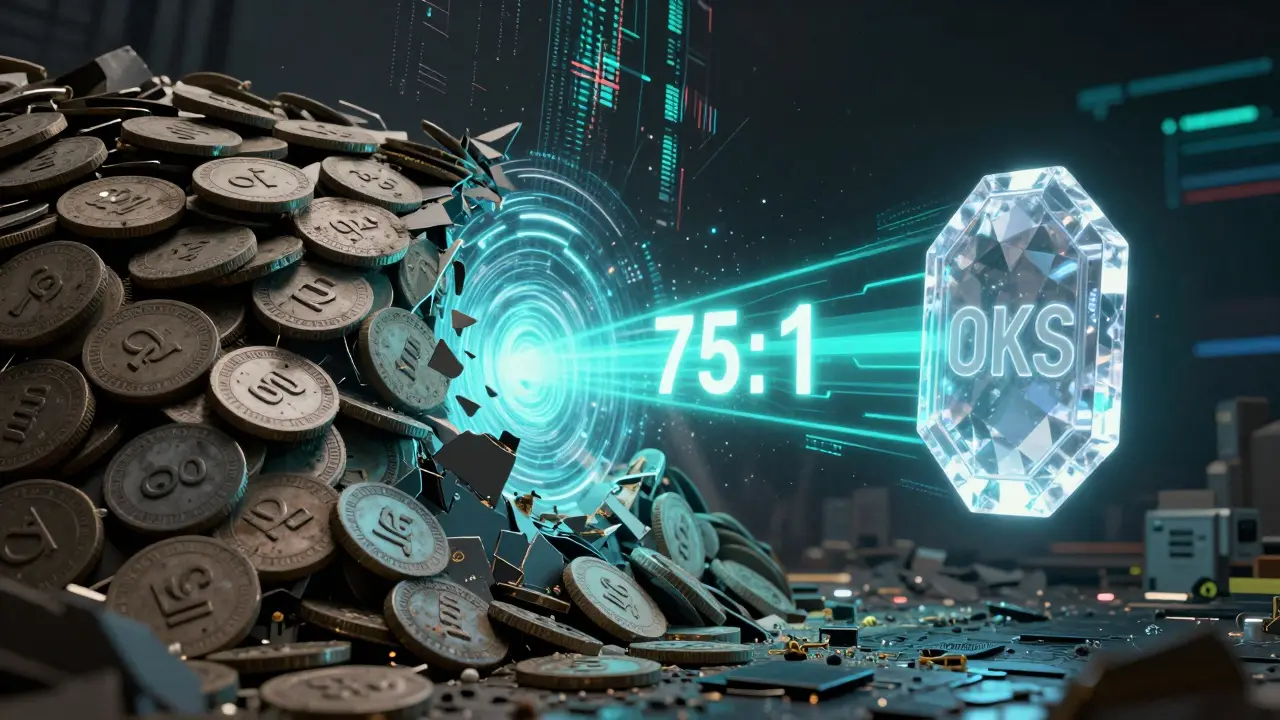
The swap ratio was 75:1. For every 75 tokens of the old Oikos you held, you received one new OKS token. This massive consolidation reduced the total supply from hundreds of millions down to just 4.3 million tokens for the new version. The goal behind such swaps is usually to reset the tokenomics, burn excess supply, and create a more manageable economic model for the future. However, the result here was stark. The old token effectively became worthless, trading at $0 with no volume. The new token, OKS, carries the weight of the entire project’s remaining value.
This transition is critical because it means any historical data or community sentiment attached to the old token doesn’t directly translate to the new one. You are looking at a fresh start, but one that started with very little momentum.
| Feature | Oikos (Old) | Oikos (New) (OKS) |
|---|---|---|
| Total Supply | 256.42 Million | 4.3 Million |
| Circulating Supply | 252.57 Million | 530,310 (~12.3%) |
| Current Price (May 2026) | $0.00 | $0.1388 - $0.1795 |
| Market Status | Abandoned/Dead | Active but Illiquid |
| Swap Ratio | N/A | 75 Old = 1 New |
How the Protocol Works: Synthetic Assets on BSC
At its core, Oikos is built on the Binance Smart Chain (BSC). This blockchain is popular for decentralized finance (DeFi) applications because it offers fast transaction speeds and low fees compared to Ethereum. Oikos uses this infrastructure to facilitate the creation of "Synths." These are synthetic assets that track the price of real-world items.
The mechanism relies on collateralization. To mint a synthetic asset-say, a token that tracks the price of gold-you must lock up OKS tokens into smart contracts. Your OKS acts as security. If the value of the underlying asset moves against you, or if the collateral ratio drops too low, the system may liquidate your position. This ensures the stability of the synthetic assets issued by the platform.
The platform claims to offer exposure to various classes:
- Fiat Currencies: Tokens tracking USD, EUR, etc.
- Commodities: Gold, platinum, oil, natural gas, wheat, and corn.
- Indices: NASDAQ, S&P 500, and other major market benchmarks.
In theory, this allows users to gain leveraged exposure to these markets without needing a traditional brokerage account. The platform also promotes "concentrated liquidity" mechanisms, similar to Uniswap V3, which allow liquidity providers to target specific price ranges for higher capital efficiency. Additionally, they highlight "unruggable" mechanics, suggesting built-in safeguards against developers withdrawing liquidity and abandoning the project-a common fear in DeFi.
Market Reality: Liquidity Crisis and Price Stagnation
Here is where the theoretical appeal meets harsh reality. As of May 8, 2026, Oikos (New) ranks #9,256 on CoinMarketCap. Its market capitalization is approximately $73,660 USD. While that number might sound like something, in the world of cryptocurrency, it is microscopic. For context, established competitors like Synthetix have market caps exceeding $400 million.
The most alarming metric is the 24-hour trading volume, which is reported as $0 USD on major aggregators. This indicates that there is effectively no secondary market activity. You cannot easily buy or sell OKS without causing massive slippage. Even a small order could move the price significantly due to the thin order books.
Furthermore, the price has been stagnant. The all-time high was recorded on August 12, 2025, at $0.1389. Nine months later, the price remains almost exactly at that level. There is no growth, no decline, just stagnation. Some exchanges, like Crypto.com, list the price slightly higher at $0.1795, but explicitly note that the token is "not tradable yet." This discrepancy highlights a lack of price discovery and confirms that the token is largely frozen in place.
Risk Factors and Viability Assessment
If you are considering investing in or using Oikos (OKS), you must weigh several critical risks. First, the lack of liquidity means you might not be able to exit your position. In DeFi, liquidity is king. Without it, a token is essentially a paperweight.
Second, the development activity appears minimal. There is little evidence of active community engagement, social media presence, or recent technical updates. Successful protocols usually have vibrant communities discussing governance, features, and strategies. Oikos lacks this ecosystem entirely.
Third, the history of the token swap suggests past failures. The fact that the original token was abandoned implies that the initial model did not work or lost investor confidence. While the new structure aims to fix this, there is no proof that it has succeeded. The project remains in a marginal position with no clear roadmap or strategic partnerships to drive adoption.
Finally, compare OKS to alternatives. Platforms like Synthetix or Mirror Protocol offer similar synthetic asset services but with deep liquidity, robust security audits, and large user bases. Choosing Oikos over these established players offers no obvious advantage in terms of utility, safety, or potential returns.
Conclusion: Proceed with Extreme Caution
Oikos (New) is a functioning protocol on paper, offering synthetic assets backed by OKS collateral on the Binance Smart Chain. However, in practice, it is a dormant project with negligible market activity. The transition from the old token to the new one did not spark renewed interest. Instead, the project languishes with zero trading volume and a static price.
For traders, this represents a high-risk scenario with limited upside. For users seeking synthetic asset exposure, there are far better, more liquid options available. Unless you have insider knowledge of upcoming developments that are not publicly documented, engaging with OKS carries significant risk of losing access to your funds due to illiquidity. Always prioritize projects with active communities, transparent teams, and proven trading volumes.
Is Oikos (OKS) a scam?
There is no definitive evidence labeling Oikos as a fraudulent scam in the legal sense. However, it exhibits many characteristics of a failed or abandoned project. The lack of liquidity, zero trading volume, and stagnant price suggest it is not actively maintained or supported by a user base. While it may not be a "rug pull" in the traditional sense, it poses significant financial risk due to its inability to function as a tradable asset.
Why did Oikos change from Old to New?
The change was driven by a 75:1 token swap restructuring. The original Oikos token had a supply of over 256 million and eventually became worthless. The new version consolidated the supply to 4.3 million tokens, aiming to reset the economic model and improve tokenomics. However, this restructuring did not lead to increased adoption or trading activity.
Can I buy Oikos (OKS) on major exchanges?
Technically, yes, but practically, no. Major aggregators show $0 trading volume, and some platforms like Crypto.com explicitly state the token is not tradable. Even if you find a pair, the extreme illiquidity means you would likely suffer massive slippage, paying far more than the listed price or being unable to sell at all.
What is the current price of OKS?
As of May 2026, the price hovers around $0.1388 to $0.1795 depending on the data source. However, this price is misleading because there is no actual trading activity. The price has remained unchanged since its all-time high in August 2025, indicating a lack of market movement rather than stable value.
Are there better alternatives for synthetic assets?
Yes. Protocols like Synthetix (SNX) and Mirror Protocol offer similar services with significantly higher market capitalizations, active trading volumes, and larger communities. These platforms provide better liquidity, security assurances, and user support compared to Oikos.