
Imagine if you could use the rock-solid security of Bitcoin but still run complex financial apps like you do on Ethereum. That is exactly what Rootstock Infrastructure Framework (or RIF) tries to solve. It is not just another coin hoping for a price pump; it is the fuel that powers a whole layer of tools built on top of Bitcoin.
If you have heard about "Bitcoin Layer 2" solutions or projects trying to bring decentralized finance (DeFi) to the world’s largest cryptocurrency, you likely came across RIF. But what does this token actually do? Why was it created, and is it worth your attention in 2026?
Quick Summary: Key Takeaways
- RIF is a utility token: It pays for services like domain names, storage, and payments on the Rootstock network.
- Built on Bitcoin: It runs on Rootstock, a sidechain secured by Bitcoin miners, offering high security with Ethereum-like flexibility.
- Fully circulating supply: All 1 billion RIF tokens are already in circulation, meaning no new inflation from mining or unlocks.
- Staking rewards: You can stake RIF to earn governance rights and rewards in both RIF and Bitcoin (rBTC).
- Current Status: As of June 2026, RIF trades as a small-cap asset with a market cap between $67M and $90M.
What Exactly Is the RIF Token?
To understand RIF, you first need to understand its home: Rootstock (a smart contract sidechain for Bitcoin). Think of Rootstock as a bridge. On one side, you have Bitcoin, which is incredibly secure but limited in what it can do (mostly sending money). On the other side, you have the world of smart contracts-apps that can lend, borrow, trade, and store data automatically.
Rootstock connects these two worlds. It allows developers to write code similar to Ethereum’s Solidity language, but that code runs on a network protected by Bitcoin’s massive hash power. This process is called merge-mining. Bitcoin miners secure Rootstock without spending extra energy, making it one of the most secure smart contract platforms available.
Now, enter RIF (the utility token for Rootstock infrastructure). RIF is the currency used within this ecosystem. It was launched in November 2018 by RIF Labs (now RootstockLabs). Unlike many tokens that promise future features, RIF was designed from day one to be the payment method for a suite of open-source protocols.
You use RIF to pay for:
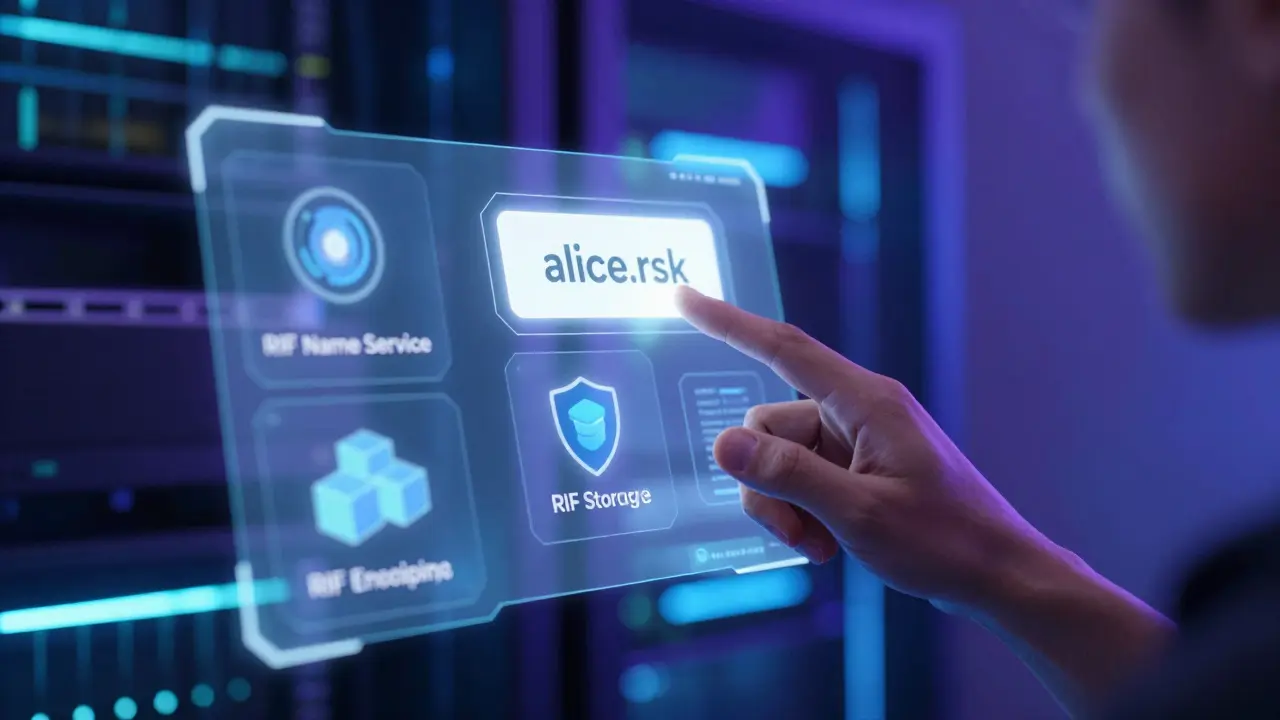
- RIF Name Service (RNS): Get a human-readable name for your wallet instead of a long string of characters.
- RIF Storage: Store encrypted data on a decentralized network.
- RIF Payments & Relay: Send transactions where someone else might pay the gas fees for you.
- Governance: Vote on how the RootstockCollective DAO spends its treasury.
How Does the Technology Work?
The technical setup of RIF is unique because it sits at the intersection of two major blockchain philosophies. Here is how the pieces fit together.
EVM Compatibility: Rootstock is compatible with the Ethereum Virtual Machine (EVM). This means if you are a developer who knows how to build on Ethereum, you can move your project to Rootstock with very little changes. You can use tools like MetaMask, Hardhat, and standard JavaScript libraries. This lowers the barrier to entry for building Bitcoin-based apps.
Merge-Mining Security: Most sidechains rely on their own validators or miners. Rootstock relies on Bitcoin miners. When a Bitcoin miner secures the main Bitcoin chain, they also have the option to secure Rootstock simultaneously. At various points, up to 88% of Bitcoin’s total computing power has been used to protect Rootstock. This makes hacking the network virtually impossible compared to smaller chains.
The ERC-677 Standard: The RIF token itself follows an extended version of the standard Ethereum token format. Specifically, it uses ERC-677. This small technical detail matters because it allows the token to notify smart contracts when it is transferred. This improves efficiency for apps that need to know instantly when a user sends them RIF, reducing errors and saving gas costs.
RIF Tokenomics: Supply and Distribution
One of the most important things to know about RIF is that there will never be more than 1 billion tokens. This hard cap was set at launch in 2018. By mid-2026, nearly all of these tokens are in circulation.
Here is how the original supply was distributed:
- Private Sale: About 35-40% went to early investors and contributors.
- RIF Labs: About 40% was allocated to the development team, vested over five years.
- Community & Bounties: 21 million tokens were set aside for early adopters and bug hunters.
Because the five-year vesting period ended around 2023-2024, there are no large "unlocks" happening now that could flood the market with sell pressure. This is different from many newer tokens that release millions of coins every month, diluting existing holders. With a fixed supply, the value of RIF depends entirely on demand for the services it powers.
Key Features and Ecosystem Services
RIF isn't just a token; it is a gateway to a stack of products. Let’s look at the specific tools that make up the Rootstock Infrastructure Framework.
| Service | Function | User Benefit |
|---|---|---|
| RIF Name Service (RNS) | Decentralized domain naming | Sends crypto using names like 'alice.rsk' instead of addresses |
| RIF Enveloping | Meta-transactions | Apps pay gas fees for users, improving onboarding |
| RIF Rollup | Zero-knowledge proof scaling | High-speed, low-cost payments with full security |
| RIF Flyover | Cross-chain bridge | Move BTC from Bitcoin mainnet to Rootstock quickly |
| USDRIF | Stablecoin | Dollar-pegged asset collateralized by RIF for trading |
RIF Enveloping is particularly interesting for everyday users. In traditional crypto, you always need the native gas token (like ETH for Ethereum or rBTC for Rootstock) to pay for transaction fees. This creates friction for new users. With RIF Enveloping, a third party (like a dApp or a wallet provider) can sponsor the gas fee for you. You might pay for the service in RIF or another token, but you don’t need to worry about buying rBTC first. This makes DeFi feel more like using a regular banking app.
USDRIF represents a newer development in the ecosystem. Launched as a stablecoin pegged 1:1 to the US dollar, it is backed by RIF tokens. This allows traders and users to hold a stable asset within the Bitcoin-secured environment without leaving the Rootstock network.
Market Performance and Price Context (June 2026)
As of late June 2026, RIF is classified as a small-to-mid-cap cryptocurrency. Its performance reflects the broader niche of Bitcoin-centric DeFi rather than the general altcoin market.
Recent data shows some variation depending on the exchange:
- Price Range: Trading between $0.067 and $0.090 USD.
- Market Cap: Approximately $67 million to $90 million USD.
- Volume: Daily trading volume hovers around $7-11 million USD.
- Ranking: Typically ranked between #280 and #350 globally.
Why is the market cap relatively small? While Rootstock is technically robust, it competes against giants like Ethereum and Solana, which have much larger communities and liquidity pools. However, RIF’s supporters argue that its value is tied to Bitcoin’s security, not just speculative hype. If Bitcoin DeFi grows, RIF is positioned as the primary utility token to benefit from that growth.
Price predictions vary wildly. Some models suggest modest growth to around $0.095 by 2027, while others warn of potential declines if adoption stalls. Remember, these are estimates, not guarantees. The key driver for RIF’s price is real usage: are people using RNS domains? Are they bridging BTC via Flyover? Are they staking RIF?
Staking and Governance: How to Earn Rewards
You don’t just have to hold RIF; you can put it to work. Through the RootstockCollective DAO (the decentralized autonomous organization governing Rootstock), holders can stake their tokens.
When you stake RIF, you receive stRIF. This governance token gives you voting rights on proposals, such as how to spend the DAO’s $10 million treasury fund dedicated to supporting Bitcoin builders. More importantly, stakers earn rewards.
These rewards come in two forms:
- rBTC: Bitcoin that has been bridged to Rootstock. This ties your returns directly to Bitcoin’s price action.
- RIF: Additional RIF tokens generated through protocol incentives.
This dual-reward system is unique. Most staking protocols only pay out in their own token. By paying partly in Bitcoin, Rootstock aligns the interests of RIF holders with the health of the Bitcoin network itself.
Risks and Challenges to Consider
No investment is without risk, and RIF has specific challenges you should weigh.
Liquidity Risk: With a market cap under $100 million, large buy or sell orders can move the price significantly. If you plan to invest a large amount, ensure you check the order books on exchanges like Binance, Kraken, or Gate.io before executing trades.
Complexity Barrier: Using Rootstock requires understanding bridges. To get started, you usually need to move Bitcoin from the main chain to Rootstock using Powpeg or Flyover. This adds steps compared to just sending ETH on Ethereum. While tools like RIF Enveloping help, the initial learning curve remains.
Competition: Other projects like Stacks (STX) are also fighting to be the leading smart contract layer for Bitcoin. Stacks has a larger marketing budget and broader brand recognition. RIF must prove that its integrated suite of tools (storage, naming, payments) offers better value than fragmented alternatives.
Regulatory Uncertainty: Like all utility tokens, RIF operates in a gray area in some jurisdictions. While it is clearly defined as a utility token for accessing services, regulatory frameworks like MiCA in Europe or SEC guidelines in the US continue to evolve. Always check local laws before participating.
Who Is RIF For?
RIF is not a one-size-fits-all solution. Here is who benefits most:
- Bitcoin Maximalists: If you believe in Bitcoin but want exposure to DeFi yields without trusting a separate, less-secure chain, Rootstock offers a middle ground.
- Developers: If you build on Ethereum but want lower fees and higher security, porting your dApp to Rootstock is straightforward due to EVM compatibility.
- Long-Term Holders: Those who believe Bitcoin will eventually support a rich ecosystem of applications may view RIF as an early bet on that infrastructure.
If you are looking for quick meme-coin gains or simple, click-and-forget savings accounts, RIF might be too complex. It requires active participation-staking, voting, or using the tools-to realize its full value proposition.
Final Thoughts
The Rootstock Infrastructure Framework token fills a specific gap in the crypto landscape. It provides the necessary plumbing for Bitcoin to function as more than just digital gold. By combining Bitcoin’s security with Ethereum’s developer-friendly environment, RIF enables a new class of applications.
In 2026, the project is mature. The token is fully unlocked, the technology is proven, and the community is active through the DAO. However, its success hinges on adoption. Will mainstream users choose to bridge their Bitcoin to Rootstock? Will developers find the toolset compelling enough to leave Ethereum L2s? The answers to these questions will determine whether RIF remains a niche utility token or becomes a cornerstone of Bitcoin’s future economy.
Is RIF the same as RSK?
No, they are related but distinct. RSK (Rootstock) is the blockchain network-the actual sidechain secured by Bitcoin miners. RIF is the utility token used to access services built on top of that network. Think of RSK as the highway and RIF as the toll currency or fuel for the cars driving on it.
Can I mine RIF tokens?
No, RIF cannot be mined. It has a fixed supply of 1 billion tokens, all of which were created during the initial token generation event in 2018. You can only acquire RIF by buying it on exchanges or earning it through staking rewards and bounties.
How do I buy RIF in 2026?
You can buy RIF on major cryptocurrency exchanges such as Binance, Coinbase, Kraken, and Gate.io. Since it is an ERC-677 compatible token on the Rootstock network, ensure your wallet supports Rootstock addresses (like MetaMask configured for Rootstock) if you plan to withdraw it off-exchange.
What is the difference between RIF and Stacks (STX)?
Both aim to add smart contracts to Bitcoin, but they differ technically. Rootstock (and thus RIF) is a sidechain that uses merge-mining with Bitcoin, making it EVM-compatible (like Ethereum). Stacks uses a different consensus mechanism called Proof-of-Transfer (PoX) and uses its own programming language (Clarity). RIF focuses on a unified infrastructure suite, while Stacks has a broader focus on sovereign smart contracts.
Is RIF a good investment?
That depends on your belief in Bitcoin-based DeFi. RIF is a high-risk, high-reward asset due to its small market cap. It benefits if Bitcoin DeFi adoption grows, but it faces stiff competition from larger ecosystems. Always do your own research and never invest more than you can afford to lose.
Jay Sharma
June 27, 2026 AT 15:54They want you to believe it's secure because of Bitcoin miners.
But have you noticed how the hash rate spikes exactly when these sidechains launch?
It's not organic growth, folks.
It's a coordinated effort by mining pools to inflate the security narrative while they siphon off liquidity in the dark.
The 'merge-mining' is just a Trojan horse for centralization.
Who do you think really controls the RootstockLabs treasury?
Not the DAO.
Never the DAO.
Wake up before they rug pull your rBTC.
Scott Miller
June 28, 2026 AT 20:28This is actually a game changer for the entire crypto space!
Finally, someone is bringing real utility to Bitcoin instead of just hoarding it like digital gold under a mattress.
The fact that RIF is fully circulating means no more dilution shocks from VC unlocks crashing the price overnight.
I am staking all my available capital into this immediately.
If you are not paying attention to Rootstock in 2026, you are literally leaving money on the table.
Get in now before the institutions realize what a gem this is and pump it to the moon.
Bitcoin DeFi is the future and RIF is the engine driving it forward!
Melissa L
June 29, 2026 AT 04:47i mean its kinda cool that u dont need eth gas fees but i still find the whole bridging thing super confusing tbh.
like why cant i just send btc directly without all these extra steps with flyover and powpeg?
feels like too much work for small transactions honestly.
maybe im just old school but ethereum feels easier even if its expensive sometimes.
ross harris
June 30, 2026 AT 19:54You cling to the illusion of 'security' provided by merge-mining, mistaking computational brute force for existential safety.
Rootstock is a parasitic organism feeding on the carcass of Bitcoin's legacy, pretending to offer innovation while merely replicating Ethereum's failed experiments in a walled garden.
The ERC-677 standard is not a feature; it is a shackle binding you to a centralized narrative of efficiency.
We are not building infrastructure; we are constructing elaborate cages for our own financial autonomy.
RIF is not fuel; it is the ash of burnt potential, scattered across a network that serves only the ego of its developers.
To stake is to surrender your agency to a DAO that governs nothing but its own irrelevance.
The silence of the chain is deafening, echoing the hollow promises of a technology that solves problems which never existed in the first place.
Carl Belgrave
July 2, 2026 AT 16:50Look, I love American ingenuity, but this feels like another one of those Silicon Valley projects trying to complicate simple things.
Bitcoin was built to be simple and secure, and now we have these guys adding layers upon layers of unnecessary complexity.
Why do we need 'RIF Name Service' when a wallet address works fine?
It's bloated.
It's inefficient.
And frankly, it smells like a cash grab for people who don't understand the original vision of decentralized currency.
We need strong, independent chains, not these依附 (dependent) sidechains that rely on others for security.
Stand on your own two feet or get out of the way.
Carl Hanzel
July 2, 2026 AT 21:56Everyone here is so excited about 'staking rewards' and 'governance rights' as if they matter at all.
You are being played.
The dual-reward system is a carrot dangled in front of a mule.
You think you are earning rBTC?
You are providing liquidity for the insiders to exit their positions.
I see through the hype.
I see through the 'utility.'
It is all smoke and mirrors designed to keep you engaged while the value bleeds out slowly.
Don't bother reading the rest of this article.
Save your time.
Save your money.
Stay away.
Daniel J. Cox
July 3, 2026 AT 10:35As someone who has been following the evolution of blockchain tech for years, I find the EVM compatibility on Rootstock fascinating.
It bridges a significant cultural gap between Bitcoin maximalists and Ethereum developers.
In many cultures, trust is built through familiarity, and allowing devs to use Solidity lowers that barrier immensely.
The RIF Enveloping feature is particularly elegant from a user experience perspective, removing the friction of gas fees which is a universal pain point.
It reminds me of how mobile banking simplified finance in emerging markets.
Maybe this is the next step for global adoption. :)
Emma Rémond
July 5, 2026 AT 02:30The tokenomics are fundamentally flawed for any serious institutional adoption.
The reliance on a fixed supply of 1 billion tokens creates an artificial scarcity that does not correlate with actual network throughput or demand elasticity.
Furthermore, the integration of USDRIF as a stablecoin collateralized by RIF introduces unnecessary counterparty risk within a supposedly permissionless environment.
The notion that 'merge-mining' equates to superior security is a gross oversimplification often touted by proponents who lack a deep understanding of cryptographic consensus mechanisms.
One must question the long-term viability of a ecosystem that depends so heavily on the goodwill of Bitcoin miners rather than its own intrinsic economic incentives.
It is a niche experiment, nothing more.
ELNORA JEFFERSON
July 6, 2026 AT 22:45Another boring article about another obscure token.
Why should I care about RIF when I can just buy Bitcoin or Ethereum?
The market cap is tiny and the volume is pathetic.
It's just noise.
Save your breath.
Carol @minaszilda
July 7, 2026 AT 21:38Let us look at the bigger picture together.
RIF offers a unique opportunity for those who wish to participate in governance without high barriers to entry.
Staking allows you to have a voice in how the treasury is spent.
This is democracy in action.
We should support projects that empower individuals.
Take your time to learn.
Be kind to yourself as you explore new technologies.
Growth takes patience.
Trent Erman1
July 9, 2026 AT 03:34Hey everyone! 👋 Great discussion here.
I wanted to highlight that the RIF Rollup using zero-knowledge proofs is a huge deal for scalability.
Many people overlook this, but it means faster transactions with full security guarantees.
Plus, the community is super helpful if you get stuck setting up MetaMask for Rootstock.
Just remember to double-check your network settings!
Let's keep building and learning together. 🚀💪