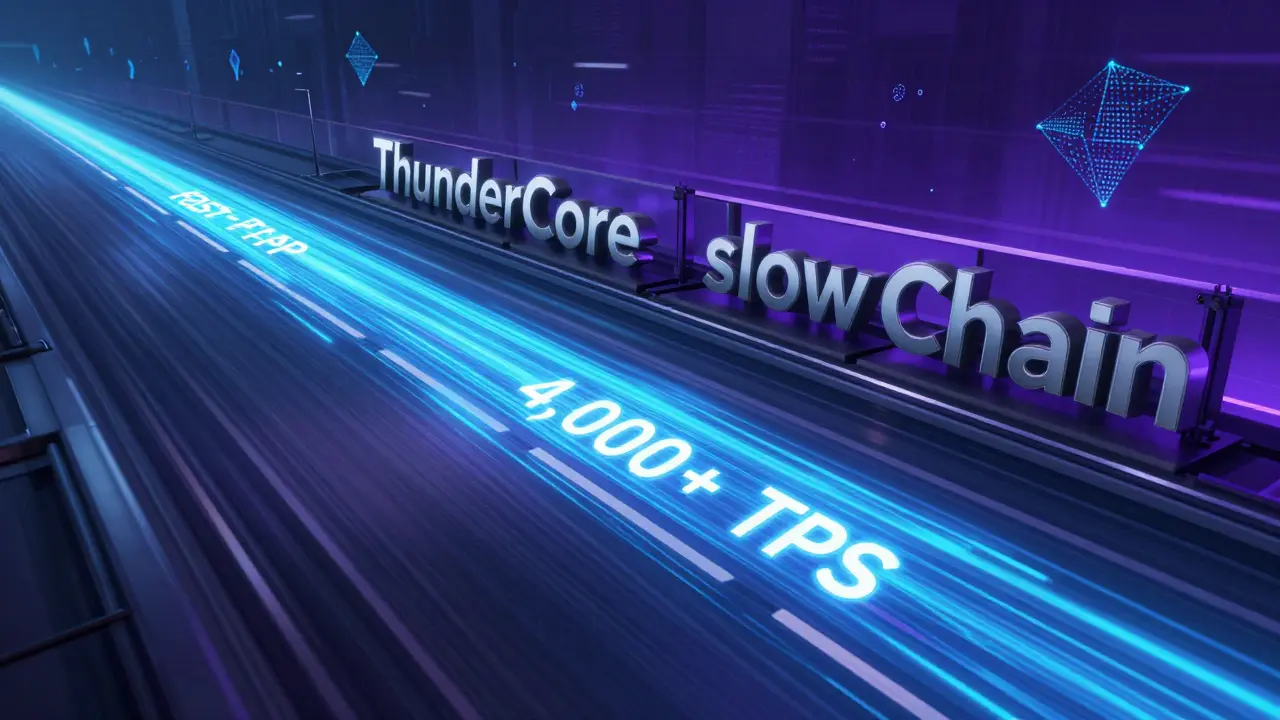
You’ve probably heard of Ethereum and Bitcoin. Maybe you even know Solana or Cardano. But have you heard of ThunderCore? It’s not the loudest name in crypto right now, but it solves one of the biggest headaches in the industry: slow, expensive transactions. If you’ve ever tried to buy a digital item or swap tokens on a congested network and watched your fees skyrocket while waiting ten minutes for confirmation, ThunderCore exists to fix that exact problem.
Founded in 2017 by Chris Wang, ThunderCore is a public blockchain designed from the ground up for speed and low cost. It doesn’t try to be everything to everyone. Instead, it focuses on being a high-performance engine for decentralized applications (dApps), especially those in gaming and finance where milliseconds matter. This guide breaks down what makes this network tick, how its native token works, and whether it deserves a spot in your portfolio or development stack.
The Core Problem: The Blockchain Trilemma
To understand why ThunderCore matters, you first need to understand the "Blockchain Trilemma." Coined by Ethereum co-founder Vitalik Buterin, this concept suggests that blockchains can only pick two out of three desirable traits: decentralization, security, and scalability. Most networks sacrifice scalability to keep things secure and decentralized. That’s why Ethereum mainnet often crawls during busy periods.
ThunderCore argues you don’t have to choose. By using a unique technical architecture called Thunderella, the platform attempts to deliver all three. It uses a hybrid design with a "fast-path" for immediate transaction processing and a "slow-chain" fallback for ultimate security. Think of it like a highway system: the fast lane lets traffic move instantly, but if there’s an accident (a network glitch), the system reroutes to a safer, slower route without losing any data. This approach allows the network to handle over 4,000 transactions per second (TPS) with sub-second confirmations, while keeping gas fees at less than $0.00001 per transaction.
How ThunderCore Works Under the Hood
The magic behind the speed lies in its consensus mechanism. Unlike Bitcoin, which relies on energy-intensive mining (Proof-of-Work), ThunderCore uses a Proof-of-Stake model enhanced by a protocol called PaLa (Pipelined Byzantine Fault Tolerance Acceleration).
In simple terms, instead of thousands of nodes arguing over every single transaction, ThunderCore uses a committee of validator nodes. One node acts as the "Proposer," bundling transactions together efficiently, while other "Voter" nodes quickly verify them. This pipelining process drastically cuts down the time needed to reach agreement. Because every step is backed by mathematical proofs, the network remains secure against attacks while moving at lightning speed.
This efficiency has real-world implications. For developers building games or financial apps, the near-zero cost means they can charge users fractions of a cent for actions that would cost dollars on other chains. It turns micro-transactions from a logistical nightmare into a viable business model.
| Feature | ThunderCore (TT) | Ethereum (Layer 1) | Bitcoin |
|---|---|---|---|
| Transactions Per Second (TPS) | 4,000+ | ~15 | ~7 |
| Average Gas Fee | < $0.00001 | $1 - $50+ (varies widely) | $1 - $10+ |
| Block Confirmation Time | ~1 second | ~12 minutes | ~10 minutes |
| Consensus Mechanism | Proof-of-Stake (PaLa) | Proof-of-Stake | Proof-of-Work |
| EVM Compatible | Yes | Yes (Native) | No |
What Is the TT Token Used For?
ThunderToken (TT) is the fuel that powers the entire ecosystem. It’s not just a speculative asset; it has concrete utility within the network. Here is what you actually use it for:
- Paying Gas Fees: Every time you send a transaction, deploy a smart contract, or interact with a dApp on ThunderCore, you pay a tiny fee in TT.
- Staking for Security: Users can lock up their TT tokens to become validators or "Accelerators." In return, they earn rewards for helping secure the network and process transactions.
- Governance: Token holders often have a say in the future direction of the protocol through voting mechanisms.
- Ecosystem Payments: Many dApps built on ThunderCore accept TT directly for in-app purchases, subscriptions, or services.
As of mid-2026, TT has a circulating supply of approximately 10.42 billion tokens. Its market capitalization hovers around $43 million, making it a mid-to-small-cap project compared to giants like Ethereum or Solana. However, size isn’t everything. With over 400,000 active monthly users across more than 100 countries, ThunderCore demonstrates genuine adoption rather than just speculative interest.
Developer Friendly: EVM Compatibility
If you’re a developer, the biggest barrier to entering a new blockchain is usually the learning curve. Do you need to learn a new programming language? Do you need to rewrite your entire codebase? With ThunderCore, the answer is no.
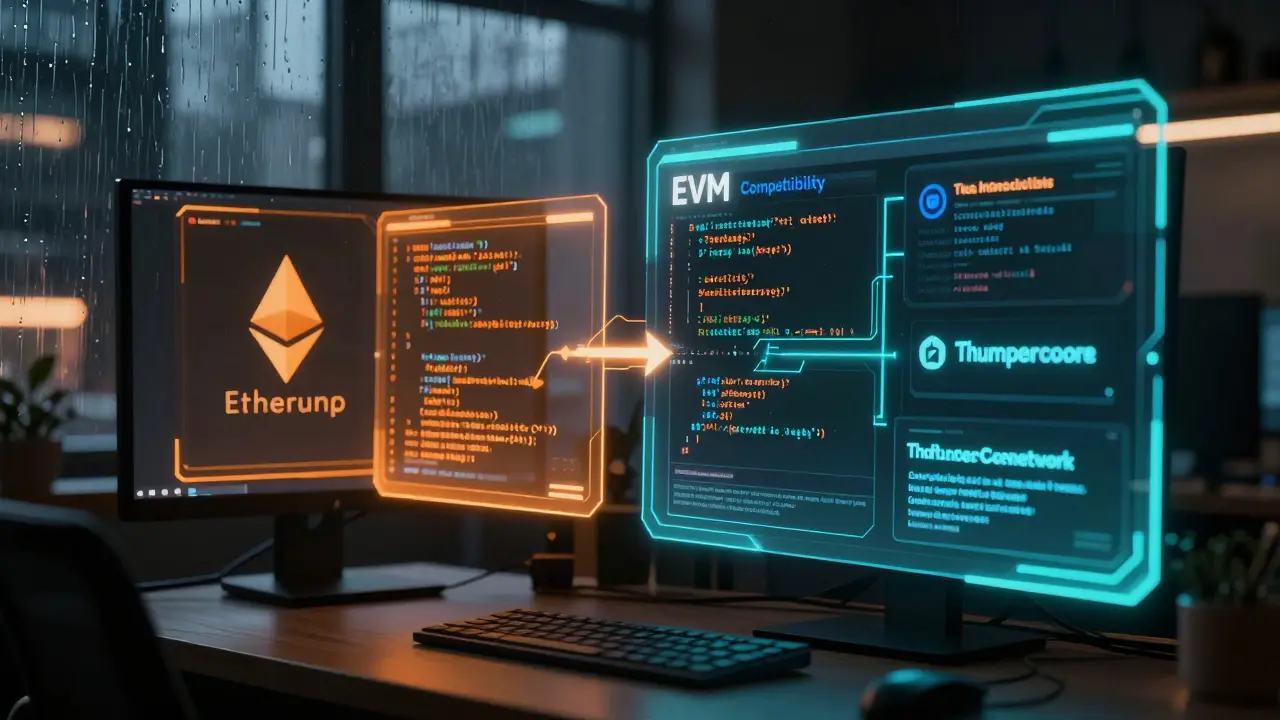
ThunderCore is fully EVM-compatible. This means it speaks the same language as Ethereum. Any application written in Solidity for Ethereum can be deployed on ThunderCore with little to no modification. This interoperability is a massive advantage. Developers can port their existing projects to ThunderCore to benefit from faster speeds and lower costs without starting from scratch.
This compatibility also extends to tools. You can use MetaMask, Remix, and other standard Web3 development tools to interact with the network. The bridge between Ethereum and ThunderCore is sophisticated, allowing assets to move seamlessly. When you bridge assets from Ethereum (the "Foreign" network) to ThunderCore (the "Home" network), the validation happens on the ThunderCore side, ensuring speed and security are maintained throughout the transfer.
Staking and Passive Income Opportunities
Holding TT isn’t just about hoping the price goes up. The network offers robust staking options for those who want to put their tokens to work. The minimum stake amount is 10,000 TT tokens. When you stake, you receive veTT tokens, which are automatically reinvested during the staking period. This creates a compounding effect, allowing your rewards to grow exponentially over time.
Rewards are distributed every epoch, which lasts three hours. However, liquidity comes with a trade-off. Unstaking takes 100 epochs, or roughly 12.5 days. This lock-up period helps stabilize the network by preventing sudden mass exits. Additionally, the TT Wallet features a "TT Mining" program that aims to generate stable returns of up to 8% APY. This feature automatically navigates DeFi protocols on the network to find the best arbitrage opportunities, essentially acting as an automated yield farmer for the user.

The TT Wallet: Your Gateway to the Ecosystem
You can’t interact with ThunderCore effectively without the TT Wallet. Available on iOS and Android, it’s more than just a storage solution. It’s a comprehensive hub for managing your crypto life on the network.
Key features include:
- Credit Card Purchases: Buy TT directly using Indacoin or BUSD via Transak, removing the friction of needing to go through a centralized exchange first.
- Cross-Chain Swaps: Swap TT for stablecoins like USDT or USDC instantly within the wallet.
- NFT Support: Manage and trade non-fungible tokens securely.
- DEX Integration: Access decentralized exchanges like TTSwap directly from the interface.
The wallet supports multichain capabilities through partnerships with protocols like Multichain and XY Finance. This means you aren’t siloed; you can move assets in and out of ThunderCore easily, connecting it to the broader Web3 world.
Real-World Use Cases: Gaming and DeFi
Where does ThunderCore shine? Two sectors stand out: Gaming and Decentralized Finance (DeFi).
In gaming, player experience is king. Nobody wants to wait five minutes for a sword purchase to confirm, nor do they want to pay $5 in gas fees for a $2 item. ThunderCore’s sub-second finality and negligible fees make it ideal for play-to-earn models and in-game economies. The platform brands itself as "the OG in the Game" because it was one of the first L1s to prioritize these metrics specifically for interactive entertainment.
In DeFi, the low costs enable complex strategies that are impossible on expensive networks. Yield farming, liquidity provision, and lending protocols thrive here because the overhead of executing trades is virtually zero. Recent updates, including a major testnet reset in August 2023, have further streamlined the environment for developers building these financial instruments, ensuring the infrastructure is robust enough for institutional-grade applications.
Is ThunderCore Right for You?
ThunderCore isn’t trying to replace Bitcoin as a store of value, nor is it trying to be the primary settlement layer for global banking. It occupies a specific niche: high-throughput, low-cost execution for consumer-facing applications. If you are a developer looking to launch a game or a dApp where user retention depends on speed and cost, ThunderCore is a top-tier choice. If you are an investor seeking exposure to infrastructure that powers actual usage rather than just speculation, TT offers a compelling value proposition backed by real user activity.
The competitive landscape is crowded, with Layer-2 solutions on Ethereum and other high-speed L1s vying for attention. However, ThunderCore’s independent architecture, combined with its established user base and EVM compatibility, gives it a durable edge. As Web3 moves toward mainstream adoption, networks that remove friction-both technical and financial-will likely capture the most significant market share.
Can I buy ThunderCore (TT) on Coinbase or Binance?
Availability varies by region and exchange listings change frequently. Historically, TT has been listed on major platforms like Huobi, Gate.io, and Upbit. It is always recommended to check current listing status on CoinMarketCap or CoinGecko before attempting to purchase. You can also buy TT directly via credit card through the TT Wallet using partners like Indacoin or Transak.
Is ThunderCore safe to use?
ThunderCore uses a mathematically proven Proof-of-Stake consensus mechanism (PaLa) with a hybrid fast-path/slow-chain architecture. This design prioritizes both speed and security. Like any blockchain, users should practice good security hygiene, such as using hardware wallets for large amounts and verifying contract addresses before interacting with dApps.
How do I migrate my Ethereum app to ThunderCore?
Because ThunderCore is EVM-compatible, migration is straightforward. You typically only need to change the RPC endpoint and chain ID in your configuration files. Smart contracts written in Solidity generally require no code changes. Developers can use standard tools like Hardhat or Truffle to deploy to the ThunderCore network.
What is the difference between TT and ETH?
ETH is the native token of Ethereum, a general-purpose blockchain known for its security and decentralization but often criticized for high fees and slower speeds. TT is the native token of ThunderCore, optimized for high speed (4,000+ TPS) and extremely low fees (<$0.00001). While both are EVM-compatible, ThunderCore sacrifices some degree of decentralization (using a smaller validator set) to achieve higher performance.
Does ThunderCore support NFTs?
Yes, ThunderCore fully supports ERC-721 and ERC-1155 NFT standards due to its EVM compatibility. The TT Wallet includes built-in support for viewing, sending, and receiving NFTs. There are also various NFT marketplaces built on the network that leverage the low gas fees for minting and trading digital art and collectibles.