
Imagine trying to save money with friends without a bank holding your cash. You pool funds, take turns using them, and rely entirely on trust. That’s essentially what WeTrust tried to digitize in 2017. The project, powered by the TRST ERC-20 cryptocurrency token, aimed to replace traditional banking intermediaries with smart contracts on the Ethereum blockchain. Today, looking back at WeTrust offers a fascinating case study in early Decentralized Finance (DeFi). It shows how ambitious concepts can struggle with liquidity and adoption, even when the technology works.
If you are researching TRST today, you might see confusing data. Some sites say it has zero market cap; others show millions of tokens circulating. Why? Because WeTrust is largely dormant. But understanding its mechanics helps you grasp how social capital interacts with blockchain code. Let’s break down what WeTrust actually was, how it worked, and where it stands now.
The Core Concept: Digitizing Rotating Savings
WeTrust didn’t invent lending circles. They invented a way to automate them. In many cultures, people form groups called ROSCAs Rotating Savings and Credit Associations. Everyone contributes a fixed amount monthly. One person takes the whole pot each month until everyone has received their turn. Usually, this relies on social pressure to keep people paying.
WeTrust moved this process onto Ethereum a decentralized blockchain platform. Their product, Trusted Lending Circles a smart contract-based savings application, used code to enforce rules. If you joined a circle, the smart contract held your funds. It automatically distributed payouts based on bidding or rotation schedules. This removed the need for a treasurer who might steal the pot. It also created an immutable record of who paid and who didn’t.
The goal wasn’t just convenience. Co-founder George Li stated the mission was to enable "decentralized financial inclusion." By removing banks, they hoped to lower fees for underbanked communities. The TRST token the native utility asset of the WeTrust platform facilitated these interactions. Users needed TRST to pay for certain services or stake in specific community features.
Tokenomics and ICO History
Every crypto story starts with funding. WeTrust raised money through an Initial Coin Offering (ICO) in early 2017. The numbers were modest but credible for the time. They sold approximately 80% of the total supply to the public. The remaining 20% went to founders and reserves.
| Metric | Value | Context |
|---|---|---|
| Total Supply | 100,000,000 TRST | Fixed maximum supply defined in whitepaper |
| ICO Price | $0.0625 USD | Price during March-April 2017 sale |
| Funds Raised | ~$4.66 Million USD | Reported by Livecoinwatch; some sources cite >$5M |
| All-Time High | ~$1.30 - $3.95 USD | Varies by aggregator due to low volume spikes |
| Current Status | Dormant / Low Liquidity | Near-zero trading volume as of 2026 |
The ICO attracted attention because of its escrow partners. Vlad Zamfir, a well-known Ethereum researcher, and Joe Urgo from District0x helped secure the funds. This gave investors confidence that the team wouldn’t run away with the money. However, raising capital is easy compared to building a sustainable user base. The project launched its mainnet product in February 2017, just weeks after the ICO ended.

How the Platform Actually Worked
Using WeTrust required more than just having ETH in your wallet. You needed to understand the flow of funds within a circle. Here is the step-by-step process for a typical Trusted Lending Circle:
- Create or Join a Group: Users formed circles with people they knew. Trust was still necessary because the blockchain couldn’t force someone to have money if they didn’t.
- Deposit Funds: Participants sent ETH or stablecoins to the smart contract. These funds were locked for the duration of the cycle.
- Bidding or Rotation: Members could bid for the payout pot. The highest bidder would receive the lump sum first, effectively paying interest to others via the loss of future access to their own contributions.
- Payout Execution: The smart contract automatically transferred the pot to the winner. No human intervention was needed.
- Reputation Building: Successful participation built a Web-of-Trust score. This reputation could theoretically help users get better terms in future loans.
This model differed significantly from modern DeFi protocols like Aave or Compound. Those platforms use over-collateralization. You deposit $150 worth of crypto to borrow $100. WeTrust relied on social collateral. If you defaulted, you lost your reputation within that specific group, not necessarily your entire crypto holdings. This made it accessible to people without large crypto balances but risky for strangers.
Why Did WeTrust Fade Away?
By 2026, WeTrust is a ghost town. Trading volumes are negligible. Market caps often report as zero because exchanges delisted the token or stopped updating prices. Several factors contributed to this decline.
First, competition exploded. After 2017, dozens of projects tackled similar problems. Many offered better user interfaces or integrated with faster chains. WeTrust remained stuck on Ethereum Mainnet, which became expensive due to gas fees. Paying $20 in gas to move $50 of savings isn’t practical for small-scale ROSCAs.
Second, adoption hurdles were high. Getting non-crypto natives to use an Ethereum dApp in 2017 was difficult. Wallets were clunky. Gas fees were unpredictable. Most informal savings groups preferred cash or simple mobile apps like Venmo or M-Pesa, which didn’t require blockchain knowledge.
Third, the team pivoted. Instead of scaling the consumer app, they focused on partnerships with non-profits. They launched WeTrust Spring a fundraising platform allowing users to stake TRST for charities. While noble, this niche didn’t drive mass token demand. Without active users burning or staking TRST, the token value collapsed.
Technical Details and On-Chain Reality
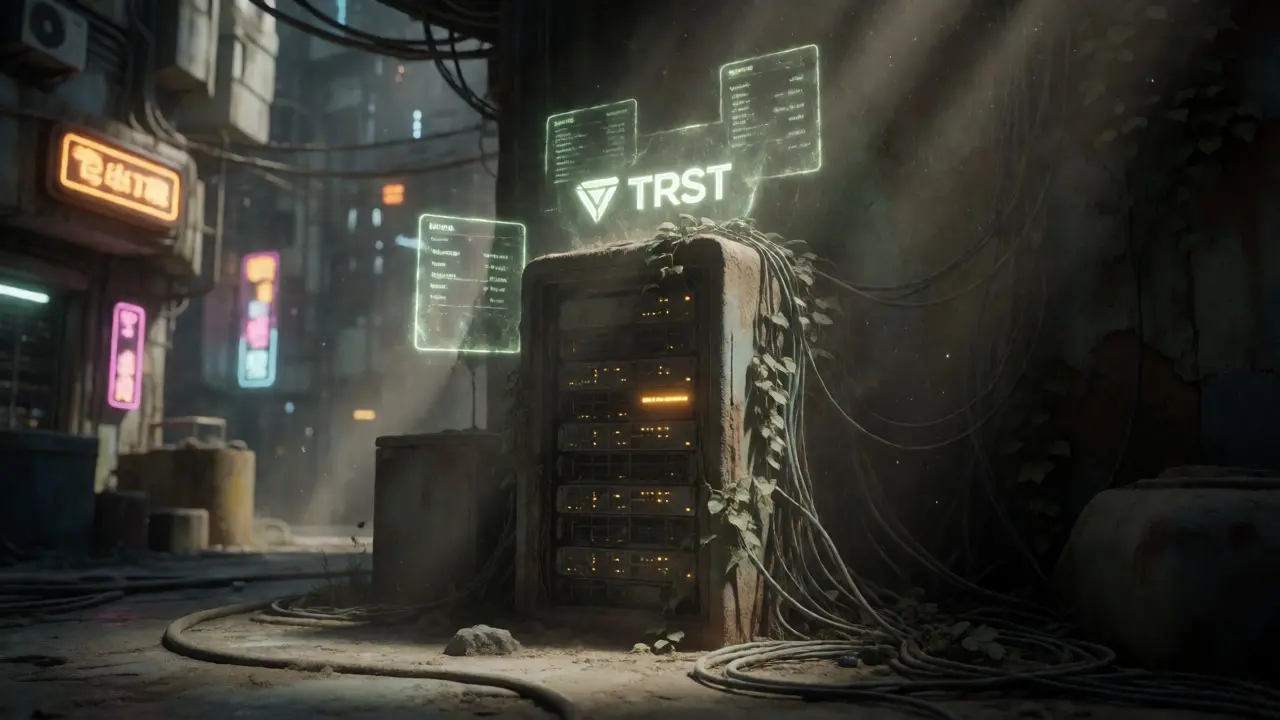
For developers or researchers, the technical footprint remains visible. TRST is a standard ERC-20 token a standard interface for fungible tokens on Ethereum. Its contract address is 0xcb94be6f13a1182e4a4b6140cb7bf2025d28e41b.
You should be careful when checking stats. Aggregators like CoinMarketCap sometimes fail to sync with dead contracts. You might see a price of $0.000289 but a market cap of $0. This happens when exchanges stop reporting volume. Always verify on-chain balances directly if you hold TRST. GitHub activity under the WeTrustPlatform organization shows minor maintenance as late as 2025, including updates to an NFT appreciation token called WTOA. But there are no signs of major feature rollouts or new marketing pushes.
Don’t confuse WeTrust (TRST) with other projects using similar names. There is a Solana-based TRUST token and a separate brand called we-trust.co that deals with digital content integrity. These are unrelated entities. When buying or researching, always check the contract address on Etherscan to ensure you are looking at the original Ethereum-based WeTrust.
Is TRST Worth Buying Now?
For most investors, the answer is likely no. TRST is a legacy asset. It lacks the liquidity needed for easy entry and exit. You might buy it for $50, but selling it could take months if anyone wants to buy it at all. The spread between buy and sell orders can be massive due to thin order books.
However, it serves as an educational tool. Holding TRST lets you interact with one of the earliest DeFi experiments. You can explore the smart contract logic and see how early teams handled upgradeability and governance. For collectors of crypto history, it holds sentimental value. For profit seekers, newer, active DeFi protocols offer far better risk-reward profiles.
If you do decide to engage with TRST, treat it as a speculative lottery ticket rather than a blue-chip investment. Assume you might never recover your initial capital. The project hasn’t officially announced a shutdown, but the silence speaks volumes. Revival would require a new team, significant funding, and a compelling reason for users to switch back to Ethereum Mainnet for savings circles.
What is the current price of WeTrust (TRST)?
As of 2026, the price fluctuates around $0.000289 to $0.000485 USD. However, due to extremely low trading volume, this price may not reflect real-world liquidity. Many exchanges list it with a market cap of $0 due to lack of active trading.
Is WeTrust (TRST) still active?
The project is largely dormant. While the smart contracts remain on the Ethereum blockchain and some minor code maintenance occurred on GitHub through 2025, there is no significant development activity, marketing, or user growth reported since roughly 2018.
Can I still use Trusted Lending Circles?
Technically, yes. The smart contracts are deployed and functional. However, the user interface and support ecosystem have faded. Using the platform requires manual interaction with Ethereum wallets and potentially high gas fees, making it impractical for most new users.
Where can I buy TRST tokens?
TRST has been delisted from most major centralized exchanges like Coinbase and Binance. You may find limited trading pairs on smaller decentralized exchanges (DEXs) or niche centralized platforms that still list legacy assets. Liquidity is very low, so expect slippage.
What is the difference between TRST and other 'Trust' coins?
TRST refers specifically to the WeTrust.io ERC-20 token on Ethereum. Other projects use similar names, such as a Solana-based TRUST token or the we-trust.co brand for content integrity. Always verify the contract address (0xcb94...e41b) to ensure you are dealing with the original WeTrust project.