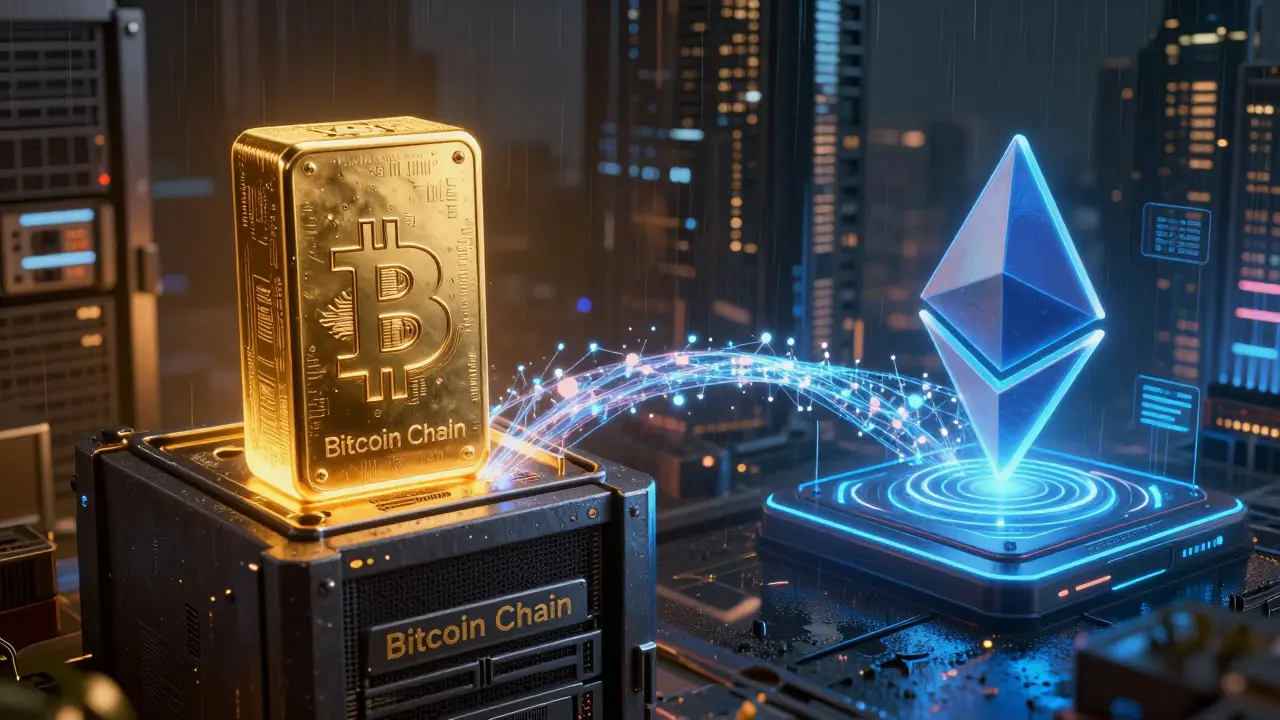
Imagine you have a physical gold bar locked in a vault in London. You want to use its value to trade on a market in Tokyo without shipping the heavy metal across the ocean. So, you get a receipt for that gold bar. That receipt is your wrapped asset. The gold bar itself? That’s your native asset.
In the world of blockchain, this exact problem exists. Bitcoin (BTC) lives on the Bitcoin network. It cannot natively interact with Ethereum smart contracts. To fix this, we created Wrapped Bitcoin (WBTC). But why does it matter which one you hold? Because they carry very different risks, costs, and utilities.
The Core Difference: Origin vs. Representation
Let's break down the definitions first, because confusion here leads to lost money.
A Native Asset is a cryptocurrency that exists on its own specific blockchain. Bitcoin lives on the Bitcoin blockchain. Ether lives on the Ethereum blockchain. These assets are secured directly by the consensus mechanism of their home chain-like Bitcoin's Proof-of-Work or Ethereum's Proof-of-Stake. They don't need permission from anyone else to exist. When you send BTC, you are moving value on the Bitcoin ledger. Period.
A Wrapped Asset, on the other hand, is a tokenized representation of that native asset on a *different* blockchain. WBTC is an ERC-20 token on Ethereum that represents Bitcoin. It is pegged 1:1. For every 1 WBTC in circulation, there should be 1 BTC locked in a custodial wallet. The wrapped asset allows the original asset to participate in ecosystems where it doesn't naturally belong.
Think of it like currency exchange at an airport kiosk. Your dollars (native) are exchanged for euros (wrapped equivalent) so you can spend them in Paris. The euros aren't dollars, but they represent the same value.
Why Do We Need Wrapped Assets?
If native assets are secure and simple, why bother with wrapping? The answer is Blockchain Interoperability.
Blockchains are isolated islands. Bitcoin has incredible security but limited functionality-it can mostly just send value. Ethereum has a massive ecosystem of decentralized finance (DeFi) protocols like lending platforms, yield farms, and automated market makers. But Bitcoin can't talk to these protocols directly.
Wrapped assets bridge this gap. By wrapping Bitcoin into WBTC, you can:
- Lend your BTC on Aave to earn interest.
- Use it as collateral to borrow USDC.
- Trade it on Uniswap against other tokens.
Without wrapped assets, Bitcoin holders would be stuck outside the $35+ billion liquidity pool of Ethereum DeFi. As of late 2023, over $12.5 billion was locked in wrapped token implementations, showing that this isn't a niche feature-it's infrastructure.
Security Models: Trustless vs. Trusted
This is where things get tricky. And this is usually where people lose money if they aren't paying attention.
Native Asset Security: When you hold BTC in your own hardware wallet, you rely on the Bitcoin network's security. The network has hundreds of exahashes of computing power securing it. No single entity controls it. If you have your private keys, no one can freeze your funds. This is often called "trustless" security.
Wrapped Asset Security: When you hold WBTC, you are trusting a system. Specifically, you are trusting the Custodian (often BitGo for WBTC) and the smart contract code on Ethereum. Here is the risk breakdown:
- Custodial Risk: The underlying BTC is held in a multisig wallet managed by merchants and custodians. If they get hacked, go bankrupt, or act maliciously, your WBTC could become worthless paper. Remember the FTX collapse? Users holding wrapped assets backed by centralized exchanges faced weeks of withdrawal delays.
- Smart Contract Risk: The WBTC token itself is code on Ethereum. If there is a bug in the minting/burning logic, funds could be drained. Security researchers have found critical vulnerabilities in nearly two-thirds of major wrapping protocols.
- Bridge Risk: Moving assets between chains often involves bridges. The Nomad bridge hack in 2022 resulted in $600 million in losses. While WBTC uses a more conservative model, cross-chain wrapped assets generally introduce higher attack surfaces.
So, while native assets offer pure cryptographic security, wrapped assets introduce centralization points. You are trading some degree of decentralization for utility.

Performance and Costs: Speed vs. Stability
Let's look at the practical experience of using both.
Transaction Speed: Bitcoin blocks take about 10 minutes to confirm. During high congestion, fees can spike to $25 or more. Ethereum, especially after the Merge and subsequent upgrades, offers faster finality for many operations. Wrapped tokens on Ethereum typically confirm in 15-30 seconds. If you are day trading or providing liquidity, speed matters. WBTC moves faster than BTC in terms of settlement time on the target chain.
Fees: Here is the catch. With native BTC, you pay the miner fee once. With wrapped assets, you pay multiple times: 1. The gas fee to wrap/unwrap (mint/burn). 2. The network gas fee for the transaction on the target chain (Ethereum gas can be expensive). 3. Often, a service fee. WBTC charges a minting fee (around 0.875% historically) to cover operational costs. So, if you are moving small amounts, the cost of wrapping might outweigh the benefits. It makes sense for large institutional players or long-term DeFi participants, but less so for micro-transactions.
| Feature | Native Asset (e.g., BTC) | Wrapped Asset (e.g., WBTC) |
|---|---|---|
| Blockchain Location | Home Chain Only | Cross-Chain (Target Network) |
| Security Model | Consensus Mechanism (Trustless) | Custodian + Smart Contracts (Trusted) |
| Primary Use Case | Store of Value, Payments | DeFi Participation, Liquidity |
| Costs | Network Miner Fee Only | Gas Fees + Minting/Burning Fees |
| Decentralization | High | Low to Medium (Depends on Protocol) |
Which One Should You Choose?
There is no single right answer. It depends entirely on what you are trying to do with your crypto.
Stick with Native Assets If: - You are HODLing (holding long-term) and want maximum security. - You believe in the ethos of decentralization and distrust intermediaries. - You only need to send value from person A to person B. - You want to avoid smart contract risks entirely.
Switch to Wrapped Assets If: - You want to earn yield on your Bitcoin via DeFi protocols like Compound or Aave. - You need to use your asset as collateral for loans on Ethereum. - You are a trader who needs faster settlement times and access to deeper liquidity pools on Ethereum DEXs. - You understand and accept the counterparty risk of the custodian.
The Future: Are Wrapped Assets Obsolete?
The industry is evolving. Developers hate the friction of wrapping. Vitalik Buterin, co-founder of Ethereum, has long argued that native cross-chain messaging is the ultimate solution. If blockchains could talk to each other directly, we wouldn't need wrappers.
However, we are not there yet. Protocols like Chainlink CCIP (Cross-Chain Interoperability Protocol) are building infrastructure to make cross-chain communication safer and more decentralized. In the meantime, wrapped assets remain the backbone of cross-chain liquidity.
Expect consolidation. There are dozens of wrapped Bitcoin variants (WBTC, renBTC, sBTC, tBTC). By 2026, analysts predict this will shrink to 5-7 major, highly audited protocols. The smaller, less secure wrappers will likely die out as users flock to the most trusted options.
Practical Tips for Using Wrapped Assets
If you decide to dip your toes into wrapped assets, follow these rules to stay safe:
- Verify the Contract Address: Never copy-paste a token address from a random website. Always check official sources like CoinGecko or the protocol's verified documentation. Sending WBTC to a native BTC address will result in permanent loss.
- Check the Custodian: Who holds the underlying assets? Is it a reputable firm like BitGo, or an unknown entity? Look for regular attestation reports proving the 1:1 backing.
- Understand the Unwrapping Process: Can you easily convert WBTC back to BTC? Some protocols have slow redemption periods (days or weeks). Ensure you have enough native ETH in your wallet to pay for the unwrapping gas fees.
- Diversify Risk: Don't put all your eggs in one basket. If you use DeFi, consider splitting your capital between different wrapped asset providers to mitigate custodial risk.
Wrapped assets are a powerful tool, but they are not magic. They are financial instruments with specific risks. Treat them with the same caution you would treat any leveraged product or third-party custody service.
Is WBTC safe?
WBTC is considered relatively safe compared to newer, experimental wrapped tokens because it has been around since 2019 and is managed by established entities like BitGo. However, it is not risk-free. It relies on centralized custodians, meaning if those custodians are hacked or fail, your WBTC could be at risk. It is less secure than holding native Bitcoin in a self-custody hardware wallet.
Can I lose money if I hold wrapped assets?
Yes. You can lose money through de-pegging (if the wrapped token loses its 1:1 value due to lack of reserves), smart contract exploits (bugs in the code allowing theft), or custodial failure (the company holding the underlying asset goes bankrupt). Always research the audit history and backing of any wrapped token.
What is the difference between WETH and ETH?
ETH is the native currency of the Ethereum network, used to pay for gas fees. WETH (Wrapped Ether) is an ERC-20 token version of ETH. It behaves like a standard token, making it easier to swap on decentralized exchanges and use in smart contracts that require ERC-20 compatibility. WETH is pegged 1:1 to ETH.
Do wrapped assets have infinite supply?
No. Reputable wrapped assets operate on a mint-and-burn model. New tokens are only created (minted) when an equivalent amount of the underlying asset is deposited. Tokens are destroyed (burned) when the underlying asset is withdrawn. This ensures the supply matches the reserves.
Are there non-custodial wrapped assets?
Yes. Projects like renBTC (Ren Project) and tBTC (Threshold Network) aim to provide decentralized, non-custodial wrapping. They use cryptographic techniques and distributed networks instead of a single corporate custodian. However, these solutions are often more complex and may have lower liquidity than centralized alternatives like WBTC.